Our destiny is death

https://odb.org/2026/05/05/plan-on-it
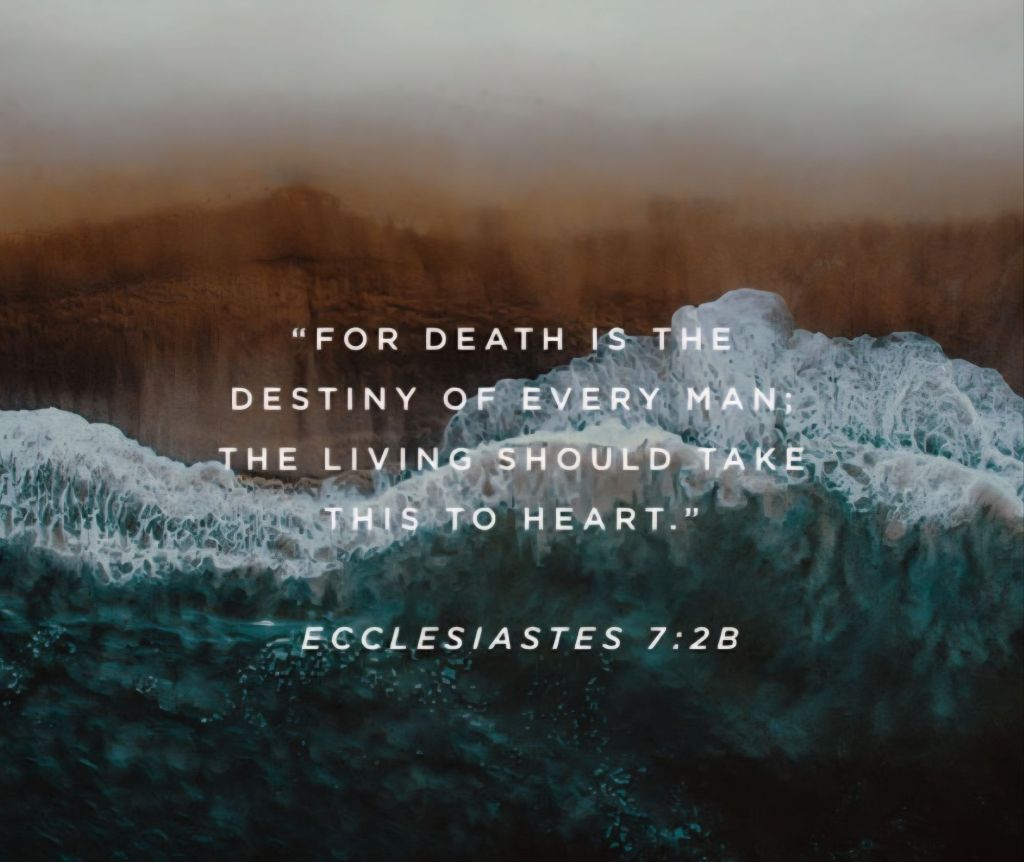
Ecclesiastes 7:1–10 (NIV): 7 A good name is better than fine perfume, and the day of death better than the day of birth. 2 It is better to go to a house of mourning than to go to a house of feasting, for death is the destiny of everyone; the living should take this to heart. 3 Frustration is better than laughter, because a sad face is good for the heart. 4 The heart of the wise is in the house of mourning, but the heart of fools is in the house of pleasure.
5 It is better to heed the rebuke of a wise person than to listen to the song of fools.
6 Like the crackling of thorns under the pot, so is the laughter of fools. This too is meaningless. 7 Extortion turns a wise person into a fool, and a bribe corrupts the heart. 8 The end of a matter is better than its beginning, and patience is better than pride. 9 Do not be quickly provoked in your spirit, for anger resides in the lap of fools. 10 Do not say, “Why were the old days better than these?” For it is not wise to ask such questions.

Death is a sobering reality we all must face. King Solomon, who searched for the meaning of life in pleasure, work, and knowledge, and came up empty, said, “It is better to go to a house of mourning than to go to a house of feasting” (Ecclesiastes 7:2). Negative situations give more perspective than happy times. If we face the reality of death, we can better prepare for what comes after. Verse two adds, “Death is the destiny of everyone; the living should take this to heart.” We should ponder it and plan on it. Preparation comes from receiving forgiveness of sin from Jesus, who died for us and rose again. Everyone dies because death came when the first man, Adam, disobeyed God, and we have followed his ways. But “everyone who belongs to Christ will be given new life” (1 Corinthians 15:22 nlt). (Anne Cates, Our Daily Bread 5th May 2026)

As the saying goes, there are two things man cannot avoid in life – death and taxes. As much as kings have pursued and searched for immorality, it remains a fantasy only seen in novels and films. Immortality only exists in our make-believe world. The reality is, as we can see in ourselves – we grow older by the day. It is also evidenced by the funerals we attend. People will pass on one by one from this world to the next. “For death is the destiny of everyone; the living should take this to heart” (Ecclesiastes 7:2B)

One thing I learnt from attending funerals is that our attendance is for the living. The dead is gone. Some believe that the spirit of the dead lingers on for a while but as far as our Christian theology is concerned, once we die, our spirit returns to God. The dead is gone and is no longer a part of the affairs of the living. When we die, the tasks and deadlines we chase at work cease to matter. How much money we have to live on also ceases to matter since we are already dead! After we die, we don’t need to eat anymore!

To prepare for our inevitable destiny, most importantly, we need to settle our hearts with God. Make our peace with our Maker, our LORD God. Our sadness, disappointments, even anger at how our life or certain things had turned out, settle all that with God. Seek forgiveness of sin from Jesus Christ our Lord, from our Heavenly Father. Reconcile in our spirit with our Father God in heaven.

Then we should prepare for the living. Our family, our loved ones, our church and ministry. Because, in the end, our departure will affect them the most. They will not see us again in our present self. We will meet them one day but that day may be a long time more to come, after all the events predicted in Revelation come to pass.

Finally, before we meet our ultimate destiny, do the things we always wanted to do. Travel abroad if we can afford to. Be kinder to the people around us. Spend more time with our loved ones. Make that road trip to the smaller towns in Malaysia, some still frozen to a bygone era of the 50s and 60s. Have meals with our friends. Continue to serve God fervently in whatever capacity assigned to us. When the day finally comes, we will have no regrets – we have done our best for God and our loved ones. We are ready to meet Jesus face to face.

Ecclesiastes 7:8 “The end of a matter is better than its beginning“. Let’s all end well, no matter how we started or how we have journeyed thus far!

P/s If my late dad is still alive, he would be 84 today…

Apocalypse

https://odb.org/2026/05/04/the-purpose-of-the-apocalypse

Revelation 1:12–18 (NIV): 12 I turned around to see the voice that was speaking to me. And when I turned I saw seven golden lampstands, 13 and among the lampstands was someone like a son of man, dressed in a robe reaching down to his feet and with a golden sash around his chest. 14 The hair on his head was white like wool, as white as snow, and his eyes were like blazing fire. 15 His feet were like bronze glowing in a furnace, and his voice was like the sound of rushing waters. 16 In his right hand he held seven stars, and coming out of his mouth was a sharp, double-edged sword. His face was like the sun shining in all its brilliance. 17 When I saw him, I fell at his feet as though dead. Then he placed his right hand on me and said: “Do not be afraid. I am the First and the Last. 18 I am the Living One; I was dead, and now look, I am alive for ever and ever! And I hold the keys of death and Hades.

The ominous word apocalypse intrigues us. It’s the Greek title of the book of Revelation (apokalypsis). But the word doesn’t only mean a catastrophe or the end of the world. As the title Revelation implies, it also refers to an unveiling, a revealing. The book opens, “The revelation from Jesus Christ” (Revelation 1:1). Revelation reveals Jesus as the Lamb of God, a term John uses in the book more than twenty-five times to describe Him. Revelation also reveals Christ as one whose “eyes were like blazing fire. (Bill Crowder, Our Daily Bread 4th May 2026)

Although the Greek word of apokalypsis has given rise to the English word apocalypse, which means end of the world, apokalypsis originally meant revelation or an unveiling. Thus, the Greek didn’t name the book of Revelation written by Apostle John as end of the world. However, if they had done so, they wouldn’t be far too wrong either as indeed Revelation speaks of the end of this world, the world as we know it. The world that we know today with its various human advancements like the internet and artificial intelligence, air travel, electric cars and smartphones, to name a few, will come to an end when Jesus Christ comes again as Lord and King.

It will culminate in the new heaven and new earth and the new Jerusalem where God will once again dwell amongst His people. The Tree of Life which enables eternal life will once again be available and accessible to humanity again. Except that only those whose names are written in the Book of Life will continue to live on this earth, including believers and followers of Jesus Christ throughout the ages who will now be resurrected to their glorified bodies. To some, this end time scenario may seemed far-fetched or even illusionary but that’s the bitter truth as revealed by the book of Revelation or Apokalypsis in Greek. We may choose not to believe but unbelief by itself will not change things as we all know very well because truth does not depend on our belief. But wait, there is even more to this – the end-time scenario may even start during our lifetime when the events predicted and revealed by the book of Revelation start to unravel one by one.

Apocalypse as it is understood today is not something to be feared because in the new heaven and new earth, there will no longer be tears or sadness or evil or injustice. Satan would have been banished to hell and sin and death will no longer exist. How the new world will look like, we do not know but as believers, we know that we will be a part of it because we believe and put our trust and hope in our Lord and Saviour, Jesus Christ.

Whatever age we are today and whatever struggles or troubles we face today, always remember that so long as we keep our Lord Jesus Christ in our hearts and abide by His Word, we have no fear if our lives were to end tomorrow or the world as we know it comes to an end. For example, if the Iran War in the Middle East somehow leads to a devastating nuclear war killing millions – whether we survive in that aftermath or perish with the millions, we have no fear because our LORD God is with us and we will be with Him again at the end of time. Practically, we must cling on to our faith come what may! Never give up on God, keep on striving and moving ahead, serving Him and worshipping Hin until our very last breath!

God created us in His image

https://odb.org/2026/05/01/gods-perfect-specifications

Genesis 1:26–31 (NIV): 26 Then God said, “Let us make mankind in our image, in our likeness, so that they may rule over the fish in the sea and the birds in the sky, over the livestock and all the wild animals, and over all the creatures that move along the ground.” 27 So God created mankind in his own image, in the image of God he created them; male and female he created them. 28 God blessed them and said to them, “Be fruitful and increase in number; fill the earth and subdue it. Rule over the fish in the sea and the birds in the sky and over every living creature that moves on the ground.” 29 Then God said, “I give you every seed-bearing plant on the face of the whole earth and every tree that has fruit with seed in it. They will be yours for food. 30 And to all the beasts of the earth and all the birds in the sky and all the creatures that move along the ground—everything that has the breath of life in it—I give every green plant for food.” And it was so. 31 God saw all that he had made, and it was very good. And there was evening, and there was morning—the sixth day.

Genesis 1:27 reminds us that each human being has been made to God’s perfect specifications: “God created mankind in his own image, in the image of God he created them; male and female he created them.” How we’re created reflects God’s character and nature. Being created in His image means everyone has inherent dignity and worth. God said that each person’s story begins with being made “in [His] image, in [His] likeness” (v. 26). This truth provides the foundation for understanding human dignity, identity, and relationships with others. (Marvin Williams, Our Daily Bread 1st May 2026)

Adam and Eve were created in God’s image (Genesis 1:27), but that image was distorted when they sinned (3:6, 16-19). Everyone now carries that distorted image of our Creator. But through our salvation and the process of sanctification, we’re being recreated in the image (or likeness) of Christ. Paul wrote, “Those God foreknew he also predestined to be conformed to the image of his Son, that he might be the firstborn among many brothers and sisters” (Romans 8:29). As believers in Jesus, we know that “he who began a good work in [us] will carry it on to completion until the day of Christ Jesus” (Philippians 1:6). As we wait for our complete transformation, we can be assured of our dignity and worth because we’ve been created in God’s image. (Bill Crowder, Insight, Our Daily Bread 1st May 2026)

It is interesting to note that when we read the story of creation in the Genesis, there are two accounts of it. The first is in Genesis 1:26 onwards which is part of the generic narrative on the creation of the world and the things in it including homo sapiens. The distinctiveness of humankind is that we were created in God’s image. As we compare ourselves to other creatures, we are different because we have soul and spirit. So as Solomon writes in Ecclesiastes 3:11 – He has set eternity in our hearts. We live on in the spirit even though we may die. In other words, our spirit lives for eternity. Only question is whether it is life everlasting or eternal damnation as in heaven or hell.

The creation story of mankind in Genesis 2 however is more specific and detailed in the sense there is the Garden of Eden and God Himself being in fellowship with Adam and Eve, as much as they are real persons, Adam means man and Eve means woman. Genesis 2 also describes the task and responsibility of man to cultivate and take care of the Garden of Eden and all the trees and plants in it. Adam named every animal God had created but God found that none was suitable to be a companion to Adam. Thus, woman or Eve was created from his rib bone and she became his perfect companion and helper. Woman is thus “the flesh of my flesh and the bone of my bones“. Genesis 2:23-24 is also the origin of the institution of marriage. It is also in Genesis 2 that the first law was enacted governing the relationship between man and God and that is that man may eat from any tree but not the tree of knowledge of good and evil as its fruit brings death to man. When we read on to Genesis 3, we see the origin of sin when the one and only law was broken by man through the deceit of Satan in the form of the serpent.

Besides the fact that we are created in the image of God and thus has eternity set in our hearts, Genesis 1 and 2 illustrates an important principle in our relationship with God. As much as the LORD is generic and global, He is also specific and detailed with us. He is as concerned with the events surrounding the Iran war as He is tuned to the proposal paper we are writing to our Board of Directors. The class we are conducting or the message we are preparing to deliver or the songs we will be singing this Sunday worship service, the LORD God has a keen interest. He also knows about the RM1,000 we have left after paying all our bills that is needed to last until our next paycheck. Or the things we need to do, as in my own case, to keep my glucose levels under control.

Life does not end when we die. Our life here on earth ends. We will be out of and away from the affairs of this world, but our spirit lives on. That, in my view, is the most significant element in God creating us in His image. So cling on hard to the salvation Jesus has given us by the grace of God. Don’t lose it. If we struggle to keep up, reach out in prayer to the LORD God our Heavenly Father, to Jesus Christ our Lord and Saviour and the Holy Spirit. Remember God has as much interest in the generic as well as the specifics, in the affairs of the world and in our daily life!

Spiritual lethargy

https://odb.org/2026/04/30/follow-gods-way

Haggai 1:5–11 (NIV): 5 Now this is what the LORD Almighty says: “Give careful thought to your ways. 6 You have planted much, but harvested little. You eat, but never have enough. You drink, but never have your fill. You put on clothes, but are not warm. You earn wages, only to put them in a purse with holes in it.”
7 This is what the LORD Almighty says: “Give careful thought to your ways. 8 Go up into the mountains and bring down timber and build my house, so that I may take pleasure in it and be honored,” says the LORD. 9 “You expected much, but see, it turned out to be little. What you brought home, I blew away. Why?” declares the LORD Almighty. “Because of my house, which remains a ruin, while each of you is busy with your own house. 10 Therefore, because of you the heavens have withheld their dew and the earth its crops. 11 I called for a drought on the fields and the mountains, on the grain, the new wine, the olive oil and everything else the ground produces, on people and livestock, and on all the labor of your hands.”

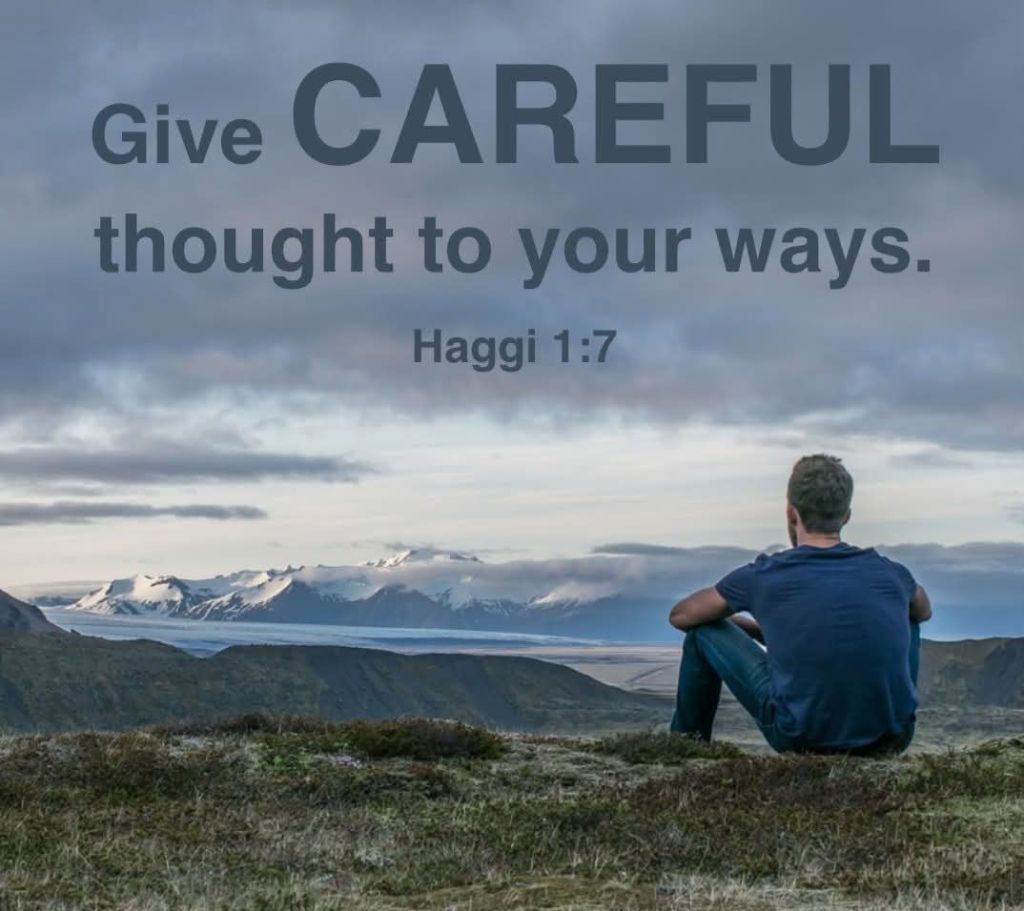
Scripture tells us of when God confronted the Israelites with a similar warning: “Give careful thought to your ways” (Haggai 1:7). After their captivity in Babylon, His people returned to Jerusalem, tasked to rebuild the temple. God had “moved the heart of Cyrus king of Persia” (Ezra 1:1) to order the construction and provide funds (vv. 2-4). But after the people laid the foundation, opposition grew (4:1-5), so they neglected the project for fourteen years. Through the prophet Haggai, God told them, “Give careful thought to your ways. . . . My house . . . remains a ruin, while each of you is busy with your own house” (Haggai 1:7, 9). God was saying, “Think carefully about how you’re living. Are you doing what I want you to do?” (Karen Huang, Our Daily Bread 30th April 2026)

When the Babylonian captivity ended, the Jewish people returned with a mandate from King Cyrus to rebuild the house of God (Ezra 5:13-14). When the prophet Haggai wrote, it had been eighteen years since their return, and the project remained unfinished due in part to spiritual lethargy. This became, in a sense, the theme for the book of Haggai—spiritual lethargy that dulls the enthusiasm of the people of God for the things of God. To follow His way requires a heart and passion for Him. Today, God likewise wants to show us where we need to follow Him in obedience. (Bill Crowder, Insight, Our Daily Bread 30th April 2026)

I guess like nearly everyone else, we will experience some spiritual lethargy as we progress through life. While work will push us on because of the deadlines and pressure from top management, our spiritual life is personal. What is happening inside of us, no one can really tell. So whether we are active pursuing God or not, no one will know. Are we still actively seeking God for His plans and purposes for our life, for this season? Or are we just drifting along. Quiet time or devotion in the mornings and church on Sundays. That’s basically all there is to it to our spiritual life?

The Israelites, during their exile in Babylon, were allowed to return to Jerusalem after the Persians overrun and took over Babylon. The ancient Persians are the Iranians of today. The Israelites returned and started to rebuild the Temple. But after a few years due to local opposition and other factors, they ceased work. The project was left in abeyance for 14 years before work continued with the encouragement and exaltation from prophets Haggai and Zechariah. It was only later that Nehemiah and Ezra started rebuilding the walls of Jerusalem.

Is there anything from Jesus that we have put aside because of our other pursuits? Did we defer our calling in God to focus on our careers and jobs? There is no doubt that we have bills to pay and need to put food on the table. Have we kept our spiritual ambitions suspended as we cope with the pressures of life? Whatever we are doing, just remember we are body, soul and spirit. We mustn’t neglect the spiritual part of us. Moreover, with God in our lives, we will do better in life. We may tap into the supernatural while living in the natural. The blessings of heaven may be poured out into our lives.

The work is unfinished. Will we finish it? Will we complete our part? Give careful thought to your ways indeed!

Have a good weekend as the Labour Day long weekend approaches! Spend some time reflecting on our journey with Christ so far. Reach out to Him and He will fill you with His marvellous presence! Amen!

Getting angry at God?

https://odb.org/2026/04/29/prayer-in-disguise

Job 19:5–12 (NIV): 5 If indeed you would exalt yourselves above me and use my humiliation against me, 6 then know that God has wronged me and drawn his net around me. 7 “Though I cry, ‘Violence!’ I get no response; though I call for help, there is no justice. 8 He has blocked my way so I cannot pass; he has shrouded my paths in darkness. 9 He has stripped me of my honor and removed the crown from my head. 10 He tears me down on every side till I am gone; he uproots my hope like a tree. 11 His anger burns against me; he counts me among his enemies. His troops advance in force; they build a siege ramp against me and encamp around my tent.

After the horrors of Auschwitz, Elie Wiesel lost his faith. “Where were you, God of kindness?” he asked, recalling the evil he and others suffered. “In my childhood I did not expect much from human beings. But I expected everything from you.” And yet, Wiesel realized later that his faith had never really left him. “It is because I believed in God that I was angry at God,” he told a journalist, “and still am.” You don’t get angry at someone you don’t believe exists. (Sheridan Voysey, Our Daily Bread 29th April 2026)

I’m not sure that anyone should be angry with God for anything. For example, for generic things like evil and injustice. Why get angry at God? Evil exists because we human beings have the will to do things on our own. As a result, we also ended up having injustice. But there is also good in humanity as can be seen from us helping each other in times of difficulty and disaster, and justice from the legal system.

As a believer, there are even more reasons why we should not be angry with God. We don’t deserve salvation but it is by His grace that we are saved. We are unworthy and yet Jesus died for our sins and redeemed us from eternal damnation. Instead, He gave us eternal life and the hope that we will one day live with God for all eternity in the new heaven and new earth. Will anger at God change anything? He is sovereign and whatever we go through, He has a plan for us and our lives.  Always remember Romans 8:28 – “And we know that in all things God works for the good of those who love him, who have been called according to his purpose”.

Whatever losses we have suffered, whatever injustice or evil we have been afflicted with, illnesses or health issues we face – commit all these and our future into His hands. His plans for us – “are plans to prosper you and not to harm you, plans to give you hope and a future,” (Jeremiah 29:11). Unforseen and unfortunate things may happen in our lives but always remember that the LORD always wants only the best for us. It is through adversity and suffering that we get to know God better and experience His grace, love and compassion. So why get angry at God? He is the creator of heaven and earth and our Heavenly Father who loves and treasures us deeply.

Our God watches over us

https://odb.org/2026/04/28/in-gods-line-of-sight

Psalm 121 (NIV):

A song of ascents.

      1 I lift up my eyes to the mountains—
         where does my help come from?
      2 My help comes from the LORD,
         the Maker of heaven and earth.
      3 He will not let your foot slip—
         he who watches over you will not slumber;
      4 indeed, he who watches over Israel
         will neither slumber nor sleep.
      5 The LORD watches over you—
         the LORD is your shade at your right hand;
      6 the sun will not harm you by day,
         nor the moon by night.
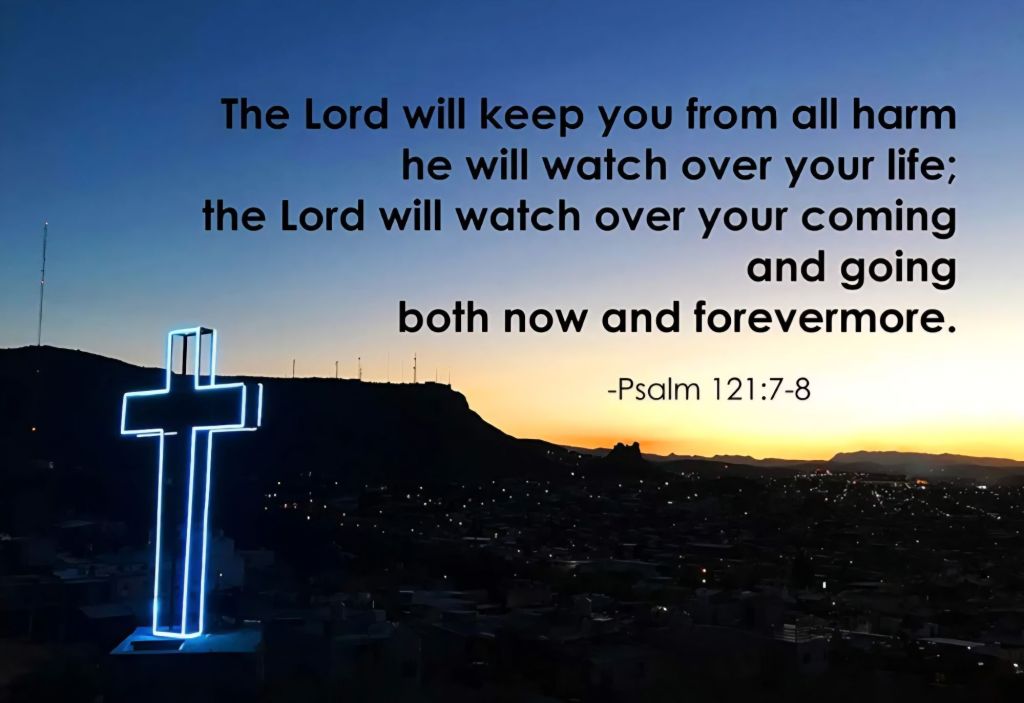
      7 The LORD will keep you from all harm—  he will watch over your life;
      8 the LORD will watch over your coming and going
         both now and forevermore.

While it’s not wrong to enjoy unexpected blessings, big breaks, or once-in-a-lifetime opportunities, a desire for enjoyment can easily turn into a fear of missing out. We can even be tempted to think God holds out on us or loses sight of us. However, the “Maker of heaven and earth” (Psalm 121:2) is our ever-watchful and never-sleeping provider and protector (vv. 3-7). So we don’t have to fret over detours, delays, or even missed opportunities. God will watch over our “coming and going both now and forevermore” (v. 8). (Xochitl Dixon, Our Daily Bread 28th April 2026)

Psalm 121 is part of a collection of songs designed for use during the high holy days of Israel’s calendar. People from all over the land would journey to Jerusalem for the celebration of “the Festival of Unleavened Bread, the Festival of Weeks and the Festival of Tabernacles” (Deuteronomy 16:16). However, most of them made the journey on foot (as Jesus did with His family in Luke 2:41-52), and the trek could be treacherous. Most pilgrims made the journey from the lowlands around Jerusalem, so going to the city meant climbing up Mount Zion. That’s why Psalms 120-134 are called Songs of Ascents. Psalm 121, in particular, promises that the God who lives on Zion watches over all those journeying to His city, and He’ll protect them on their way. Even today, we can trust that the God who lives in the heavenly Zion watches over us no matter where we are. (Insight, Jed Ostoich, Our Daily Bread 28th April 2026)

As we live life as a believer, we know that Jesus watches over us, the same way Jehovah used to watch over the Israelites as a whole. From the time He delivered them out of Egypt into the wilderness and then forty years later, into the Promised Land. He didn’t only watch over them, He also guided them daily. By a miraculous pillar of cloud in the day and by a miraculous pillar of fire in the night. He also provided them with manna from heaven. With such a heavenly tangible and visible presence on earth, no one dared to attack them and in fact no one ever did even though they were in the wilderness.

Similarly, in more modern times when the Jewish populace travel to Jerusalem for the high holy festivals, they pray and petition that God watches over them. As they needed to travel up to Mount Zion, a treacherous journey filled with bandits, they sang the Songs of Ascents (Psalms 120-134) including Psalm 121, believing that God will protect them as they journey to Zion.

They may be times when we miss certain opportunities. Or we couldn’t get tickets to a concert or performance of our favourite singers. Or because of our heavy workload, we couldn’t catch a movie on the big screen. Or we are already quite advanced in age but have yet to see the Northern Lights or walked on the Great Wall of China or have not seen the cherry blossoms in Japan. Or that despite precautions taken, we still met an accident or a careful lifestyle we are still afflicted with illness or cancer. Or with all the publicity surrounding scams, we are still scammed!

If it was an accident, we could have suffered a worse fate if not for God’s oversight. If it was an illness, we could have been afflicted with a fatal disease. Or we could have suffered a cardiac arrest and passed on. Missed opportunities are missed opportunities – perhaps we will have a better treat one day! As for travel, perhaps we could one day have a beautiful family reunion in a nice climate place, colder than Malaysia but not like the Artic! We may not have all the things or the experiences we wished for in this lifetime. If so, we will probably have that experience in the next one when we live for eternity!

Most importantly, this morning, know that the LORD our God, our Lord Jesus Christ and the Holy Spirit will all watch over us. Unless our time is up for us to go home to be with Jesus in heaven, we will live on and He will take care of us. The God who lives in Zion will watch over His people! Amen! Have a good week ahead, everyone!

Psalm 121:8 NIV The LORD will watch over your coming and going both now and forevermore.

P/S – I couldn’t write and post yesterday as we needed to travel from Seremban early in the morning having missed the golden window on Sunday due to church commitments. Will try to compensate by putting up a post this Saturday.

Rivers to cross

https://odb.org/2026/04/24/rivers-to-cross

Joshua 3:9–11, 13–17 (NIV): 9 Joshua said to the Israelites, “Come here and listen to the words of the LORD your God. 10 This is how you will know that the living God is among you and that he will certainly drive out before you the Canaanites, Hittites, Hivites, Perizzites, Girgashites, Amorites and Jebusites. 11 See, the ark of the covenant of the Lord of all the earth will go into the Jordan ahead of you. 13 And as soon as the priests who carry the ark of the LORD—the Lord of all the earth—set foot in the Jordan, its waters flowing downstream will be cut off and stand up in a heap.” 14 So when the people broke camp to cross the Jordan, the priests carrying the ark of the covenant went ahead of them. 15 Now the Jordan is at flood stage all during harvest. Yet as soon as the priests who carried the ark reached the Jordan and their feet touched the water’s edge, 16 the water from upstream stopped flowing. It piled up in a heap a great distance away, at a town called Adam in the vicinity of Zarethan, while the water flowing down to the Sea of the Arabah (that is, the Dead Sea) was completely cut off. So the people crossed over opposite Jericho. 17 The priests who carried the ark of the covenant of the LORD stopped in the middle of the Jordan and stood on dry ground, while all Israel passed by until the whole nation had completed the crossing on dry ground.

When Chris McCandless wandered off the grid and into the Alaskan wilderness, he expected to return. But he crossed the Teklanika in April, well before summer ice-melt would swell that river into an impassable torrent. Months later, out of food, McCandless couldn’t get back. His tragic death is memorialized in book and film.

The people of ancient Israel faced a crucial river crossing in order to enter the promised land. However, “the Jordan [was] at flood stage” (Joshua 3:15), a challenge that would grow their faith. God told Joshua, “Today I will begin to exalt you in the eyes of all Israel, so they may know that I am with you as I was with Moses” (v. 7). (Tim Gustafson, Our Daily Bread 24th April 2026)

If you have been to the Jordan River, accessible from either the Jordanian or the Israeli side, you will know that people do conduct baptisms there today as a symbolic act to remember Jesus’s baptism by John the Baptist. In fact, in our trip to Israel in 2013, our local pastor conducted a baptism service for one of our members.

Of more significance, however, is that the River Jordan is mostly calm and shallow. In fact some parts of it dries out during the drier seasons. But during the harvest season of March to April in spring, the river floods its banks. If you remember your Geography, flooding of riverbanks is a natural phenomenon that helps rivers unload the sediments they carry downstream and is a key element to making its surroundings fertile. For example, the Chao Phraya has a major flood every decade or so and runs through central Bangkok on its way to the Gulf of Thailand (about 40 kms away from Bangkok). You could say that the major floods of the Chao Phraya over the centuries have made Bangkok the city it is today, similar to how the volcanic ash made Java such fertile ground.

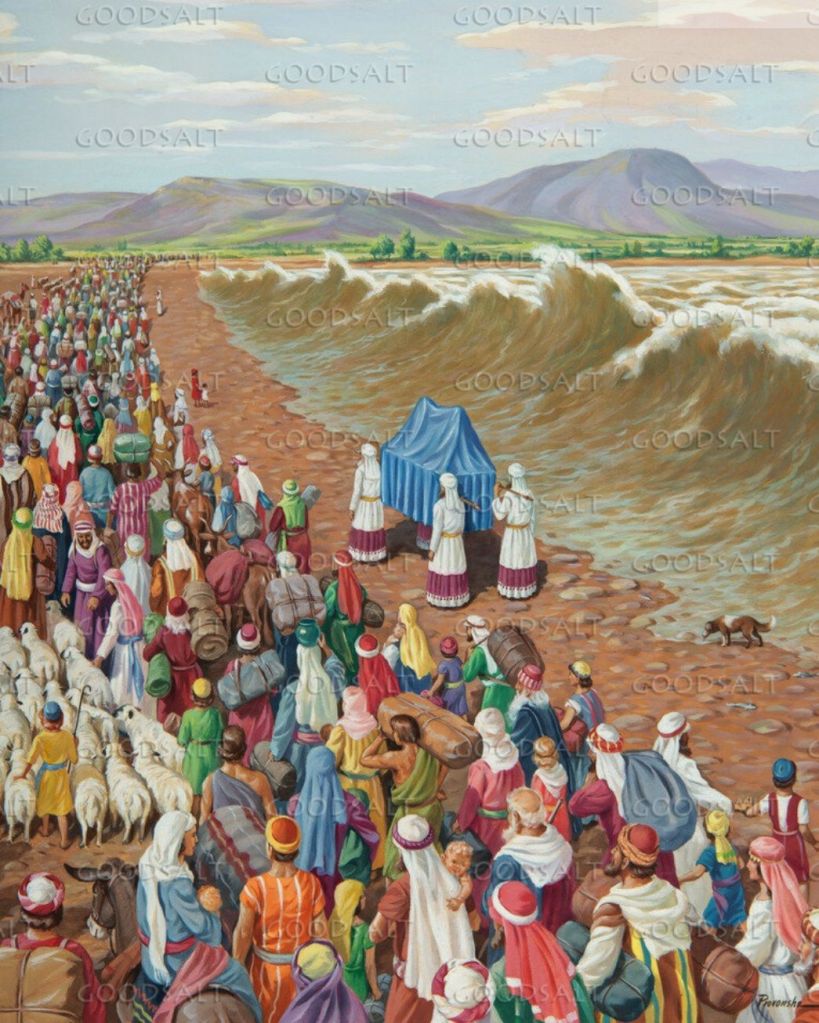
In the book of Joshua, when the Israelites were about to cross the Jordan River into the Promised Land of Canaan, the river was flooding its banks. Now instead of waiting for the Jordan to normalise (and it is common during ancient times to wait for nature to take its course), the LORD God chose to bring them across when it was flooding, when it was at its peak and the most dangerous. See Joshua 3, verse 15.

The LORD God that we serve, our heavenly Father, has a knack for the dramatic! To do the most difficult thing at the most difficult time to show to both the Israelites and the surrounding nations that He is indeed the God that created the heavens and earth! He parted the flooding river for the children of Israel to cross on dry land when the priests carried the Ark of the Covenant into the water!

With the excellent example shown by God in Joshua 3 and Moses having parted the Red Sea (the sea is more momentous!), or the soaking of the offering with buckets of water before Elijah calling down fire from heaven to consume it, we must stay encouraged that the deeper and tougher our situation, the more likely will the LORD act and intervene on our behalf. We cannot determine how and when, but rest assured that He will! Jesus loves us and is compassionate as we can see in the Gospels. He is at the right hand of the Father interceding for us. We will see the light at the end of the tunnel! Commit our situation to him and trust Him! The rivers we need to cross in life may be flooding its banks, but our God will bring us through them safely and victoriously! Amen!

Unity and harmony in the body

https://odb.org/2026/04/23/staying-in-step

Romans 15:5–7 (NIV): 5 May the God who gives endurance and encouragement give you the same attitude of mind toward each other that Christ Jesus had, 6 so that with one mind and one voice you may glorify the God and Father of our Lord Jesus Christ.
7 Accept one another, then, just as Christ accepted you, in order to bring praise to God.

Lillian Colón, who grew up in an orphanage, beat out four hundred dancers to win a coveted spot on a world-renowned dance team. She performed with that group, with its tightly ordered synchronized choreography, until her mid-forties. Now teaching dance at age seventy, she imparts to students her greatest lesson from precision artistry: Work together. “On and off the stage, our lives are deeply intertwined,” she said, “and we all fare better when we support and care for one another.” (Patricia Raybon, Our Daily Bread 23rd April 2026)

I think no one doubts the importance of unity and harmony in the local church. If we are united, we are able to achieve much in good. If we have harmony in church, even the Holy Spirit is encouraged and glad and we may experience a greater outpouring of His power and might in healing and signs and wonders. Congregational worship becomes powerful when we move collectively in the body, our praise and worship reaching greater heights in the heavenlies, with more on the ground having face to face encounters with Jesus in the spiritual realm. The body, united and harmonious, is touched and encouraged.

One key aspect to unity and harmony in the body is as enumerated in Romans 15:7 that we accept one another, just as Christ accepted us in order to bring praise to God. We want to glorify God. We want the name of Christ to be glorified in our lives as He deserves all glory and honour.

Therefore, accept one another. That’s the key to unity and harmony. In church, there are all sorts of people. Like the king’s invitation to the wedding feast – in the end, those at the wayside and on the streets are invited. God brings in everyone. Most of those in church are good but there are likely a few still learning and growing in their journey of faith. Many at large have been conditioned by their environment, the upbringing they had as they were growing up. Humans are naturally selfish, self-serving and even narcissist. We prioritise our own well-being, before we start thinking of the congregation. That’s natural. It’s a process that Christ works in us so that we began to prioritise the needs of others, that of the congregation or community.

For example, in a church potluck gathering we eat less of the good stuff first, so others may also have the opportunity to get a little bite. Not eat as much as we can and leave the rest to fate! An attitude of sharing and giving is easily seen on how we approach buffet meals. Only after everyone has had their fill should we start taking more for ourselves – of the leftovers. In other words, wait for the second round before we indulge. Part of accepting one another is to give everyone a fair chance to fill their plates! Our ultimate goal remains – unity and harmony in the body! Amen!

Helping the oppressed and those suffering

https://odb.org/2026/04/22/joining-god-to-help

Psalm 72:12–14 (NIV): 12 For he will deliver the needy who cry out,
the afflicted who have no one to help.
13 He will take pity on the weak and the needy
and save the needy from death.
14 He will rescue them from oppression and violence,
for precious is their blood in his sight.

It’s stunning, however, to see God’s attention turned toward these places of suffering and hopelessness. Somehow, ultimately, in His own way and time, He will “deliver the needy who cry out, the afflicted who have no one to help” (72:12). And remarkably, one way God’s help arrives is through us. Psalm 72 refers to both King Solomon’s work and God’s work—and it’s not always easy to disentangle which is which. God is the rescuer, but He calls us to move with Him. (Winn Collier, Our Daily Bread 22nd April 2026)

The Scripture that comes to mind on the LORD God helping the oppressed and those suffering was when He declared He had seen the suffering of His people and heard their cries and sent Moses to deliver them from Pharoah. See below;

Exodus 3:7-10 NIV – 7 Then the Lord said, “I have seen how cruelly my people are being treated in Egypt; I have heard them cry out to be rescued from their slave drivers. I know all about their sufferings, 8 and so I have come down to rescue them from the Egyptians and to bring them out of Egypt to a spacious land, one which is rich and fertile and in which the Canaanites, the Hittites, the Amorites, the Perizzites, the Hivites, and the Jebusites now live. 9 I have indeed heard the cry of my people, and I see how the Egyptians are oppressing them. 10 Now I am sending you to the king of Egypt so that you can lead my people out of his country.”

The LORD God also acted similarly during the time of the Babylonian exile of the Israelites when He proclaimed through His prophets Ezekial, Daniel and Jeremiah that He would free and deliver them. These culminated with Nehemiah and Ezra rebuilding the Temple and the walls of Jerusalem when the exiled Israelites were allowed to return during Persian rule (after the Babylonians were overrun). These are the same Persians that the Americans and Israelis are now at warring against, with both the Americans and Iranians blocking the Straits of Hormuz and disrupting the global flow of crude.

If you’re suffering and feeling hopeless, cry out to God. He will rescue and deliver you. Do not despair. Help is on the way. It may not be immediate but the Lord will surely help us out of our misery and sufferings. Times of difficulty are pivotal points for us not only to experience God’s grace but also to grow in our relationship with Him. These are times when we rely on Christ and not our own strength and abilities.

At the other end of the spectrum, there are those amongst us who may be inclined to work with the LORD God to help those who are suffering and are overwhelmed by hopelessness. Step up and step out in faith and action. Open our hearts to the prompting of the Holy Spirit. We may not know who are those suffering. The Lord will reveal to us as we move with Him. Let us be vessels and instruments for God to move in our midst, whether through signs and wonders, healing, finance or just being there with our presence and company!

Lost and found

https://odb.org/2026/04/21/lost-but-now-found

Luke 15:8–10 (NIV): 8 “Or suppose a woman has ten silver coins and loses one. Doesn’t she light a lamp, sweep the house and search carefully until she finds it? 9 And when she finds it, she calls her friends and neighbors together and says, ‘Rejoice with me; I have found my lost coin.’ 10 In the same way, I tell you, there is rejoicing in the presence of the angels of God over one sinner who repents.”

When I visited Ecuador’s Amazon region with my father many years ago, we took a fun speedboat ride to a small village to take in the sights and learn about the local tribes. My dear dad bought me handmade jewelry, including a set of earrings. I only wore those earrings on special occasions, including when I went to visit my sister for my birthday. When I came back from my trip, I was horrified to discover I’d lost one of my earrings. I looked everywhere.

It was just an earring, but I’d have to travel all the way back to the Amazon jungle to replace it. Amazingly, when my sister returned to the restaurant we had visited for my birthday, she spotted my missing earring in their lost and found. I was overjoyed! (Nancy Gavilanes, Our Daily Bread 21st April 2026)

Jesus uses this metaphor of having lost something precious and finding it to describe the joy in heaven when a sinner repents and accepts Jesus as Lord and Saviour. Jesus teaches this with the parables of the Lost Coin (today’s Scripture) and the Lost Sheep. The LORD God, our Heavenly Father, is genuinely happy and glad when we turn from our selfish ways to follow Him as illustrated by His joy when the Israelites chose to obey His law. He gladly becomes their God and is benevolent towards them, providing both protection and blessings. The psalmist uses the phrase “under the shadow of His wings” to describe the LORD’s love, mercy and grace.

Jesus also uses the parable of the Prodigal Son to teach about those turning from their wayward ways. That parable could be applied to sinners coming to Jesus for the first time but more towards believers returning to Christ after wandering off to pursue their own dreams and ambitions. The rejoicing in heaven is illustrated by the Father throwing a feast and killing the fatten calf (reserved for special celebrations) to celebrate the return of the wayward son.

This morning, we need to be reminded that we are precious to God. But most importantly, we remain precious to God and will always be precious to Him. Like every father, God longs for His children to be close to Him. For earthly fathers, that’s the meaning of family. Your children close by or living with you. Interacting and eating together daily. That’s the ideal as parents will not live forever in the natural course of life (that is, barring Jesus returning during our lifetime). So while we are still on earth, we want to spend our remaining time with our flesh and blood, the ones who are precious to us.

If we have drifted away from God, it’s time to return. We are precious to God. If we haven’t known God, accept Jesus as your Lord and Saviour now. Don’t hesitate and wait anymore. You are precious to God and as you turn to God, there will be much joy and rejoicing in heaven! The blessings and providence of God will be upon you. The LORD God of Abraham, Isaac and Jacob – the Great I Am – Jehovah Elohim, will be your God! His love and grace will be upon you! Amen!