Our God watches over us

https://odb.org/2026/04/28/in-gods-line-of-sight
Psalm 121 (NIV):

A song of ascents.

      1 I lift up my eyes to the mountains—
         where does my help come from?
      2 My help comes from the LORD,
         the Maker of heaven and earth.
      3 He will not let your foot slip—
         he who watches over you will not slumber;
      4 indeed, he who watches over Israel
         will neither slumber nor sleep.
      5 The LORD watches over you—
         the LORD is your shade at your right hand;
      6 the sun will not harm you by day,
         nor the moon by night.
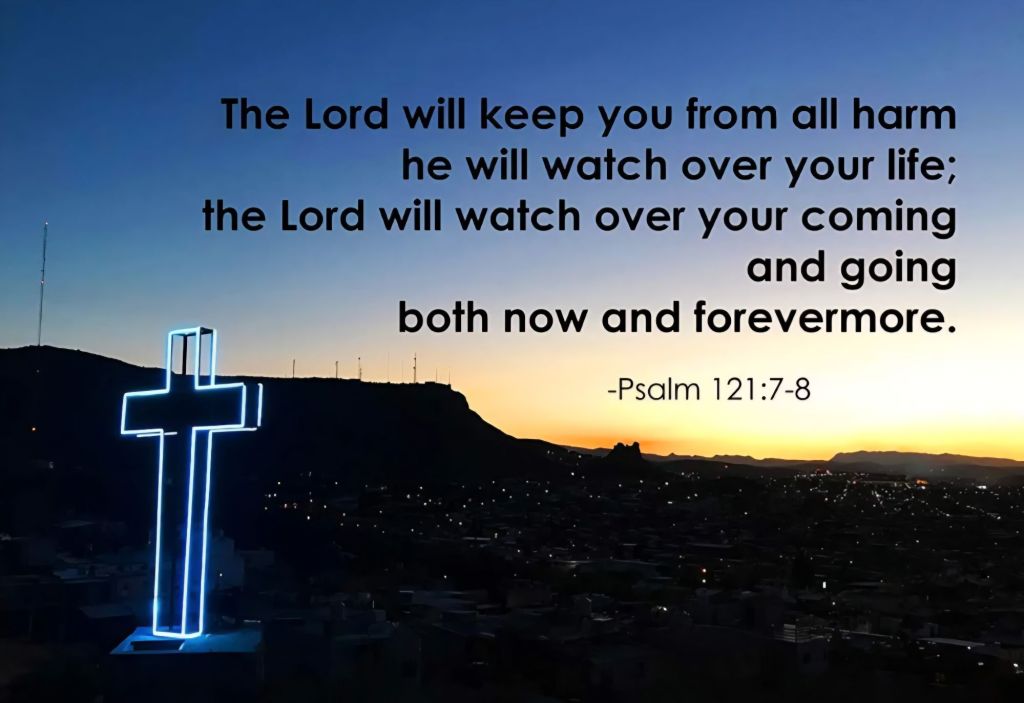
      7 The LORD will keep you from all harm—  he will watch over your life;
      8 the LORD will watch over your coming and going
         both now and forevermore.

While it’s not wrong to enjoy unexpected blessings, big breaks, or once-in-a-lifetime opportunities, a desire for enjoyment can easily turn into a fear of missing out. We can even be tempted to think God holds out on us or loses sight of us. However, the “Maker of heaven and earth” (Psalm 121:2) is our ever-watchful and never-sleeping provider and protector (vv. 3-7). So we don’t have to fret over detours, delays, or even missed opportunities. God will watch over our “coming and going both now and forevermore” (v. 8). (Xochitl Dixon, Our Daily Bread 28th April 2026)

Psalm 121 is part of a collection of songs designed for use during the high holy days of Israel’s calendar. People from all over the land would journey to Jerusalem for the celebration of “the Festival of Unleavened Bread, the Festival of Weeks and the Festival of Tabernacles” (Deuteronomy 16:16). However, most of them made the journey on foot (as Jesus did with His family in Luke 2:41-52), and the trek could be treacherous. Most pilgrims made the journey from the lowlands around Jerusalem, so going to the city meant climbing up Mount Zion. That’s why Psalms 120-134 are called Songs of Ascents. Psalm 121, in particular, promises that the God who lives on Zion watches over all those journeying to His city, and He’ll protect them on their way. Even today, we can trust that the God who lives in the heavenly Zion watches over us no matter where we are. (Insight, Jed Ostoich, Our Daily Bread 28th April 2026)

As we live life as a believer, we know that Jesus watches over us, the same way Jehovah used to watch over the Israelites as a whole. From the time He delivered them out of Egypt into the wilderness and then forty years later, into the Promised Land. He didn’t only watch over them, He also guided them daily. By a miraculous pillar of cloud in the day and by a miraculous pillar of fire in the night. He also provided them with manna from heaven. With such a heavenly tangible and visible presence on earth, no one dared to attack them and in fact no one ever did even though they were in the wilderness.

Similarly, in more modern times when the Jewish populace travel to Jerusalem for the high holy festivals, they pray and petition that God watches over them. As they needed to travel up to Mount Zion, a treacherous journey filled with bandits, they sang the Songs of Ascents (Psalms 120-134) including Psalm 121, believing that God will protect them as they journey to Zion.

They may be times when we miss certain opportunities. Or we couldn’t get tickets to a concert or performance of our favourite singers. Or because of our heavy workload, we couldn’t catch a movie on the big screen. Or we are already quite advanced in age but have yet to see the Northern Lights or walked on the Great Wall of China or have not seen the cherry blossoms in Japan. Or that despite precautions taken, we still met an accident or a careful lifestyle we are still afflicted with illness or cancer. Or with all the publicity surrounding scams, we are still scammed!

If it was an accident, we could have suffered a worse fate if not for God’s oversight. If it was an illness, we could have been afflicted with a fatal disease. Or we could have suffered a cardiac arrest and passed on. Missed opportunities are missed opportunities – perhaps we will have a better treat one day! As for travel, perhaps we could one day have a beautiful family reunion in a nice climate place, colder than Malaysia but not like the Artic! We may not have all the things or the experiences we wished for in this lifetime. If so, we will probably have that experience in the next one when we live for eternity!

Most importantly, this morning, know that the LORD our God, our Lord Jesus Christ and the Holy Spirit will all watch over us. Unless our time is up for us to go home to be with Jesus in heaven, we will live on and He will take care of us. The God who lives in Zion will watch over His people! Amen! Have a good week ahead, everyone!

Psalm 121:8 NIV The LORD will watch over your coming and going both now and forevermore.

P/S – I couldn’t write and post yesterday as we needed to travel from Seremban early in the morning having missed the golden window on Sunday due to church commitments. Will try to compensate by putting up a post this Saturday.

Rivers to cross

https://odb.org/2026/04/24/rivers-to-cross

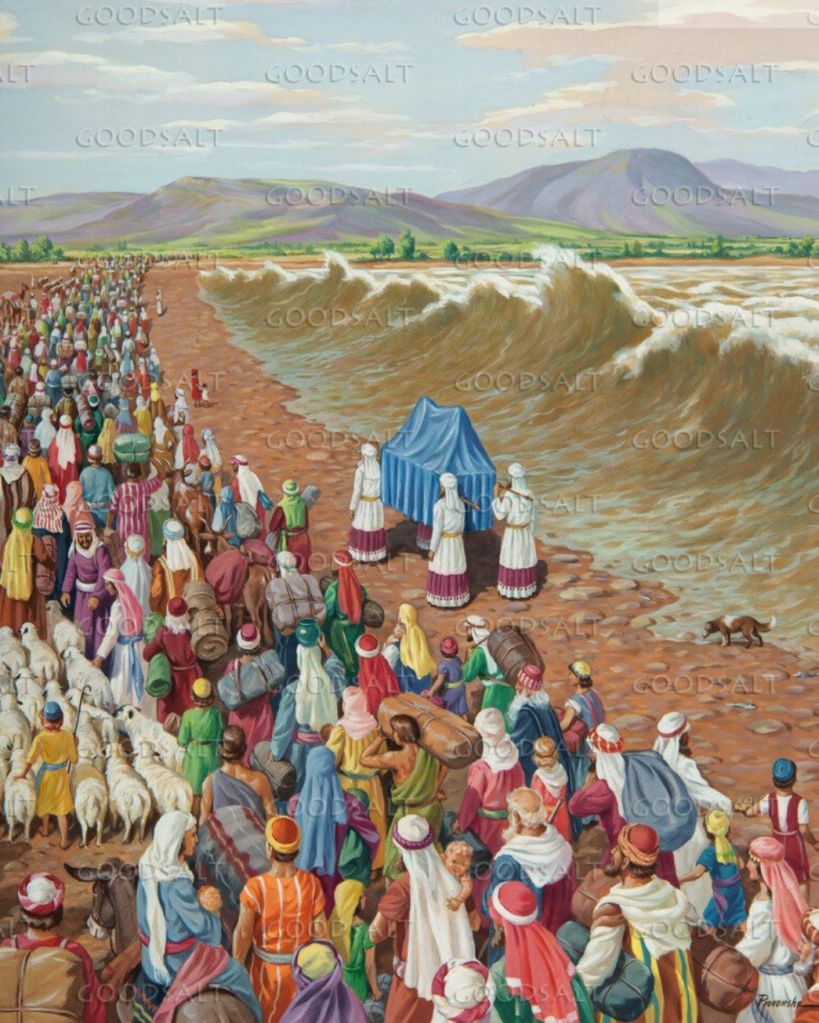
Joshua 3:9–11, 13–17 (NIV): 9 Joshua said to the Israelites, “Come here and listen to the words of the LORD your God. 10 This is how you will know that the living God is among you and that he will certainly drive out before you the Canaanites, Hittites, Hivites, Perizzites, Girgashites, Amorites and Jebusites. 11 See, the ark of the covenant of the Lord of all the earth will go into the Jordan ahead of you. 13 And as soon as the priests who carry the ark of the LORD—the Lord of all the earth—set foot in the Jordan, its waters flowing downstream will be cut off and stand up in a heap.” 14 So when the people broke camp to cross the Jordan, the priests carrying the ark of the covenant went ahead of them. 15 Now the Jordan is at flood stage all during harvest. Yet as soon as the priests who carried the ark reached the Jordan and their feet touched the water’s edge, 16 the water from upstream stopped flowing. It piled up in a heap a great distance away, at a town called Adam in the vicinity of Zarethan, while the water flowing down to the Sea of the Arabah (that is, the Dead Sea) was completely cut off. So the people crossed over opposite Jericho. 17 The priests who carried the ark of the covenant of the LORD stopped in the middle of the Jordan and stood on dry ground, while all Israel passed by until the whole nation had completed the crossing on dry ground.

When Chris McCandless wandered off the grid and into the Alaskan wilderness, he expected to return. But he crossed the Teklanika in April, well before summer ice-melt would swell that river into an impassable torrent. Months later, out of food, McCandless couldn’t get back. His tragic death is memorialized in book and film.

The people of ancient Israel faced a crucial river crossing in order to enter the promised land. However, “the Jordan [was] at flood stage” (Joshua 3:15), a challenge that would grow their faith. God told Joshua, “Today I will begin to exalt you in the eyes of all Israel, so they may know that I am with you as I was with Moses” (v. 7). (Tim Gustafson, Our Daily Bread 24th April 2026)

If you have been to the Jordan River, accessible from either the Jordanian or the Israeli side, you will know that people do conduct baptisms there today as a symbolic act to remember Jesus’s baptism by John the Baptist. In fact, in our trip to Israel in 2013, our local pastor conducted a baptism service for one of our members.

Of more significance, however, is that the River Jordan is mostly calm and shallow. In fact some parts of it dries out during the drier seasons. But during the harvest season of March to April in spring, the river floods its banks. If you remember your Geography, flooding of riverbanks is a natural phenomenon that helps rivers unload the sediments they carry downstream and is a key element to making its surroundings fertile. For example, the Chao Phraya has a major flood every decade or so and runs through central Bangkok on its way to the Gulf of Thailand (about 40 kms away from Bangkok). You could say that the major floods of the Chao Phraya over the centuries have made Bangkok the city it is today, similar to how the volcanic ash made Java such fertile ground.

In the book of Joshua, when the Israelites were about to cross the Jordan River into the Promised Land of Canaan, the river was flooding its banks. Now instead of waiting for the Jordan to normalise (and it is common during ancient times to wait for nature to take its course), the LORD God chose to bring them across when it was flooding, when it was at its peak and the most dangerous. See Joshua 3, verse 15.

The LORD God that we serve, our heavenly Father, has a knack for the dramatic! To do the most difficult thing at the most difficult time to show to both the Israelites and the surrounding nations that He is indeed the God that created the heavens and earth! He parted the flooding river for the children of Israel to cross on dry land when the priests carried the Ark of the Covenant into the water!

With the excellent example shown by God in Joshua 3 and Moses having parted the Red Sea (the sea is more momentous!), or the soaking of the offering with buckets of water before Elijah calling down fire from heaven to consume it, we must stay encouraged that the deeper and tougher our situation, the more likely will the LORD act and intervene on our behalf. We cannot determine how and when, but rest assured that He will! Jesus loves us and is compassionate as we can see in the Gospels. He is at the right hand of the Father interceding for us. We will see the light at the end of the tunnel! Commit our situation to him and trust Him! The rivers we need to cross in life may be flooding its banks, but our God will bring us through them safely and victoriously! Amen!

Unity and harmony in the body

https://odb.org/2026/04/23/staying-in-step

Romans 15:5–7 (NIV): 5 May the God who gives endurance and encouragement give you the same attitude of mind toward each other that Christ Jesus had, 6 so that with one mind and one voice you may glorify the God and Father of our Lord Jesus Christ.
7 Accept one another, then, just as Christ accepted you, in order to bring praise to God.

Lillian Colón, who grew up in an orphanage, beat out four hundred dancers to win a coveted spot on a world-renowned dance team. She performed with that group, with its tightly ordered synchronized choreography, until her mid-forties. Now teaching dance at age seventy, she imparts to students her greatest lesson from precision artistry: Work together. “On and off the stage, our lives are deeply intertwined,” she said, “and we all fare better when we support and care for one another.” (Patricia Raybon, Our Daily Bread 23rd April 2026)

I think no one doubts the importance of unity and harmony in the local church. If we are united, we are able to achieve much in good. If we have harmony in church, even the Holy Spirit is encouraged and glad and we may experience a greater outpouring of His power and might in healing and signs and wonders. Congregational worship becomes powerful when we move collectively in the body, our praise and worship reaching greater heights in the heavenlies, with more on the ground having face to face encounters with Jesus in the spiritual realm. The body, united and harmonious, is touched and encouraged.

One key aspect to unity and harmony in the body is as enumerated in Romans 15:7 that we accept one another, just as Christ accepted us in order to bring praise to God. We want to glorify God. We want the name of Christ to be glorified in our lives as He deserves all glory and honour.

Therefore, accept one another. That’s the key to unity and harmony. In church, there are all sorts of people. Like the king’s invitation to the wedding feast – in the end, those at the wayside and on the streets are invited. God brings in everyone. Most of those in church are good but there are likely a few still learning and growing in their journey of faith. Many at large have been conditioned by their environment, the upbringing they had as they were growing up. Humans are naturally selfish, self-serving and even narcissist. We prioritise our own well-being, before we start thinking of the congregation. That’s natural. It’s a process that Christ works in us so that we began to prioritise the needs of others, that of the congregation or community.

For example, in a church potluck gathering we eat less of the good stuff first, so others may also have the opportunity to get a little bite. Not eat as much as we can and leave the rest to fate! An attitude of sharing and giving is easily seen on how we approach buffet meals. Only after everyone has had their fill should we start taking more for ourselves – of the leftovers. In other words, wait for the second round before we indulge. Part of accepting one another is to give everyone a fair chance to fill their plates! Our ultimate goal remains – unity and harmony in the body! Amen!

Helping the oppressed and those suffering

https://odb.org/2026/04/22/joining-god-to-help

Psalm 72:12–14 (NIV): 12 For he will deliver the needy who cry out,
the afflicted who have no one to help.
13 He will take pity on the weak and the needy
and save the needy from death.
14 He will rescue them from oppression and violence,
for precious is their blood in his sight.

It’s stunning, however, to see God’s attention turned toward these places of suffering and hopelessness. Somehow, ultimately, in His own way and time, He will “deliver the needy who cry out, the afflicted who have no one to help” (72:12). And remarkably, one way God’s help arrives is through us. Psalm 72 refers to both King Solomon’s work and God’s work—and it’s not always easy to disentangle which is which. God is the rescuer, but He calls us to move with Him. (Winn Collier, Our Daily Bread 22nd April 2026)

The Scripture that comes to mind on the LORD God helping the oppressed and those suffering was when He declared He had seen the suffering of His people and heard their cries and sent Moses to deliver them from Pharoah. See below;

Exodus 3:7-10 NIV – 7 Then the Lord said, “I have seen how cruelly my people are being treated in Egypt; I have heard them cry out to be rescued from their slave drivers. I know all about their sufferings, 8 and so I have come down to rescue them from the Egyptians and to bring them out of Egypt to a spacious land, one which is rich and fertile and in which the Canaanites, the Hittites, the Amorites, the Perizzites, the Hivites, and the Jebusites now live. 9 I have indeed heard the cry of my people, and I see how the Egyptians are oppressing them. 10 Now I am sending you to the king of Egypt so that you can lead my people out of his country.”

The LORD God also acted similarly during the time of the Babylonian exile of the Israelites when He proclaimed through His prophets Ezekial, Daniel and Jeremiah that He would free and deliver them. These culminated with Nehemiah and Ezra rebuilding the Temple and the walls of Jerusalem when the exiled Israelites were allowed to return during Persian rule (after the Babylonians were overrun). These are the same Persians that the Americans and Israelis are now at warring against, with both the Americans and Iranians blocking the Straits of Hormuz and disrupting the global flow of crude.

If you’re suffering and feeling hopeless, cry out to God. He will rescue and deliver you. Do not despair. Help is on the way. It may not be immediate but the Lord will surely help us out of our misery and sufferings. Times of difficulty are pivotal points for us not only to experience God’s grace but also to grow in our relationship with Him. These are times when we rely on Christ and not our own strength and abilities.

At the other end of the spectrum, there are those amongst us who may be inclined to work with the LORD God to help those who are suffering and are overwhelmed by hopelessness. Step up and step out in faith and action. Open our hearts to the prompting of the Holy Spirit. We may not know who are those suffering. The Lord will reveal to us as we move with Him. Let us be vessels and instruments for God to move in our midst, whether through signs and wonders, healing, finance or just being there with our presence and company!

Lost and found

https://odb.org/2026/04/21/lost-but-now-found

Luke 15:8–10 (NIV): 8 “Or suppose a woman has ten silver coins and loses one. Doesn’t she light a lamp, sweep the house and search carefully until she finds it? 9 And when she finds it, she calls her friends and neighbors together and says, ‘Rejoice with me; I have found my lost coin.’ 10 In the same way, I tell you, there is rejoicing in the presence of the angels of God over one sinner who repents.”

When I visited Ecuador’s Amazon region with my father many years ago, we took a fun speedboat ride to a small village to take in the sights and learn about the local tribes. My dear dad bought me handmade jewelry, including a set of earrings. I only wore those earrings on special occasions, including when I went to visit my sister for my birthday. When I came back from my trip, I was horrified to discover I’d lost one of my earrings. I looked everywhere.

It was just an earring, but I’d have to travel all the way back to the Amazon jungle to replace it. Amazingly, when my sister returned to the restaurant we had visited for my birthday, she spotted my missing earring in their lost and found. I was overjoyed! (Nancy Gavilanes, Our Daily Bread 21st April 2026)

Jesus uses this metaphor of having lost something precious and finding it to describe the joy in heaven when a sinner repents and accepts Jesus as Lord and Saviour. Jesus teaches this with the parables of the Lost Coin (today’s Scripture) and the Lost Sheep. The LORD God, our Heavenly Father, is genuinely happy and glad when we turn from our selfish ways to follow Him as illustrated by His joy when the Israelites chose to obey His law. He gladly becomes their God and is benevolent towards them, providing both protection and blessings. The psalmist uses the phrase “under the shadow of His wings” to describe the LORD’s love, mercy and grace.

Jesus also uses the parable of the Prodigal Son to teach about those turning from their wayward ways. That parable could be applied to sinners coming to Jesus for the first time but more towards believers returning to Christ after wandering off to pursue their own dreams and ambitions. The rejoicing in heaven is illustrated by the Father throwing a feast and killing the fatten calf (reserved for special celebrations) to celebrate the return of the wayward son.

This morning, we need to be reminded that we are precious to God. But most importantly, we remain precious to God and will always be precious to Him. Like every father, God longs for His children to be close to Him. For earthly fathers, that’s the meaning of family. Your children close by or living with you. Interacting and eating together daily. That’s the ideal as parents will not live forever in the natural course of life (that is, barring Jesus returning during our lifetime). So while we are still on earth, we want to spend our remaining time with our flesh and blood, the ones who are precious to us.

If we have drifted away from God, it’s time to return. We are precious to God. If we haven’t known God, accept Jesus as your Lord and Saviour now. Don’t hesitate and wait anymore. You are precious to God and as you turn to God, there will be much joy and rejoicing in heaven! The blessings and providence of God will be upon you. The LORD God of Abraham, Isaac and Jacob – the Great I Am – Jehovah Elohim, will be your God! His love and grace will be upon you! Amen!

Who am I, LORD God… that you have brought me this far?

https://odb.org/2026/04/20/humble-sacrifice

1 Chronicles 17:16–22 (NIV): 16 Then King David went in and sat before the LORD, and he said:
“Who am I, LORD God, and what is my family, that you have brought me this far? 17 And as if this were not enough in your sight, my God, you have spoken about the future of the house of your servant. You, LORD God, have looked on me as though I were the most exalted of men.
18 “What more can David say to you for honoring your servant? For you know your servant, 19 LORD. For the sake of your servant and according to your will, you have done this great thing and made known all these great promises.
20 “There is no one like you, LORD, and there is no God but you, as we have heard with our own ears. 21 And who is like your people Israel—the one nation on earth whose God went out to redeem a people for himself, and to make a name for yourself, and to perform great and awesome wonders by driving out nations from before your people, whom you redeemed from Egypt? 22 You made your people Israel your very own forever, and you, LORD, have become their God.

King David sacrificed much for the people of Israel, including battling to save them from their enemies (1 Chronicles 14:8-17). Then he heard from the prophet Nathan that through his bloodline a throne would be “established forever,” as fulfilled in Christ (17:14; see Luke 1:30-33). He replied in humility, “Who am I, Lord God, and what is my family, that you have brought me this far?” (1 Chronicles 17:16). He knew that his life was established by God and His will (v. 19) and that He had ultimately done the work of rescue and redemption for David and his people (vv. 20-22). (Tom Felten, Our Daily Bread 20th April 2026)

Even King David, the most illustrious of Israel’s kings, admits in humility who is he that the LORD God would bring him and his family that far in his life. He was anointed by Prophet Samuel as a lad to be king. He defeated the giant champion of the Philistines, Goliath, while he was still in his youth. He led Israel to numerous victories at the battlefield. The surrounding nations were eager to take back what they had lost since the time of Joshua and Caleb, David and his mighty army stopped them and drove them away.

The main defining characteristic of the Israelites was that they had their God, Yahweh Elohim the Great I Am with them. He was with them ever since the days of Abraham, Isaac and Jacob. He raised up a descendant adopted as a prince into the royal household of the Egyptian Pharoah to deliver the Israelites out of Egypt. The irony of Moses confronting his adoptive father to free his people from slavery. External writings tell of a little-known diety of a small band of people making a difference transforming them into a feared nation. They prosper when they obey His laws and falter when they become rebellious.

Are we as believers any different from the children of Israel? It is our LORD God who established us and brought us out of the miry clay into solid ground, able to stand on our own in this world we are passing through as pilgrims. We are in the world but not of this world. Our citizenship is in heaven. We will one day live with God as He dwells again amongst His people like at the beginning at the Garden of Eden and in a way when His presence was at the Tent of the Meeting with Moses.

This morning let us remember and acknowledge Jesus for who He is in our lives. Who are we that He brought us this far? Yet we live in the shadow of His mighty wings. It is Jehovah the Great I Am that established and made us who we are today. Our wealth, our reputation, our stature in society, our sphere of influence. We may be a billionaire or a CEO or a vice president or an associate, it is God who established and made us. Who are we and yet He loves us and is gracious towards us, blessing us though we don’t deserve His blessings, compassion and love!

Have a good week ahead, everyone! May we live in His abundant grace as we live out His will for our lives!

Life’s a marathon, not a sprint

https://odb.org/2026/04/17/strength-to-endure

2 Timothy 4:6–8 (NIV): 6 For I am already being poured out like a drink offering, and the time for my departure is near. 7 I have fought the good fight, I have finished the race, I have kept the faith. 8 Now there is in store for me the crown of righteousness, which the Lord, the righteous Judge, will award to me on that day—and not only to me, but also to all who have longed for his appearing.

Life’s more like a marathon than a sprint. At times we experience fatigue and we feel like giving up. Yet God’s grace and strength are unending for those who trust Him. As the imprisoned apostle Paul neared the finish line of life (2 Timothy 4:6), he encouraged his protégé Timothy, “I have fought the good fight, I have finished the race, I have kept the faith” (v. 7). Life’s paths take us to different places. But regardless of where we are on life’s journey, it’s always good to remember that faith-filled endurance is essential and rewarding (v. 8); that God is the source of our strength (v. 17); and that, by His grace, he “will bring [us] safely to his heavenly kingdom” (v. 18). (Arthur Jackson, Our Daily Bread 17th April 2026)

It’s remarkable to consider how much the apostle Paul suffered in his service for Christ and the gospel (see 2 Corinthians 11:23-28), and yet he stayed true to his calling and “finished the race” that had been set before him (2 Timothy 4:6-8). How was he able to endure such hardship? He answered that question himself in 2 Corinthians 12:9 while discussing one particular season of suffering. He learned that God’s grace was sufficient, and his weakness wasn’t a liability: “[The Lord] said to me, ‘My grace is sufficient for you, for my power is made perfect in weakness.’ ” It was the opening through which God’s mighty power could flow. (Bill Crowder, Insight, Our Daily Bread 17th April 2026)

I recently went for a follow up blood test and it revealed that my glucose levels are now under control. But in these few months, I realised that as much as we who are diabetic (whether due to lifestyle or our genes or both) are targeting good HbA1c numbers (6.5 and below or at least below 7.0), it is the daily glucose spikes that we must really avoid, as much as we can. Thus, wearing a CGM (continuos glucose monitoring) device is a good practice to teach us in real time what food to avoid and what best to consume. For example, avoid industrial flour stuff, focus on fibres and proteins. Then, keep hydrated and physically active. I am very happy that my eGFR levels (a kidney function indicator) are now >90 and thus back to normal as I was on a downward trend towards the low 80s just 3 months ago. The point nevertheless is that this is a life-long thing, not so much a chase for quarterly HbA1c or even eGFR numbers.

Life is indeed a marathon. Our good health is a marathon. Our spiritual life is much more so. Bursts of spiritual brilliance or supernatural experiences will not do. What we need is long-term consistency. Our faithfulness to God is an hour by hour, minute by minute, daily thing. We must stay true to our calling every moment of our lives. Certainly not just on Sundays but every single day, every single moment!

Yes, there are ups and downs, trials and tribulations but we persevere on. We keep on fighting the good fight to finish the race in the faith. How? Paul said His grace is sufficient for me, His power is made perfect in me. When we live for God moment to moment, we experience His grace and power in our weaknesses, in our inadequacies and our lacks.

Have a good weekend ahead, everyone! Recharge ourselves for us to face life the week ahead! Pray that the Lord will grant us wisdom and discernment in all that we do as we walk in the power of His grace.

P/s: The HbA1c test measures the percentage of glucose clinging on to our blood haemoglobin as an indicator of the average glucose in our blood over the past 3 months.

Keeping secrets as a believer

https://odb.org/2026/04/16/hollow-willow

Proverbs 11:11–13 (NIV): 11 Through the blessing of the upright a city is exalted,
but by the mouth of the wicked it is destroyed. 12 Whoever derides their neighbour has no sense, but he who has understanding holds their tongue. 13 A gossip betrays a confidence, but a trustworthy person keeps a secret.

When explaining how valuable he found time with an older advisor who regularly listened to his concerns, Tomáš said, “He is my hollow willow.” Tomáš explained that the phrase is a Slovak expression signifying someone who keeps your secrets. In essence, the person is like a willow tree holding confidential information safely within its trunk.

It’s a treasure to have someone to whom we can confide our deepest fears and longings. Perhaps speaking from his own experience, in a section of Proverbs highlighting the power of our words, King King Solomon commended the individual who displays discretion or can “[hold] their tongue” (Proverbs 11:12). He also contrasted two people: “A gossip betrays a confidence, but a trustworthy person keeps a secret” (v. 13). The comparison is a helpful reminder to carefully steward private conversations, though we shouldn’t remain silent if we’re genuinely concerned for someone’s safety. (Lisa M. Samra, Our Daily Bread 16th April 2026)

This is one of the dilemmas faced by the contemporary believer these days. Do you trust another believer or your cell leader or pastor with your deepest secrets? Granted, most secrets need not be shared. Some secrets can even be taken to the grave. But there are some struggles like fears and anxieties or an illness or affliction or family issues that may need to be shared for prayer covering or supplication. The problem with the latter is  that some things once shared will somehow have legs of their own. News travel fast, rumours travel even faster!

A good brother or sister in Christ not only listens, understands, emphatises and counsels, but is one who doesn’t transmit things shared in confidence. In other words, they keep secrets and don’t become human broadcasters, for lack of a better expression. Human tendency is to share juicy stuff and that is why office extra-marital affairs are a big no-no as people will talk and speculate, and harmony will be impacted. That is why Solomon teaches in Proverbs 11:13 that a gossip betrays a confidence, but a trustworthy person keeps a secret. Surely as people carrying the name of our Lord Jesus Christ, we don’t want to be branded as a betrayer but a trustworthy person? Are we someone who may be trusted not only with money but also confidential information? Sensational or intriguing news is perhaps like fine music to the ear but the person being talked about will surely not feel the same! That is possibly why some believers don’t open up on their lives in church or worse, even avoid church altogether.

I feel that sometimes when we inquire about someone’s well-being, we should question our own motives. Do we genuinely care or are we just making conversation to dig for juicy details? We may invariably be pulled into in a fishing expedition like a malicious phishing email. Perhaps, we harbour no ill intentions at the start, but there could be times when we unintentionally become vessels of gossip and malice. I think a prudent approach is always only share good stuff that make us beam with pride and leave out the sordid and less flattering details when talking about other people! 

Citizens of heaven

https://odb.org/2026/04/15/agents-of-a-higher-king

Philippians 3:4–11 (NIV): 4 though I myself have reasons for such confidence.
If someone else thinks they have reasons to put confidence in the flesh, I have more: 5 circumcised on the eighth day, of the people of Israel, of the tribe of Benjamin, a Hebrew of Hebrews; in regard to the law, a Pharisee; 6 as for zeal, persecuting the church; as for righteousness based on the law, faultless.
7 But whatever were gains to me I now consider loss for the sake of Christ. 8 What is more, I consider everything a loss because of the surpassing worth of knowing Christ Jesus my Lord, for whose sake I have lost all things. I consider them garbage, that I may gain Christ 9 and be found in him, not having a righteousness of my own that comes from the law, but that which is through faith in Christ—the righteousness that comes from God on the basis of faith. 10 I want to know Christ—yes, to know the power of his resurrection and participation in his sufferings, becoming like him in his death, 11 and so, somehow, attaining to the resurrection from the dead.

Anna and her husband lived in Argentina with their two children. They kept to themselves and spoke only fluent Spanish. But they weren’t Argentines. They were sleeper agents, spies who’d been born in another country. They’d mastered blending into their host culture, down to how to hold their forks. But a change in their civil registry aroused suspicion, and eventually the couple was caught. As the family was being flown to their true homeland, Anna looked at her eleven-year-old daughter. How would she break the news that they weren’t who her daughter thought?

Believers in Jesus have a citizenship even more vital. We’re agents of a higher king, for “our citizenship is in heaven” (Philippians 3:20). The citizens of Philippi were proud of their Roman citizenship; they loyally served Rome as they lived in Philippi. Paul said their loyalty stretched even further. Their highest allegiance was to Jesus, who ruled Rome and Philippi from heaven. (Mike Wittmer, Our Daily Bread 15th April 2026)

We’re citizens of heaven through the blood of Jesus shed on Calvary. He hung on the tree for our sake and through His resurrection, we have victory over sin and death. The Kingdom of God is the ground that we stand on, where we live and work. We are the Kingdom of God as born-again believers of the Great I Am, the Almighty God Yahweh, the God of Abraham, Isaac and Jacob.

Yet we are also citizens of the country we are born into, not by our own choice, but by birth. If our parents are not Malaysians, we will then follow the citizenship of our parents. Different countries have different citizenship laws but in Malaysia, we follow principally the citizenship of our father. If our father is not Malaysian although our mother is, we do not automatically become Malaysian even though we are born in this country. Steps are however being taken to rectify this situation.

What if our country of citizenship persecutes us because of our faith? Do we remain loyal to our country? The answer is a resounding yes! We are still citizens of this country in the natural as much as we are citizens of heaven in spiritually. We still live here and earn our living here. We still raise our family here on earth in this country. Unless we are called to emigrate to another country, this is where we were born, raised and will die and be buried. My parents were born and died here. If we are not loyal to our country of citizenship, which country will we be loyal to? There is none whatsoever. We only draw the line if we are called to deny Christ and for that, we are not afraid to die if we have to as Christ conquered death for us. That’s when our citizenship in heaven comes into play. When we depart this world, we have a place in our Father’s heavenly mansion. Jesus had gone ahead to prepare a place for us. Hallelujah! Praise the Lord!

It is highly unlikely anyone will make us a spy for their country. If it is for gratification, we must vehemently decline. Why? Because it amounts to a betrayal of our country. We must always remain loyal,  come what may despite the circumstances, the unfairness. The latter is not a justifiable excuse to be disloyal and neither is money. We are citizens of heaven, yet Malaysians by birth!

The blessings of God

https://odb.org/2026/04/14/harvest-his-blessing

Leviticus 26:3–12 (NIV): 3 “ ‘If you follow my decrees and are careful to obey my commands, 4 I will send you rain in its season, and the ground will yield its crops and the trees their fruit. 5 Your threshing will continue until grape harvest and the grape harvest will continue until planting, and you will eat all the food you want and live in safety in your land.
6 “ ‘I will grant peace in the land, and you will lie down and no one will make you afraid. I will remove wild beasts from the land, and the sword will not pass through your country. 7 You will pursue your enemies, and they will fall by the sword before you. 8 Five of you will chase a hundred, and a hundred of you will chase ten thousand, and your enemies will fall by the sword before you.
9 “ ‘I will look on you with favor and make you fruitful and increase your numbers, and I will keep my covenant with you. 10 You will still be eating last year’s harvest when you will have to move it out to make room for the new. 11 I will put my dwelling place among you, and I will not abhor you. 12 I will walk among you and be your God, and you will be my people.

Alan is a fifth-generation fruit farmer who manages his family’s cherry, peach, and apple orchard. Over the years, his family has perfected growing trees with maximum yield. They’ve carefully planted saplings for the future, put up a deer fence, and invested in special fans that help keep the air warm when frost threatens their crops. Even so, they’re never assured of a good harvest. Factors like weather, pollinators, and disease are beyond their control.

Yet all of nature is under God’s control. He knows we need physical provision like healthy crops, but He encourages us to look even higher to the ultimate good—Himself. The book of Leviticus contains decrees that God gave the Israelites governing everything from sacrifice and worship to relationships and criminal justice. Obeying His direction would lead to blessing, including provision of a bountiful harvest (26:3-4), but disobedience would result in a curse, where their enemies would enjoy the fruit of their labor (v. 16). More than just plentiful crops (v. 10), God’s blessing included a promise to dwell with His people (v. 11) and look on them “with favor” (v. 9).(Karen Pimpo, Our Daily Bread 14th April 2026)

There is a significant difference between the approach taken by God with regards His chosen nation in the Old Testament compared to the New Testament. While the LORD emphasised obedience to His law and its reward of blessings and a bountiful harvest (as the Israelites were principally farmers), the New Testament cautions believers that Christian life may potentially be a life of suffering with the reward being eternal life. So Paul challenges us to persevere when faced with suffering as it produces character and from character we will have hope. Or we are to renew our mind and not conform to the pattern of this world so we may experience God’s will. Or that our suffering now pales in comparison to the glory that awaits us. Or that our battle is not against flesh and blood but against principalities of the air and dark spiritual forces. In other words, the spiritual dimension and eternal life is emphasised more, rather than living a blessed life here on earth. 

Strangely, though, a believer’s life is actually never short of heavenly blessings and divine provision. There might be some suffering but our lives are more like that of the widow and Elijah where the flour and oil to make bread did not run out during the time of great famine. In other words, God will nevertheless take care of our needs as we commit our lives to Him and put our trust in Jesus. Jesus promised that if we seek first the Kingdom of God, all these things shall be added unto us.

The message this morning is that rather than seek the blessings, seek Jesus first. Seek the giver, not the gift. The blessings will follow as our heavenly Father will not allow us to go hungry. My belief is that so long as His plans and purposes for our lives remain unfulfilled, He will make sure that we live as to die is gain but to live is Christ. We will have our time in the sun so long as we keep our eyes focussed on Jesus. Peter walked on the water when he was focused on Jesus but begin to falter and sink when his attention turned to the cold and and the wind! Keep our eyes on Jesus! Remember life and death is in the hands of God. Until we are called home, we are to serve His will! Amen!