Grace and mercy

https://odb.org/2026/04/13/the-power-of-grace
Ephesians 2:1–9 (NIV): 2 As for you, you were dead in your transgressions and sins, 2 in which you used to live when you followed the ways of this world and of the ruler of the kingdom of the air, the spirit who is now at work in those who are disobedient. 3 All of us also lived among them at one time, gratifying the cravings of our flesh and following its desires and thoughts. Like the rest, we were by nature deserving of wrath. 4 But because of his great love for us, God, who is rich in mercy, 5 made us alive with Christ even when we were dead in transgressions—it is by grace you have been saved. 6 And God raised us up with Christ and seated us with him in the heavenly realms in Christ Jesus, 7 in order that in the coming ages he might show the incomparable riches of his grace, expressed in his kindness to us in Christ Jesus. 8 For it is by grace you have been saved, through faith—and this is not from yourselves, it is the gift of God—9 not by works, so that no one can boast.

When Mark was pulled over by an officer for driving while intoxicated, he was afraid his college football career was over. He was sure he was going to jail. But the policeman instead dropped him off at his college. When Mark asked why, he said, “I’m giving you grace.”

Still, the young man was certain his coach would find out, and he’d lose his scholarship. So when his coach asked to see Mark after practice the next day, he was very apprehensive. Surprisingly the coach said, “I know what happened last night, but I’m giving you grace.” He then suggested that Mark consider attending church the next Sunday.

He went. And guess what the pastor talked about? The grace of Jesus in offering us salvation when we don’t deserve it. Mark got the message. That day, he trusted Jesus as Savior, and he spent the rest of his life serving Him—starting a ranch for boys who need a second chance—who need grace. (Dave Branon, Our Daily Bread 13th April 2026)

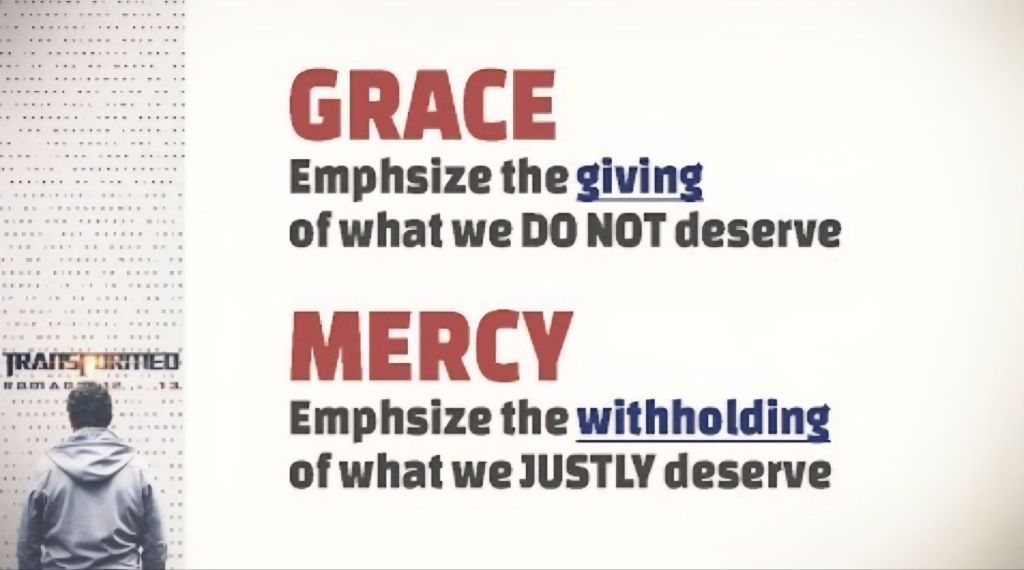
The concept of grace and mercy may sometimes be used interchangeably although strictly “mercy” in the Bible means being spared a punishment we deserve and “grace” means being given a blessing we don’t deserve. Thus salvation is a combination of both since we are supposed to be condemned because of sin but instead we are not only spared (mercy) because Jesus died for our sins, but are also bestowed with the abundant and overflowing blessings of God which we don’t deserve (grace). Mercy relieves misery or punishment and speaks of God’s compassion, while grace provides enablement or blessings and speaks of God’s favour. God is therefore both merciful and gracious to us for inviting us to be His children and be part of His Kingdom.

But the real principle behind God’s grace and mercy is that we must likewise be gracious and merciful when dealing with others. It’s however difficult to execute in real life as certain actions or omissions will result in consequences whether it is the law of the land or the rules of our employer or school (including colleges and universities). If we go through a hearing and are found guilty of wrongdoing, we will face consequence management and as any court or tribunal will allow mitigation, there will still be punishment. It is at this stage that mercy may be exercised. Instead of a harsh punishment, we may be subject to a lighter consequence. In the human context, however, grace is rarely dispensed as it is almost impossible to justify rewarding bad behaviour.

In our day to day living, on the other hand, the reality is we rarely get to exercise mercy unless we are a judge or magistrate or we sit on a tribunal. We don’t usually get involved in dispensing justice or mercy, except perhaps in dealing with our children’s behaviour or if we are a teacher in a classroom. However, it is certainly within our power to reward people who do not deserve our blessings. So we could exercise grace by blessing someone with a tip although he may not have done us any service, like a beggar on the street or a homeless person or a busker. Or even those who provide us with a service like for a RM7 Grab ride, we pay RM10 instead.

I’m always reminded by Jesus’s teaching in the Parable of the Ungrateful Servant. If we are shown mercy and grace after being forgiven of a significant debt (we escaped punishment for compounded interest and are blessed with an undeserved capital gain), we should likewise do the same for others.

Have a great week ahead, everyone! May we all experience our Heavenly Father’s abundant mercy and grace, and likewise exercise grace and mercy, as we live out our faith in dealing with issues of life!
I am your God and will uphold you with my righteous right hand

https://odb.org/2026/04/10/safe-in-his-hands

Isaiah 41:8–10 (NIV): 8 “But you, Israel, my servant, Jacob, whom I have chosen,
you descendants of Abraham my friend,
9 I took you from the ends of the earth,
from its farthest corners I called you.
I said, ‘You are my servant’;
I have chosen you and have not rejected you. 10 So do not fear, for I am with you;
do not be dismayed, for I am your God.
I will strengthen you and help you;
I will uphold you with my righteous right hand.

Sometimes in life it can feel like we’re falling further and further with no one to catch us. But when life seems chaotic and out of control, we can find comfort in knowing that God is with us. As believers, we know that God dwells in us through the Holy Spirit. We can speak to Him and be guided by Scripture.

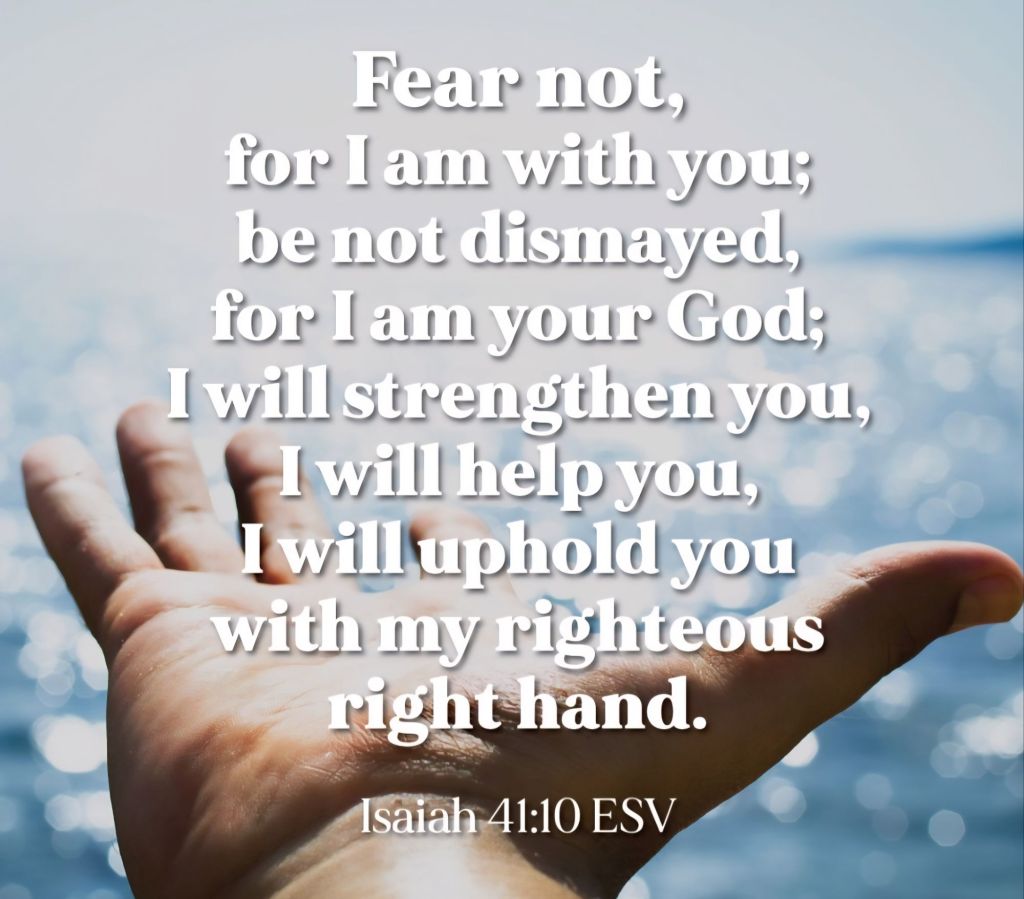
God wanted to assure the Israelites that He would “catch” them even in the midst of their “fall” of rebellion. He said through the prophet Isaiah, “Do not fear, for I am with you; do not be dismayed, for I am your God. I will strengthen you and help you; I will uphold you with my righteous right hand” (Isaiah 41:10). God wanted them to know He would help them through their trials (v. 13). How encouraging it must’ve been for the Israelites to know that God hadn’t abandoned them even while they were living as prisoners in a foreign land. (Nancy Gavilanes, Our Daily Bread 10th April 2026)

Israel as a nation in the Old Testament is usually seen as a picture of our spiritual life in this post-Jesus era of the church. That is why some will argue that modern-day Israel is not ancient Israel of the Bible. While that assertion may be valid, what happens to the contemporary state of Israel has a bearing on the coming to pass of the end-time prophesies in the book of Revelation. In other words, Israel in the context of Revelation is not the universal church of Christ. That is also why Christians in general watch with hawk eyes the events transpiring in Israel and the Middle East. The prophesy is that the risen Jesus Christ Himself will return to earth in His second coming at Mount Olives (the same place where He previously ascended to heaven after His crucifixion and resurrection) at the Eastern Gate in Jerusalem.

However, if we follow the assertion that ancient Israel is a picture of our spiritual life as a believer of Jesus Christ, then Isaiah 41 expounds an important spiritual principle. That is, while sin will run its consequences (in the context of ancient Israel, their rebellion against God), God’s love and compassion remain. In exile by the Assyrians, the LORD did not forget the Israelites although history will show that many did not return unlike in the case of the second exile by the Babylonians. The ten tribes of Northern Israel (the split kingdom with Judah at the south) were lost in the first exile (either died in captivity or assimilated into the Assyrians). The LORD God continually encouraged the exiled Israelites, promising their freedom and liberation in time to come.

The message this morning is that if we had sinned against God by disobeying His Word, we will suffer the consequences of our disobedience. But He still loves us like the father in the parable of the Prodigal Son taught by Christ. Our heavenly Father waits and longs for our return. If we repent of our sins and seek His forgiveness, He will surely forgive and accept us back into His family and the Kingdom of God. If we had fallen off this boat to eternity due to our insolence, we will have the chance to hop right back on if we repent of our sins.

Isaiah 41:10 (NIV) –  So do not fear, for I am with you; do not be dismayed, for I am your God. I will strengthen you and help you;
I will uphold you with my righteous right hand.

Be a Tabitha (Dorcas)

https://odb.org/2026/04/09/prompted-by-love

1 Thessalonians 1:2–7 (NIV): 2 We always thank God for all of you and continually mention you in our prayers. 3 We remember before our God and Father your work produced by faith, your labor prompted by love, and your endurance inspired by hope in our Lord Jesus Christ.
4 For we know, brothers and sisters loved by God, that he has chosen you, 5 because our gospel came to you not simply with words but also with power, with the Holy Spirit and deep conviction. You know how we lived among you for your sake. 6 You became imitators of us and of the Lord, for you welcomed the message in the midst of severe suffering with the joy given by the Holy Spirit. 7 And so you became a model to all the believers in Macedonia and Achaia.

Emily Kenward walked down Lavender Street in Brighton, England. Having recently become a believer in Jesus, she now saw the street differently. She noticed how many homes had their curtains drawn in the daytime, and how few older people were about, despite the area’s high elderly population. It spurred an idea.

Emily found out where Brighton’s elderly lived and invited them to an afternoon tea. Those who came told a similar story. Now living alone, they often went months without seeing anyone. What they longed for, they said, was a visitor.

Emily was so moved by what she heard at that afternoon tea that she started a charity linking Brighton’s elderly with volunteer visitors. She remembers one woman hugging her tightly, sobbing, grateful for finally feeling seen and heard. The work grew, inspiring others to do the same. It makes me wonder what labors prompted by love the Holy Spirit might inspire you and me to do today. (Sheridan Voysey, Our Daily Bread 9th April 2026)

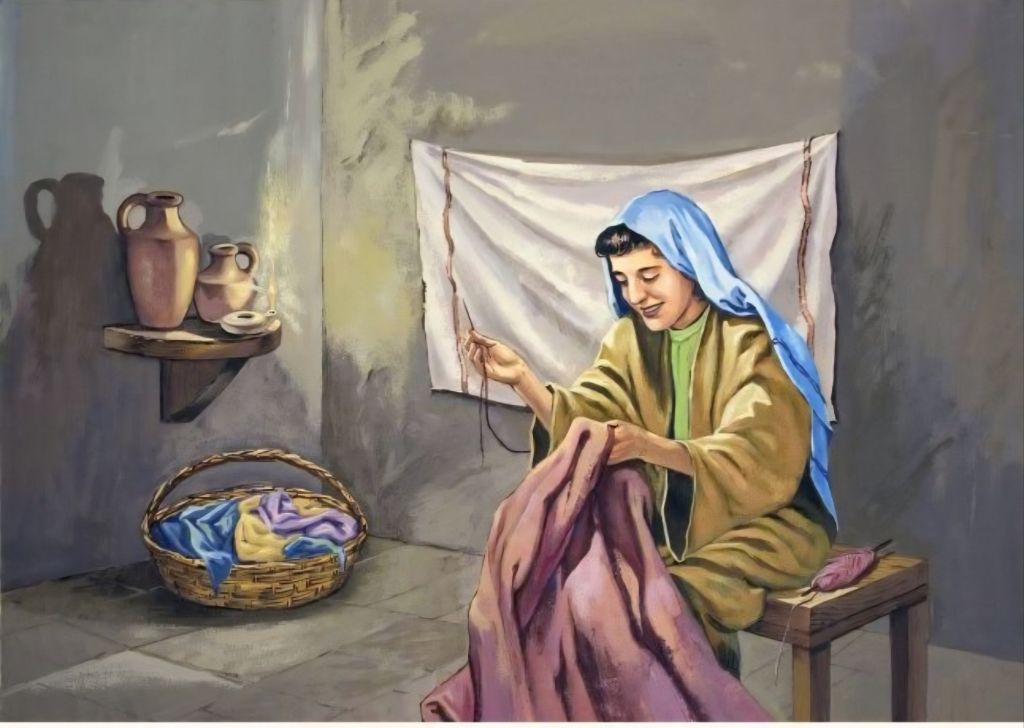
Acts 9 introduces us to a believer in Jesus who was prompted by love to serve others. “In Joppa there was a disciple named Tabitha [Dorcas] . . . ; she was always doing good and helping the poor” (v. 36). The Greek word at the root of the word translated “helping the poor” means to “have mercy” or “pity.” In Joppa (modern day Tel Aviv), there was a specific group of people who benefited from Tabitha’s “acts of charity” (v. 36 esv). We read how “all the widows stood around [Peter], crying and showing him the robes and other clothing that Dorcas (Tabitha’s Greek name) had made while she was still with them” (v. 39). (Arthur Jackson, Insight, Our Daily Bread 9th April 2026)

The examples of Emily Kenward, and Tabitha (Dorcas in Greek) in the bible point to women who looked at ministry for God as something beyond the church. Yes, we serve God primarily in church but our calling may extend beyond its corridors and beyond our congregation. There is a social element in ministry and reaching out may be more effective if we see ourselves as being a part of the community.

Specifically, there are vulnerable people within our communities. Older mothers who are widowed and whose children had moved to the big city for work or whose children have migrated overseas. If their spouses were still alive, they would still have company. Alas, nowadays women outlive men. Even if their children return during weekends, they are still alone the remaining days. We are not even talking about the single elderly who never married. Some had the privilege to live with their other single siblings but they may also outlive them.

I’m sure there are organisations that cater to visiting the seniors at their homes or at old folks homes. Or we could set up such a group within our own church and lead to reach out to these older people in the community. This could be our calling for this season of our lives. In my own local church, we have a group of golden age retired folks who meet every now and then for fellowship. Perhaps they could spearhead this initiative by visiting their friends around their age.

Is there a ministry that God is calling us to in order to fulfil a need in our society? Pray and seek the Lord. He may well lead us to another adventure with Him!

Nothing is impossible for God

https://odb.org/2026/04/08/an-unlikely-catch

Matthew 17:24–27 (NIV): 24 After Jesus and his disciples arrived in Capernaum, the collectors of the two-drachma temple tax came to Peter and asked, “Doesn’t your teacher pay the temple tax?”
25 “Yes, he does,” he replied.
When Peter came into the house, Jesus was the first to speak. “What do you think, Simon?” he asked. “From whom do the kings of the earth collect duty and taxes—from their own children or from others?”
26 “From others,” Peter answered.
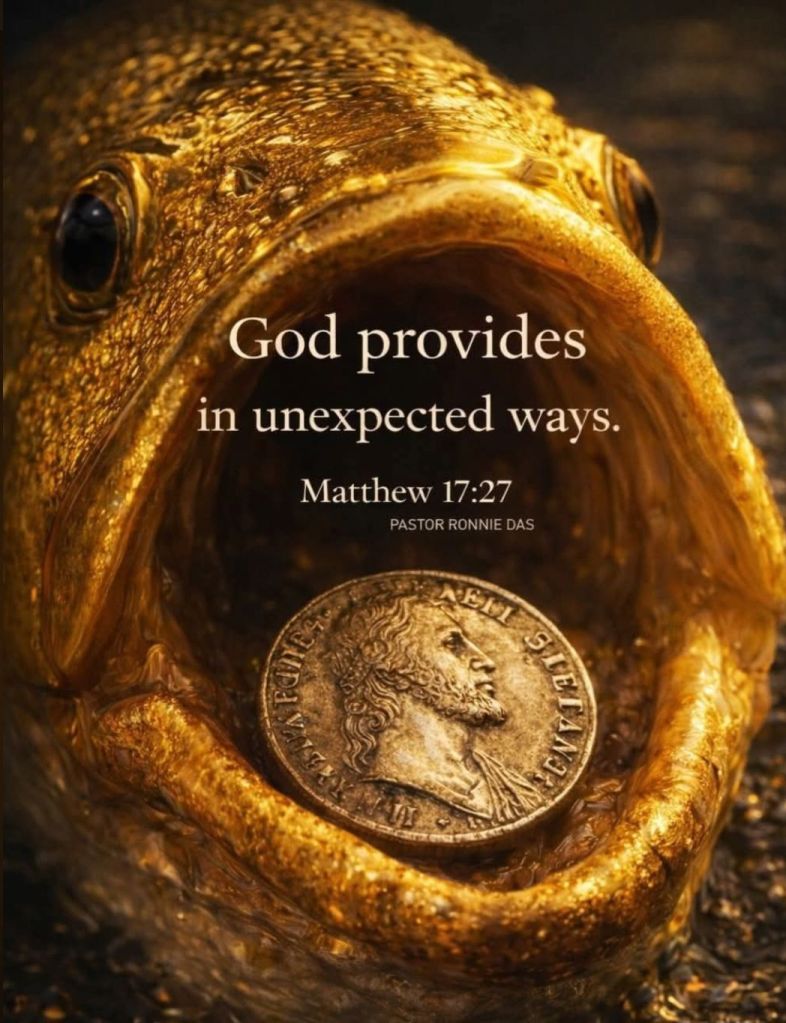
“Then the children are exempt,” Jesus said to him. 27 “But so that we may not cause offense, go to the lake and throw out your line. Take the first fish you catch; open its mouth and you will find a four-drachma coin. Take it and give it to them for my tax and yours.”

In 2024, teenager Keegan happily reeled in a two-foot barramundi. But his happiness became elation when his little sister pointed out a tag on the fish. His catch was worth one million dollars as part of an Australian fishing competition. The annual event had been held since 2015; Keegan was the first to win the coveted top cash prize. However slim the odds of catching that fish, the odds were far lower that a fish caught at random would have a coin in its mouth. But in Matthew’s gospel, Jesus instructed His disciple Peter to “go to the lake and . . . take the first fish you catch; open its mouth and you will find a four-drachma coin” (17:27). The context of this unlikely catch was a question of whether Jesus paid the temple tax (v. 24). The irony of insisting that Jesus—God’s Son—pay a tax to support God’s temple, wasn’t lost on Him. He pointed out that the king’s children don’t pay taxes to the king (vv. 25-26). (Monica La Rose, Our Daily Bread 8th April 2026)

I may have read about Matthew 17:27 before but honestly, I cannot recall knowing about this event of Jesus asking Peter to catch a fish at the lake and the first fish that he catches will have a four -drachma coin in its mouth. It is like a magic trick from the likes of David Copperfield and David Blaine fame, except that this is for real. It is not an illusion or trick. Either Jesus made the coin appear out of nothing or he made it such that Peter catches a fish that had somehow swallowed a coin for the exact denomination of 4 drachma! Both are impossible in the ordinary course of things.

The background to the event was that Jesus wanted to pay the Temple tax for Peter and Him although He had already stated that as the Son of God, He is exempt from paying any Temple tax to God, His Father. In terms of signs and wonders, Jesus needed to get two things right for Peter. One, for Peter to catch the first fish with a coin in its mouth, not the second or third fish. Secondly, the coin is a 4-drachma coin! Truly, it’s a needle in the haystack situation. As difficult as it is for a rich man to enter the kingdom of God – it is as difficult as a camel to enter the eye of a needle – while with man it is impossible, with God all things are possible!

The message this morning is that although there are things that appear to be impossible in the natural, it is still possible for God. It may be healing from cancer. Or a seemingly impossible trip to a far out place like Europe. Or reaching out to someone we love and care dearly – hearts may seemed closed but with God, nothing is impossible! Or a mission trip to China. Or a promotion or a better opportunity for growth. If the Lord calls us, He can make it come to pass. Just commit it to Him, work at it and we will one day see the 4-drachma coin in the mouth of a fish!

Be doers of the Word

https://odb.org/2026/04/07/doers-of-the-scriptures

James 1:22–25 (NIV): 22 Do not merely listen to the word, and so deceive yourselves. Do what it says. 23 Anyone who listens to the word but does not do what it says is like someone who looks at his face in a mirror 24 and, after looking at himself, goes away and immediately forgets what he looks like. 25 But whoever looks intently into the perfect law that gives freedom, and continues in it—not forgetting what they have heard, but doing it—they will be blessed in what they do.

James describes something similar in the attitude of many believers toward the Scriptures: “Anyone who listens to the word but does not do what it says is like someone who looks at his face in a mirror and . . . goes away and immediately forgets what he looks like” (James 1:23-24). Many followers of Christ are aware of what the Bible says. However, we may “merely listen to the word” (v. 22), and the extent to which we submit to it ends there. In this way, we deceive ourselves about the power and authority of Scripture, failing to see it as providing the “perfect law that gives [us] freedom” (v. 25). (Karen Huang, Our Daily Bread 7th April 2026)

An interesting fact is that the cross reference to James 1:22 is Matthew 7:21 which reads “Not everyone who says to me, ‘Lord, Lord,’ will enter the kingdom of heaven, but only the one who does the will of my Father who is in heaven. Thus, when James says that we ought to not just listen but do what the Word says, it means ultimately that we do the will of the Father. This is because the will of God is embedded in the Word.

Let’s take a simple piece of Scripture. For example, faith is believing in things unseen. It’s a spiritual fact. That’s the definition of faith. But how do we do it? How do we action that Word? Well, when we face situations that seemed difficult, we exercise faith. We believe God will help us through it. That’s one way. But a better way will be when it is something that originates from the Holy Spirit. The Holy Spirit prompts us to a certain action. For example, to give someone RM100. So we just give. That’s because we acted on faith is believing in things unseen. Can we physically hear the prompting of the Holy Spirit? No, but we believe in things unseen. In this whole process, we ended up doing the will of the Father.

Of course, the obvious “doing of the Word” is to obey the moral code in the Bible. From the Ten Commandments to the love your enemy as thyself to love your God the LORD with all your heart, soul and mind. But ultimately it always boils down to doing the will of the Father. That’s our aim and goal. In all things we do, we do the will of God as we always want to live at the center of His will. To be part of the things He is doing in our midst.

Another example – faith without works is dead. Effectively, we are to do good deeds as part of our faith as we work out our salvation with fear and trembling. Faith is not just belief. It is action. It’s not internalised only. It is acted out by the things we do for others. By our service in God, in the church or as we work. Our lives are not meant to be lived in isolation. It needs to be in fellowship with others around us, building up each other’s faith. Encouraging each other to run the race and fight the good fight.

Perhaps this morning, we could take a Scripture. Memorise it. Meditate upon it. Ask the Lord to speak to us. Ask the Holy Spirit to reveal God’s will for us for the moment. Discover and explore the rhema of the Word. Then do it! Action it! Make the Word come alive and see the power of God flow through it, transforming lives, making a difference.

Repent and He will forgive us our sins

https://odb.org/2026/04/06/not-my-fault

Exodus 32:19–24 (NIV): 19 When Moses approached the camp and saw the calf and the dancing, his anger burned and he threw the tablets out of his hands, breaking them to pieces at the foot of the mountain. 20 And he took the calf the people had made and burned it in the fire; then he ground it to powder, scattered it on the water and made the Israelites drink it.
21 He said to Aaron, “What did these people do to you, that you led them into such great sin?”
22 “Do not be angry, my lord,” Aaron answered. “You know how prone these people are to evil. 23 They said to me, ‘Make us gods who will go before us. As for this fellow Moses who brought us up out of Egypt, we don’t know what has happened to him.’ 24 So I told them, ‘Whoever has any gold jewelry, take it off.’ Then they gave me the gold, and I threw it into the fire, and out came this calf!”

“It’s not my fault!” So says Han Solo in The Empire Strikes Back when his ship is attacked and there seems to be no escape, only because a repair hadn’t been made. When he says it, you wonder if he bears at least some responsibility for his predicament but doesn’t want to admit it.

I’ve been there. Sometimes it’s easier to find someone (or something) else to blame rather than accept responsibility myself. Scripture shows us that this tendency is as old as sin. Adam and Eve both did it (Genesis 3:11-13), and so did Aaron. When Moses was with God on Mount Sinai receiving the Ten Commandments, God told him that the people He’d just released from slavery had turned away to worship an idol (Exodus 32:7-8). When Moses returned and confronted Aaron (whom he’d left in charge), Aaron responded, “You know how prone these people are to evil” (v. 22). Then he rationalized about the idol he himself cast, saying, “They gave me the gold, and I threw it into the fire, and out came this calf!” (v. 24). (James Banks, Our Daily Bread 6th April 2026)

I think we all have a tendency not to take blame for things that go wrong, even when we know we were at fault. When it comes to dealings with my spouse, it could well be something like I forgot to tighten the lid of the peanut butter. So we agreed that after every use, we just tighten it even in the midst of breakfast as the last person using it may forget to do so later.

At work, the unwillingness to take blame is understandable as there could be consequences. In the end, a less forgiving environment will lead to less risk-taking and slower decision-making (what we call analysis paralysis). For example, while it is acceptable to award a tender after two years in a traditional telco, it is disastrous if we were to do so in the digital business. We used to say – by the time we award, the solution is already superseded by newer ones.

In God, however, while sin always have consequences, God is loving and forgiving. If we sin, God will punish us but if we seek His forgiveness, He will forgive us. A good example was David’s adultery with Bathsheba. David lost a total of 4 sons as the consequence. But he repented and the LORD forgave him. In the end, it was his son with Bathsheba that continued David’s lineage and in the natural, Solomon’s reign was Israel’s most glorious although in the spiritual,  David’s remain Israel’s Golden Age!

While we may or may not escape the consequences of sin, repentance will lead to forgiveness. Forgiveness is essential to ensure that our eternal destination is preserved although we may suffer some consequences in the natural. Our names remain written in the Book of Life. Any suffering in the present is nothing compared to the glory that awaits us if we fight the good fight and complete the race victoriously. Persevere through and that includes repentance and seeking forgiveness from the Father. God loves us and have compassion for us as demonstrated by Jesus’s love and compassion for the people recorded in the Gospels.

Have a good week ahead, everyone! May the LORD God, Yahweh Elohim the Great I Am grant us wisdom and discernment as we walk in His abundant grace and mercy!

Blessed Good Friday!

https://odb.org/2026/04/03/why-good-friday

1 John 4:7–12 (NIV): 7 Dear friends, let us love one another, for love comes from God. Everyone who loves has been born of God and knows God. 8 Whoever does not love does not know God, because God is love. 9 This is how God showed his love among us: He sent his one and only Son into the world that we might live through him. 10 This is love: not that we loved God, but that he loved us and sent his Son as an atoning sacrifice for our sins. 11 Dear friends, since God so loved us, we also ought to love one another. 12 No one has ever seen God; but if we love one another, God lives in us and his love is made complete in us.

What’s so good about Good Friday? Why isn’t the day called Bad or Sad Friday? After all, it’s meant to be a day of sorrowful reflection, not a day of celebration. Sometimes, this day takes other names, such as Holy Friday. In Germany, it’s called Karfreitag, or Sorrowful Friday. So where did we get the tradition of calling it “Good”? Some believe it may have originated from the older tradition of calling it “God’s Friday.” No matter the origin of the name, it’s still appropriate to call the Friday on which Jesus died “good.” Out of Christ’s sacrificial love, He died for our sins. That’s why Good Friday is good. And the great news is that three days later He rose from the grave in victory. (Alyson Kieda, Our Daily Bread 3rd April 2026)

When we dwell into the history of Good Friday, we will find some interesting facts. Although the answers are not conclusive, they nevertheless point to some history and possible origins. It is the same with Easter Sunday and Christmas. There is some pagan backgrounds to those festivals, unlike the Jewish festivals. This is because the latter festivals were instituted by the LORD God Himself through His Word for the Jews. That is also why there are believers amongst us who refuse to celebrate these Christian festivals but instead choose to celebrate the Jewish ones instead. The major problem with us celebrating Jewish festivals is that we are not Jews and we do not practice Judaism. Jesus has already been sent to the world by God the Father so that humanity will not perish but have life everlasting. The New Covenant has superseded the Old Covenant. The veil at the Temple has been broken and torn into two.

In the end, we are believers of our Lord Jesus Christ. We are adopted children of God, grafted into the Kingdom of God. We are now the chosen generation, the Holy priesthood, the present-day Israel. We are His people and the Great I Am Jehovah Elohim the LORD God is now our God. The God of Abraham, Isaac and Jacob. Thus no matter their origins and from where our early church fathers adopted them, it is the meaning behind our festivals that really matters and for Good Friday, it is to commensurate Christ’s death on Calvary as it is through the cross that we have life eternal per John 3:16. He died for our sins as the Lamb of God. The ultimate sacrifice from the only One without sin who bore the sins of mankind once and for all.

Our Christian journey and our walk of faith in the Kingdom of God would not have been possible if Christ had not died on the cross. We would remain as heathens destined for damnation. Instead we are now poised for great exploits for His kingdom in this fallen world and one day we will live in the new heaven and new earth, the new Jerusalem. At the end of time, we will be at the place where God again dwells amongst His people, where the tree of life will be freely available to us to live for all eternity in a place without sickness, pain, tears, sorrow and death.

The true meaning of Good Friday is that we will only experience one death as we have had two births! That’s the Good News and thus the “Good” of Good Friday! One death only when the time comes but to eternal life! Have a blessed Good Friday, everyone!

Holy Communion

https://odb.org/2026/04/02/the-ladle

1 Corinthians 11:23–26 (NIV): 23 For I received from the Lord what I also passed on to you: The Lord Jesus, on the night he was betrayed, took bread, 24 and when he had given thanks, he broke it and said, “This is my body, which is for you; do this in remembrance of me.” 25 In the same way, after supper he took the cup, saying, “This cup is the new covenant in my blood; do this, whenever you drink it, in remembrance of me.” 26 For whenever you eat this bread and drink this cup, you proclaim the Lord’s death until he comes.

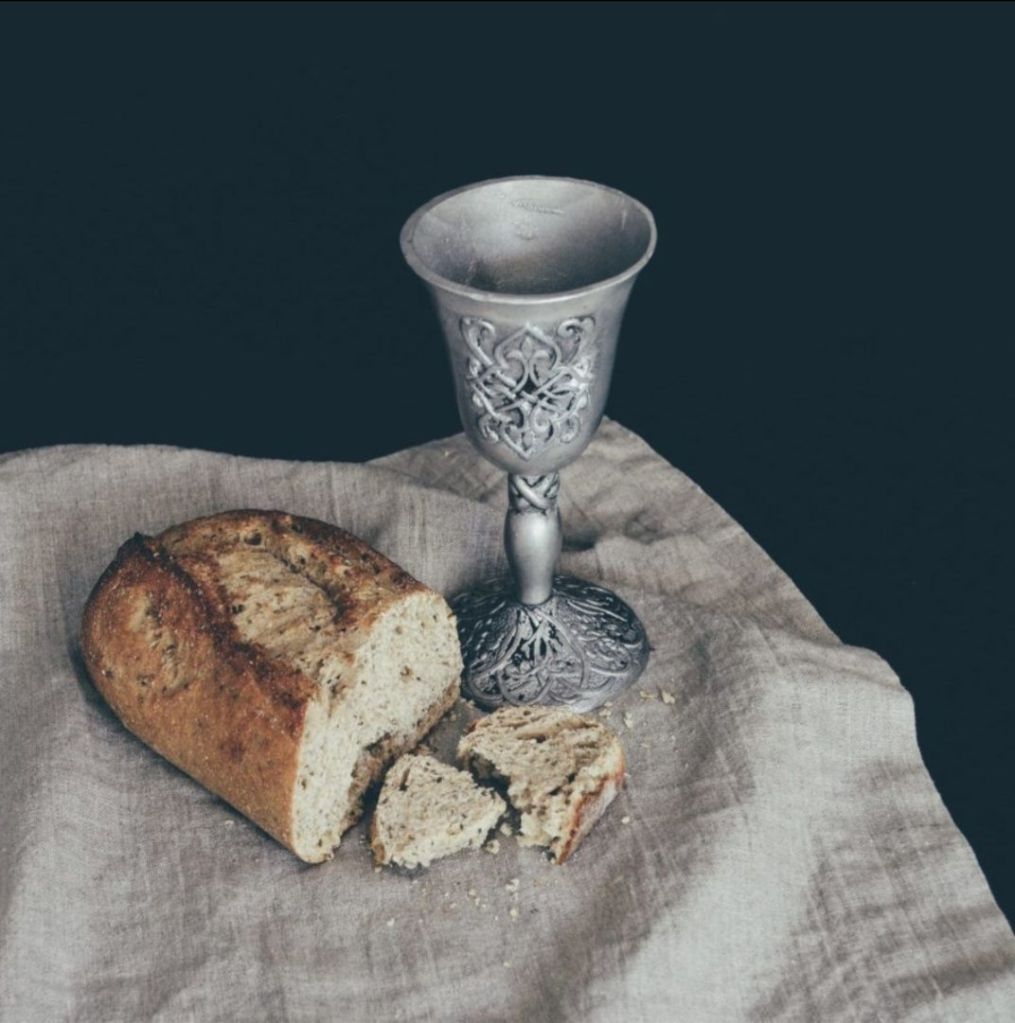
Jesus gave us a tangible gift in the celebration of Communion to help us remember His incomparable love for us (Luke 22:19). The apostle Paul reminded the Corinthians how Jesus broke bread, saying, “This is my body, which is for you; do this in remembrance of me” (1 Corinthians 11:24). Then Christ “took the cup, saying, ‘The cup is the new covenant in my blood; do this, whenever you drink it, in remembrance of me’ ” (v. 25). God’s lavish love is remembered again and again as we take the bread and lift the cup as believers in Christ. (Elisa Morgan, Our Daily Bread 2nd April 2026)

My local church, White Fields Assembly of Seremban, serves Holy Communion on the 1st and 3rd Sundays of every month. Other churches may do it once a month although there are smaller fellowships that practice taking the sacraments every time they gather together for worship. In fact, the early church in the book of Acts, when they meet daily in fellowship and prayer, as they share a meal, they break bread. The essence of the Holy Communion is thus really breaking bread and sharing a meal together. In fact when Jesus first broke bread, it was at the Passover meal just a few days before His crucifixion. Thus this is the Passion week celebrating the days before Christ’s death and resurrection and tomorrow being Good Friday and this Sunday Easter.

One thing we always need to remember when taking the sacraments is that we should examine ourselves and seek forgiveness for any sins we may have committed. We should be clean before God, washed by the blood of the Lamb. In the same way, we forgive others who have trespassed against us. It is this confession that is key to the Holy Communion although we should do this every day anyway.

Another aspect of the Holy Communion is that while it is not magical, we believe there is power in the act itself. His healing will flow through us as we partake the sacraments. That is why sometimes in home visits where we pray for the sick, we serve Holy Communion.

As we celebrate Easter this Sunday and if Holy Communion is served or at the next Communion service, let us partake of the sacraments with renewed intent. We remember Christ’s sacrifice on the Cross for our sins. We remember His victory over sin and death as commemorated by Easter Sunday. We confess our sins and seek forgiveness of Father God as we forgive those who have sinned against us. Come before the Lord, redeemed by the blood of the Lamb, unblemished and allow the power of God to renew and refresh our spirit, soul and body that we may be a living sacrifice and glowing testimony to His name!

Integrity as a believer

https://odb.org/2026/04/01/true-integrity

1 Peter 2:11–17 (NIV): 11 Dear friends, I urge you, as foreigners and exiles, to abstain from sinful desires, which wage war against your soul. 12 Live such good lives among the pagans that, though they accuse you of doing wrong, they may see your good deeds and glorify God on the day he visits us. 13 Submit yourselves for the Lord’s sake to every human authority: whether to the emperor, as the supreme authority, 14 or to governors, who are sent by him to punish those who do wrong and to commend those who do right. 15 For it is God’s will that by doing good you should silence the ignorant talk of foolish people. 16 Live as free people, but do not use your freedom as a cover-up for evil; live as God’s slaves. 17 Show proper respect to everyone, love the family of believers, fear God, honor the emperor.

At a job interview, Carol was asked repeatedly, “Why did you leave your previous job?” The interviewer had an inkling of the conflict she’d had with her former employer. While acknowledging “differences in working style,” Carol refused to divulge her opinion of her former boss, believing that it would be wrong to speak ill of him. Later, after she was hired, her new boss revealed that the hiring personnel liked her response: “We were impressed by your integrity. We wouldn’t want you to bad-mouth your boss—or us next time—either.” (Leslie Koh, Our Daily Bread 1st April 2026)

Peter encourages God’s “chosen people” (1 Peter 2:9) to live honourable and blameless lives, doing good works and living as Jesus lived in an unbelieving, hostile world so as to bring glory to God (vv. 9-21). Paul similarly urges believers in Christ to “live a life worthy of the Lord” (Colossians 1:10)—a faithful and fruitful life that honours and pleases Him (see Ephesians 4:1; Philippians 1:27; 1 Thessalonians 4:1). Believers are to live with integrity as “children of light” (Ephesians 5:8)—letting their “good deeds shine out for all to see, so that everyone will praise [our] heavenly Father” (Matthew 5:16 nlt). (K.T. Sim Insight, Our Daily Bread 1st April 2026)

As a seasoned employee in the corporate sector, I have both been interviewed and have interviewed. There are generally a few rules we adhere to for interviews. One is to dress properly and sit appropriately (in terms of posture) during the interview. The other is of course to be able to articulate well the things we wrote in our resume. So only write points that we genuinely know or had experienced. Further, always be prepared for forward-looking questions like how you see yourself in 5 years’ time and hypothetical problem-solving questions.

However, one of the things we should all be aware of is never be drawn into a discussion on how your current employer treats you. Instead, focus on your drive and ambition to learn more or gain greater exposure. It’s a big “no-no” to say negative things about your present employer. Lastly, but not the least, don’t ask about the remuneration package that is on the table at the first interview. Your expected salary is usually already known to your prospective employer. If they can’t afford you, they wouldn’t have called you.

It is interesting to note that Leslie Koh highlighted a candidate’s refusal at a job interview to speak about her possible conflict with her employer as part of our integrity in God. It was actually a smart move by the canditate but I think the integrity part goes beyond job interviews. I believe that, as believers in Christ, we should not, as a rule, speak bad about others in their absence. First, they are not there to defend themselves. Secondly, there could be a perspective for their seemingly “bad behaviour” that we may not be aware of.

Most importantly, how we speak of others will reflect on us as believers in Christ. We have a duty and responsibility to glorify His name, to live honourable and blameless lives. We should instead let our good deeds shine for all to see. I think it is a worst ever scenario if we are ever known as Christians who bad-mouth or gossip against others. Or we are Christians, yet we are vindictive and manipulative or we intentionally do certain things to hurt others. How are we then different from the world?

Beyond our natural eyes

https://odb.org/2026/03/31/gods-view

Exodus 14:10–14 (NIV): 10 As Pharaoh approached, the Israelites looked up, and there were the Egyptians, marching after them. They were terrified and cried out to the LORD. 11 They said to Moses, “Was it because there were no graves in Egypt that you brought us to the desert to die? What have you done to us by bringing us out of Egypt? 12 Didn’t we say to you in Egypt, ‘Leave us alone; let us serve the Egyptians’? It would have been better for us to serve the Egyptians than to die in the desert!”
13 Moses answered the people, “Do not be afraid. Stand firm and you will see the deliverance the LORD will bring you today. The Egyptians you see today you will never see again. 14 The LORD will fight for you; you need only to be still.”

Hudson Taylor was troubled. He’d left England to share the gospel in China, and ministry—though challenging—had gone well. In 1865, as he considered sending more people to a more dangerous part of China, without protection, he felt “intense conflict.” After wrestling with God in prayer, he wrote, “The Lord conquered my unbelief, and I surrendered myself to God . . . that all responsibility . . . and consequences must rest with him.”

Moses received a call from God that likely left him troubled. As he was leading the Israelites out of Egypt, God said to Moses, “Tell the Israelites to turn back and encamp near Pi Hahiroth, between Migdol and the sea” (Exodus 14:2). This meant they were trapped between Pharaoh and the sea! The Israelites trembled as “Pharaoh approached” (v. 10). But Moses replied, “Do not be afraid” (v. 13). (Tom Felten, Our Daily Bread 31st March 2026 Condensed)

Exodus 14:1-14 shows the tension between how things can appear to us and what God’s really doing. When the Israelites were fleeing from Pharaoh, God told them to turn back – boxed in between Pharaoh’s army and the sea (v. 2). But this was God’s plan to lure and defeat Pharaoh once and for all (v. 4). When Israel panicked (vv. 10–12), Moses reminded them that their rescue wasn’t dependent on their strength but on God’s (vv. 13-14). (Monica La Rose, Insight, Our Daily Bread 31st March 2026 Condensed)

When it comes to God’s work, sometimes what is apparent in the natural may not be so in the spiritual. It could just be blind faith but usually what God is doing extends far beyond what our minds may comprehend. For example, in church planting, a fellowship of just a family of four may be a catalyst to a full functioning church a few years down the road. That is why an important lesson for us in church leadership is not to manage only by human logic. We have to pray and ask God to show us what He is doing in our midst. Fruits must not only be measured by numbers as what’s more pertinent are transformed lives and the outpouring of the Holy Spirit.

The advantage of us as believers is we have an insight into the spiritual realm. Our spirit is born-again. We could pray for the supernatural to pierce through the natural world when the Holy Spirit moves in signs and wonders, and healing. Sometimes we need to pray that our unbelief and doubts be broken in the name of Jesus! That our eyes may be opened to see the marvellous work He is doing in our midst. Like how Elisha opened the eyes of his servant in 2 Kings 6:17-20.

For this morning, I just like to remind us of God’s plans and purposes for our lives. Trust in His calling and persevere on. Don’t give up or give in to our own ambitions or desires. Pray for Jesus to open up our eyes to the wondrous work He is and will be doing in our lives. Ask that we may see beyond our natural eyes or human logic.

Just a word of caution – whatever that lies ahead, let it be something genuine that God has placed in our hearts. Not something make believe or something we want to believe or just plain blind faith. If it is real, pursue it with all our heart, mind and strength!