
https://odb.org/2026/05/01/gods-perfect-specifications
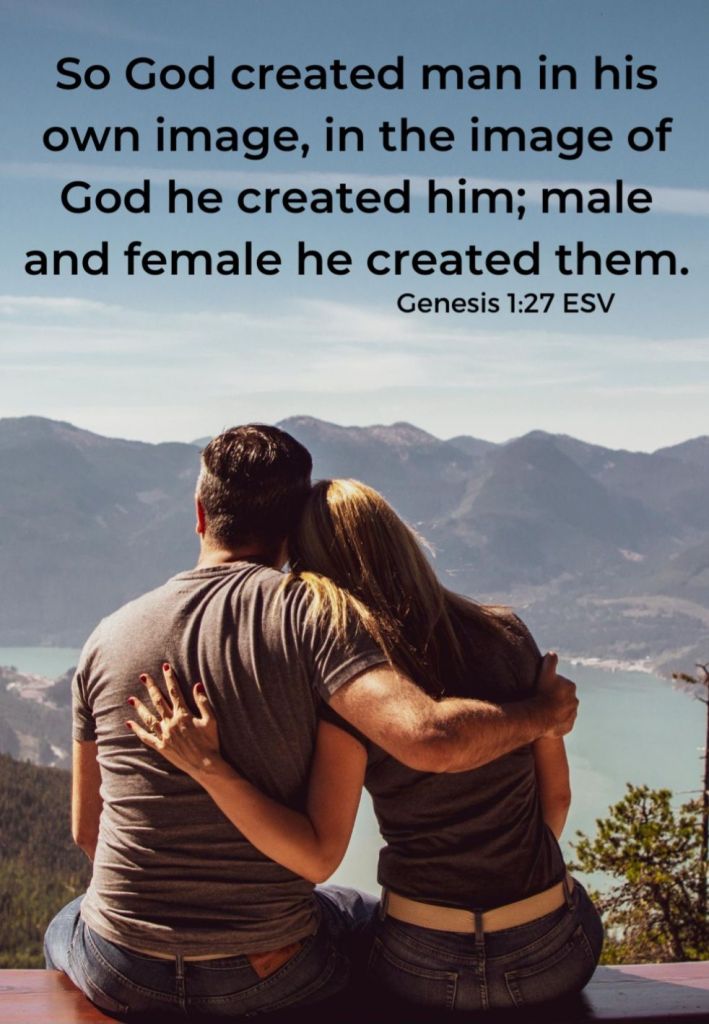
Genesis 1:26–31 (NIV): 26 Then God said, “Let us make mankind in our image, in our likeness, so that they may rule over the fish in the sea and the birds in the sky, over the livestock and all the wild animals, and over all the creatures that move along the ground.” 27 So God created mankind in his own image, in the image of God he created them; male and female he created them. 28 God blessed them and said to them, “Be fruitful and increase in number; fill the earth and subdue it. Rule over the fish in the sea and the birds in the sky and over every living creature that moves on the ground.” 29 Then God said, “I give you every seed-bearing plant on the face of the whole earth and every tree that has fruit with seed in it. They will be yours for food. 30 And to all the beasts of the earth and all the birds in the sky and all the creatures that move along the ground—everything that has the breath of life in it—I give every green plant for food.” And it was so. 31 God saw all that he had made, and it was very good. And there was evening, and there was morning—the sixth day.
Genesis 1:27 reminds us that each human being has been made to God’s perfect specifications: “God created mankind in his own image, in the image of God he created them; male and female he created them.” How we’re created reflects God’s character and nature. Being created in His image means everyone has inherent dignity and worth. God said that each person’s story begins with being made “in [His] image, in [His] likeness” (v. 26). This truth provides the foundation for understanding human dignity, identity, and relationships with others. (Marvin Williams, Our Daily Bread 1st May 2026)
Adam and Eve were created in God’s image (Genesis 1:27), but that image was distorted when they sinned (3:6, 16-19). Everyone now carries that distorted image of our Creator. But through our salvation and the process of sanctification, we’re being recreated in the image (or likeness) of Christ. Paul wrote, “Those God foreknew he also predestined to be conformed to the image of his Son, that he might be the firstborn among many brothers and sisters” (Romans 8:29). As believers in Jesus, we know that “he who began a good work in [us] will carry it on to completion until the day of Christ Jesus” (Philippians 1:6). As we wait for our complete transformation, we can be assured of our dignity and worth because we’ve been created in God’s image. (Bill Crowder, Insight, Our Daily Bread 1st May 2026)
It is interesting to note that when we read the story of creation in the Genesis, there are two accounts of it. The first is in Genesis 1:26 onwards which is part of the generic narrative on the creation of the world and the things in it including homo sapiens. The distinctiveness of humankind is that we were created in God’s image. As we compare ourselves to other creatures, we are different because we have soul and spirit. So as Solomon writes in Ecclesiastes 3:11 – He has set eternity in our hearts. We live on in the spirit even though we may die. In other words, our spirit lives for eternity. Only question is whether it is life everlasting or eternal damnation as in heaven or hell.
The creation story of mankind in Genesis 2 however is more specific and detailed in the sense there is the Garden of Eden and God Himself being in fellowship with Adam and Eve, as much as they are real persons, Adam means man and Eve means woman. Genesis 2 also describes the task and responsibility of man to cultivate and take care of the Garden of Eden and all the trees and plants in it. Adam named every animal God had created but God found that none was suitable to be a companion to Adam. Thus, woman or Eve was created from his rib bone and she became his perfect companion and helper. Woman is thus “the flesh of my flesh and the bone of my bones“. Genesis 2:23-24 is also the origin of the institution of marriage. It is also in Genesis 2 that the first law was enacted governing the relationship between man and God and that is that man may eat from any tree but not the tree of knowledge of good and evil as its fruit brings death to man. When we read on to Genesis 3, we see the origin of sin when the one and only law was broken by man through the deceit of Satan in the form of the serpent.
Besides the fact that we are created in the image of God and thus has eternity set in our hearts, Genesis 1 and 2 illustrates an important principle in our relationship with God. As much as the LORD is generic and global, He is also specific and detailed with us. He is as concerned with the events surrounding the Iran war as He is tuned to the proposal paper we are writing to our Board of Directors. The class we are conducting or the message we are preparing to deliver or the songs we will be singing this Sunday worship service, the LORD God has a keen interest. He also knows about the RM1,000 we have left after paying all our bills that is needed to last until our next paycheck. Or the things we need to do, as in my own case, to keep my glucose levels under control.
Life does not end when we die. Our life here on earth ends. We will be out of and away from the affairs of this world, but our spirit lives on. That, in my view, is the most significant element in God creating us in His image. So cling on hard to the salvation Jesus has given us by the grace of God. Don’t lose it. If we struggle to keep up, reach out in prayer to the LORD God our Heavenly Father, to Jesus Christ our Lord and Saviour and the Holy Spirit. Remember God has as much interest in the generic as well as the specifics, in the affairs of the world and in our daily life!
 Ronnie's Thoughts