The healing power of music

https://odb.org/2026/06/03/the-power-of-music-2

1 Samuel 16:14–23 (NIV): 14 Now the Spirit of the LORD had departed from Saul, and an evil spirit from the LORD tormented him. 15 Saul’s attendants said to him, “See, an evil spirit from God is tormenting you. 16 Let our lord command his servants here to search for someone who can play the lyre. He will play when the evil spirit from God comes on you, and you will feel better.”
17 So Saul said to his attendants, “Find someone who plays well and bring him to me.” 18 One of the servants answered, “I have seen a son of Jesse of Bethlehem who knows how to play the lyre. He is a brave man and a warrior. He speaks well and is a fine-looking man. And the LORD is with him.” 19 Then Saul sent messengers to Jesse and said, “Send me your son David, who is with the sheep.” 20 So Jesse took a donkey loaded with bread, a skin of wine and a young goat and sent them with his son David to Saul. 21 David came to Saul and entered his service. Saul liked him very much, and David became one of his armor-bearers. 22 Then Saul sent word to Jesse, saying, “Allow David to remain in my service, for I am pleased with him.”
23 Whenever the spirit from God came on Saul, David would take up his lyre and play. Then relief would come to Saul; he would feel better, and the evil spirit would leave him.

The Bible presents music as one of God’s immense gifts, a way His healing and comfort enter the human heart. In the tragic story of King Saul, we hear how (due to his disobedience) he was oppressed by an “evil spirit” (1 Samuel 16:14). And what did Saul’s attendants believe the king needed to provide relief? Music. So they found young David with his harp: “David would take up his lyre and play. Then relief would come to Saul; he would feel better, and the evil spirit would leave him” (v. 23). Music offers more than mere entertainment. It can bring joy, renew hope, and comfort weary souls. It’s truly one of God’s powerful gifts. (Winn Collier, Our Daily Bread 3rd June 2026)

Music has always been an integral part of my life. When I was growing up, my late mum loved to sing and we in turn as her children sang along with her. So we used to have song books with the latest songs. In fact, we had a song book of oldies and an encyclopedia of contemporary songs. Both had guitar chords written on them although at that point in time, I didn’t know how to play the guitar. My mum also loved to write out songs in her own personalised song books and sing from them. In fact, I still have these cursive handwritten song books in my old home. They must be more than 50 years old now!

In the home, my dad had a collection of vinyls of mostly country music – the likes of Jim Reeves and Hank Williams. He also liked a musical group called the Shadows. When the Saturday Night fever swept town in 1977, we had the Bee Gees blasting through our car stereo in all our long drives!

It was only in the mid-80s when God entered our lives that our song books at home took the form of church song books. We had a pile of them lying about as our home was also a house fellowship. It was a small outreach from a larger church in the capital Kota Bharu.

Later I learned how to play the guitar and started playing music at my home church. That was around 1985. It was amazing that when I first joined this church, the congregation sang in a cappella with only tambourines as accompanying instruments. It goes to show that the heart and voice are more important than musical instruments when it comes to worship. I always believed that we may worship God with any song, so long as the song is uplifting and praises Him. As much as music and skillful musicians are good to have, our hearts and voices are more essential. As a worship leader, nothing is more encouraging than to hear the congregation singing louder than the band!

Music does soothe the soul as the experience of King Saul and David in the Bible shows. 1 Samuel 16 forms a good illustration. As believers, worshipping God in spirit and truth with music will bring us peace and joy that surpasses all understanding. In this fast moving chaotic world, it is good to be able to lie prostrate before the Lord in worship and song.

We don’t have to be good singers to worship God in song. My late mum who loved to sing and worship God was a little tone-deaf and was bad at following rhythm but she sang and worshipped anyways! I’m a self-taught guitarist and can’t sight read but have served God in music for more than 40 years now! As Winn Collier wrote today, music is one of the powerful gifts of God – use it for His glory and to bring comfort to our souls!

P/S

Google AI – Music is a universal language that fundamentally alters brain chemistry. It triggers the release of dopamine to boost mood, oxytocin for social bonding, and endorphins for natural pain relief. It transcends words, evokes profound memories, and provides proven therapeutic benefits for mental and physical well-being.


Honesty and integrity in God

https://odb.org/2026/05/26/acting-with-integrity

Proverbs 12:13–23 (NIV): 13 Evildoers are trapped by their sinful talk, and so the innocent escape trouble.
      14 From the fruit of their lips people are filled with good things,  and the work of their hands brings them reward.
      15 The way of fools seems right to them, but the wise listen to advice.
      16 Fools show their annoyance at once, but the prudent overlook an insult.
      17 An honest witness tells the truth, but a false witness tells lies.
      18 The words of the reckless pierce like swords, but the tongue of the wise brings healing.
      19 Truthful lips endure forever, but a lying tongue lasts only a moment.
      20 Deceit is in the hearts of those who plot evil, but those who promote peace have joy.
      21 No harm overtakes the righteous, but the wicked have their fill of trouble.
      22 The LORD detests lying lips, but he delights in people who are trustworthy.
      23 The prudent keep their knowledge to themselves, but a fool’s heart blurts out folly.

In a moment of distraction, Sarah unknowingly dropped her diamond engagement ring into a homeless man’s cup. Billy Ray, the panhandler who was given the ring, had it appraised and considered selling it. But he chose honesty and returned it to Sarah when she came back a few days later. When we practice integrity, we please God and inspire others. Solomon says God delighted in his integrity: “The Lord detests lying lips, but He delights in people who are trustworthy” (Proverbs 12:22). He uses strong language to describe God’s view of dishonesty—He detests it. When God’s people lie or “deceit is in [their] hearts” (v. 20), it defies Him and goes against His character. In contrast, when His people have “truthful lips” (v. 19) and deal faithfully, it brings Him joy. So treating others well is more than just telling the truth—it reflects God’s own character. And in a world where deception can seem profitable, our integrity is something He “delights in” (v. 22). (Marvin Williams, Our Daily Bread 26th May 2026)

Likewise, Jesus said that a person’s speech will show what’s in one’s heart (Luke 6:45). God desires for us to honor Him with our lives. Believers in Christ want to be able to say, “We have conducted ourselves in the world, and especially in our relations with [fellow believers], with integrity and godly sincerity. We have done so, relying not on worldly wisdom but on God’s grace” (2 Corinthians 1:12). The Spirit can help us live with integrity. Even if the world doesn’t notice, God will. (K.T Sim, Insight, Our Daily Bread 26th May 2026)

A key characteristic of integrity is no one may see but God sees. When no one is watching, who are we like? The temptation to be dishonest is overwhelming when we are in the shadows and unseen. Often politicians and public officials get away with corruption. You are clean until you are caught seems to be their modus operandi. In most jurisdictions, once caught, your political life is over. But in some places, people still yield considerable influence from behind bars because of legacy but more likely because of the funding they control. Cash is king, as some have coined.

As a believer, it is sometimes difficult to be honest because of worldly influence. The bright lights of earthly wealth and the trappings it brings. The nice cars, the beautiful abodes, the fancy clothes and material things, the travel, the list goes on. Recently, Telekom Malaysia reported a US$20 million elaborate and complex fraud involving a cluster of senior employees based in the US. It is now a full criminal investigation by the DOJ and it seems that the evidence is overwhelming. Unfortunately, like most fraud cases, the reported amount may well be just the tip of the iceberg!

Integrity comes when we are presented with an opportunity to be dishonest and we decline to cheat. Even the lure of underpaying for something may be difficult to resist, what more if millions are involved. We can only say we are honest if we are tested and walked away. If not, it is just mere words, with no meaning whatsoever.

For us, if we succeed in walking away, or to turn the other way, we know God sees and He is delighted. That should be our sole and only motivation to be honest and to keep our integrity. Not in the hope of getting a reward or blessings from heaven for giving up on the gain had we been dishonest. It is knowing we have pleased God in the process and thus we are spiritually matured and better equipped to serve Him. I think this is a crucial element to look out for when we are honest. Of course if we look at Joseph’s life, it speaks of integrity being rewarded. But that should not be our motivation. Proverbs 12:22 – The LORD detests lying lips, but he delights in people who are trustworthy. Surely as children of God, we don’t want God to detest us! May our words always be truthful with no ill-intention or evil, and may our actions be full of integrity and honesty for the sake of our Lord Jesus Christ!

The beauty and blessings of sleep

https://odb.org/2026/05/25/finding-rest-4

2 Samuel 15:23–27 (NIV): 23 The whole countryside wept aloud as all the people passed by. The king also crossed the Kidron Valley, and all the people moved on toward the wilderness. 24 Zadok was there, too, and all the Levites who were with him were carrying the ark of the covenant of God. They set down the ark of God, and Abiathar offered sacrifices until all the people had finished leaving the city. 25 Then the king said to Zadok, “Take the ark of God back into the city. If I find favor in the LORD’s eyes, he will bring me back and let me see it and his dwelling place again. 26 But if he says, ‘I am not pleased with you,’ then I am ready; let him do to me whatever seems good to him.” 27 The king also said to Zadok the priest, “Do you understand? Go back to the city with my blessing. Take your son Ahimaaz with you, and also Abiathar’s son Jonathan. You and Abiathar return with your two sons.

“Tactical napping” is a series of guidelines for soldiers for effective, ten to thirty minutes of sleep. While experiencing a rush of adrenaline, loneliness, or anxiety, sleep-deprived soldiers may not be able to relax. Tips include using earplugs and reading before bed.

It’s when we most need rest that it’s often difficult to find. King David experienced this after fleeing into the wilderness to escape his son Absalom’s treason.  It was around this time that David cried out, “Lord, how many are my foes!” (Psalm 3:1). Perhaps thinking about past troubled nights, however, David continued, “I lie down and sleep; I wake again, because the Lord sustains me. I will not fear” (vv. 5-6). David realized that God, not Absalom, was in charge of his situation. David even sent the ark of the covenant back to Jerusalem, acknowledging that the future was fully in God’s hands (2 Samuel 15:25-26). (Karen Pimpo, Our Daily Bread Condensed 25th May 2026)

Being able to sleep is one of the few blessings we have as a human being. This is because sleep gives us rest and rejuvenates our body. However, I believe many have difficulty sleeping and getting proper rest. We are exhausted from the day’s work and yet as we retire to bed, we struggle to sleep and when we wake, we still feel tired and exhausted! Alas, not everyone wakes up refreshed and properly rested. That is why it’s a blessing! Those of us who have trouble sleeping may end up catching just maybe an hour or two of sleep although we may have been lying in our bed for 5 to 6 hours!

It could be a personal characteristic but usually trouble with sleeping comes from either lack of physical activities (like lying on the sofa almost the whole day) or anxiety and worry. For the former, pursuing an active lifestyle will tire us out so that when it’s time for bed, we are ready to just crash and get our well-deserved rest and sleep! I realise that swimming is one of the best sport to pursue as it works out most of our body muscles. I always find that I get hungry and sleep very well after a swim. Leading a sedentary inactive lifestyle may not only result in difficulty in sleeping but may also lead to health issues like insulin resistance and diabetes.

For the latter reason of anxiety and worry, our best remedy is always to trust God to be with and for us. We do our best but let the Lord do the rest. Trust in Romans 8:28 NIV – “And we know that in all things God works for the good of those who love him, who have been called according to his purpose.” David was in great distress when he fled, with his followers, from his own son, Absalom. He even brought the Ark of the Covenant with him. But in the end, he sent the Ark back to Jerusalem believing that God is in control of the situation and not Absalom. If God wanted him to be King, He will restore him to his rightful place despite what Absalom was doing. There is just so much we can do as a human being, it’s best we leave the rest to the LORD and His wisdom and grace. Let’s pray and commit to God an outcome that is in His will and fulfils His plans and purposes for our lives.

Pursue an active lifestyle and trust in God. I believe that’s the remedy that will work for 99% of us. If the issue still persists, perhaps it’s time to seek professional help. There could be an underlying health issue.

Bringing life to desolate places

https://odb.org/2026/05/22/smiley-face

Isaiah 41:17–20 (NIV): 17 “The poor and needy search for water, but there is none; their tongues are parched with thirst. But I the LORD will answer them; I, the God of Israel, will not forsake them.
      18 I will make rivers flow on barren heights, and springs within the valleys. I will turn the desert into pools of water, and the parched ground into springs.
      19 I will put in the desert the cedar and the acacia, the myrtle and the olive. I will set junipers in the wasteland, the fir and the cypress together,
      20 so that people may see and know, may consider and understand, that the hand of the LORD has done this, that the Holy One of Israel has created it.

Those who drive along Highway 18 in western Oregon each fall are greeted with a delightful surprise from the tree-covered hillside flanking the road: a giant smiley face. The cheerful face is only visible in the autumn when the Larch tree needles turn yellow, contrasting with the surrounding, dark green Douglas fir trees (which create the eyes and mouth). A lumber company planted the three-hundred-foot-diameter face in 2011 as part of an effort to replenish the timber they’d harvested.

Isaiah invites us to know God as the one who brings life to desolate places. He reminded the Israelites during the barrenness of their captivity that God “[makes] rivers flow,” can “turn the desert into pools of water,” and grow “the cedar and the acacia” in the desert (Isaiah 41:18-19). (Kristen Holmberg, Our Daily Bread 22nd May 2026)

It’s an important spiritual principle to remember and apply that God brings life to desolate places. Sometimes we feel our spiritual life is dry and empty. That we are fruitless. We feel we may have lost that joy in the Lord, that spark in God. Not that we have wavered from the narrow path. We are still serving God faithfully. We are stll actively involved in ministry. It’s just that our spiritual life has become boring and predictable and we feel at times that we are now doing things because of the expectations of others. More duty than love for God or compassion for the body of Christ or for the lost souls.

How do we overcome this dryness in our spiritual life? Not by creating excitement of our own, through our own efforts. But rather looking to Him in prayer as He is the God who brings life to desolate places. He is the God that gives breath to the bones at the valley of dry bones (see Ezekial 37).

Invest time in prayer. Pray for others, pray for the needs we can see within our sphere of influence. People close to us, our loved ones and family, our cell group members, our congregation, our friends. As we pray with compassion and love, I believe Jesus will re-light the fire within us, to burn strong again with joy and vigour.

Also spend time reading His Word. Perhaps in the weekend, spend time researching certain topics that interest us. Dwell deeper into the Word. Maybe we want to focus on Isaiah or Daniel or Hosea. Read the history and the context. Or maybe we want to explore the first exile of the Israelites by the Assyrians that resulted in the lost ten tribes of the Northern Kingdom of Israel? Or we want to know more about Haggai and Zechariah and how the Persian King Darius helped the return of those in Judah after the Babylonian exile? As we learn more, we gain a deeper knowledge and understanding of God and in the process we will reignite the spark in our spiritual life. Always remember that it is the LORD who brings life to desolate places!

Have a good break at the weekend, everyone!

Longing for home

https://odb.org/2026/05/21/longing-for-home-4

Psalm 137:1–6 (NIV): 1 By the rivers of Babylon we sat and wept when we remembered Zion. 2 There on the poplars we hung our harps, 3 for there our captors asked us for songs, our tormentors demanded songs of joy; they said, “Sing us one of the songs of Zion!” 4 How can we sing the songs of the LORD while in a foreign land? 5 If I forget you, Jerusalem, may my right hand forget its skill. 6 May my tongue cling to the roof of my mouth if I do not remember you, if I do not consider Jerusalem my highest joy.

Ethel and Ed live in the high desert area of the Rocky Mountains. As our family visited them on their ranch filled with memorabilia, the conversation turned to childhood stories of riding horses on the grasslands of North Dakota and herding cattle in Montana. They’re on in years now, and I could hear in their voices a longing for home.

Psalm 137 captures a similar emotion. The Israelites had been forced into captivity and longed for home. “By the rivers of Babylon we sat and wept,” they said. “There our captors asked us for songs” (vv. 1, 3), prompting the Israelites to ask, “How can we sing the songs of the Lord while in a foreign land?” (v. 4). The longing to return from exile is a common theme throughout the Old Testament prophets. Eventually the Israelites did return. They rebuilt Jerusalem and resettled in the land, but it was never the same. When the temple was rebuilt, those who remembered its former glory wept because it was a shadow of the first (Ezra 3:12). (Matt Lucas, Our Daily Bread 21st May 2026)

I joined Astro in 2000 on a transfer from Usaha Tegas. I was attached to a department in Legal called International & Special Projects, which focussed mainly on cross border joint ventures as that was the major shareholder’s idea of having a cross Asia broadcast service. That is why although Malaysia has its own geo-orbit spot for its commercial satellites, MEASAT’s footprint covers a large chunk of Asia.

In my early years in Astro, I spent a lot of time in India, finalising joint ventures. As it was a 5-hour plus flight, we usually spend the whole week there and sometimes with a spillover to the next. Thus, I understand very well what it means to miss home. In those years, my elder son was still very young, he was a year 2000 baby and in 2003, we had our second son.

The stark difference however was that the Israelites in exile did not have the privilege to fly home after a week or two abroad. They were stuck in Babylon indefinitely as slaves taken into captivity after the Babylonians had overrun Israel (specifically, the northern kingdom of Judah). Historically, they eventually returned to Jerusalem after Persia invaded Babylon but spent a good 50 to 70 years in exile. For those who do not know, ancient Babylon and Persia are modern-day Iraq and Iran.

As we grow older, I guess some of us long for our younger days. Life in the 60s or 70s were simpler and I believe people were more inclusive, compared to the divisive polarising politics of today that is always playing to the gallery on racial issues. The pace then was slower. But of course we don’t want to relive the horrors of WW2 and the atrocities of the Japanese. For me, my days growing up in Sitiawan, Perak and later in Pasir Puteh, Kelantan are remembered as those easygoing formative years. For the latter, I always cherish the cooler weather and watching flood waters during the year-end monsoon season. 

Alas, we can’t move back time. Our bodies age and time waits for no man. Soon the cycle of life will repeat itself and it will be our time to say our final goodbyes. Modern medical advancements have extended our life spans but there is still just so much left of our remaining years.

Fortunately, for us believers of Jesus Christ, we know our destiny and destination. Our real home awaits us, like the Jews remembering Jerusalem by the rivers of Babylon. Some of us may already long for our eternal home, while others are still busy serving God in the church or working hard to carve out our piece of this world for the future of our families and loved ones. Whatever stage we are in life, the LORD wants us to know that we have a home in the new heaven and new earth. It is the mansion with many rooms that our Lord Jesus Christ has gone ahead to prepare a room with our name written on it. Our longing for home will be met one day. In the meantime, serve Him with all our heart, soul and mind!

Glimpses of the glory of God

https://odb.org/2026/05/20/the-fountain-of-joy

1 Corinthians 13:8–13 (NIV): 8 Love never fails. But where there are prophecies, they will cease; where there are tongues, they will be stilled; where there is knowledge, it will pass away. 9 For we know in part and we prophesy in part, 10 but when completeness comes, what is in part disappears. 11 When I was a child, I talked like a child, I thought like a child, I reasoned like a child. When I became a man, I put the ways of childhood behind me. 12 For now we see only a reflection as in a mirror; then we shall see face to face. Now I know in part; then I shall know fully, even as I am fully known.
13 And now these three remain: faith, hope and love. But the greatest of these is love.

Do you ever long for something you see glimpses of but can’t quite grasp? C. S. Lewis longed for joy. He wrote, “Our longing to be reunited with something in the universe from which we now feel cut off, to be on the inside of some door which we have always seen from the outside, is . . . the truest index of our real situation. And to be at last summoned inside would be . . . the healing of that old ache. . . . The whole man is to drink joy from the fountain of joy.” Lewis writes of the joy we’ll experience in full when we see Jesus face-to-face. As believers in Jesus, we have the joy of Christ through our relationship with Him and the work of His Spirit inside us. But sadly our joy is hampered by sin and death, the forces of evil, and the world’s brokenness. (Alyson Kieda, Our Daily Bread 19th May 2026)

Because of the brokenness brought by sin to the world, the world has become imperfect. In fact, things are breaking down, for example, with the depleting ozone layer, we will experience global warming and havoc in weather patterns locally and across the globe. Nature is set in a certain sequence and pattern as a creation of God. If it is altered, there could be severe consequences to our way of life.

Even as human beings progress over time, we encounter issues that are alien to our forefathers. We move much faster nowadays, flying from one end of the world to another. As a result, we experience jet lag. Basically due to our body biologically adapting to different timezones. Not an issue faced by people of old as they travel by ship for days and months to transverse large distances.

The bends or decompression sickness came about because divers use specialised equipment to dive deeper into the ocean and if they surfaced too quickly, the mixture of the gasses used will result in air bubbles being trapped in their blood stream, causing problems that may lead to death. The recent deaths of a group of Italian divers exploring underwater caves in the Maldives at 55m is a case in point. They went so deep in such a dangerous environment (caves) but without specialised equipment (for example, it is believed they only had one “deco bottle” with them). The real tragedy is that one Maldivian navy diver died while searching for their bodies. In the end, they brought in specialised Finnish divers to successfully find and recover the bodies. However, if anyone dives into deeper waters using just the air we breathe at the surface, the bends will not occur even if we were to surface immediately.

Yet in the midst of all these human advancements and perils that come with them, we get a glimpse or glimpses of what it will be at the end of times. In coping with the challenges of modern life, God in His grace sometimes intervenes and helps us out. Besides lessening the impact of bad decisions we made (as mentioned in one of my writings), Jesus sometimes lead us to avoid certain perils that plague modern living. For example, on Monday, I traveled later into the city center by LRT for a meeting because we had to run an errand. If I had taken the train any earlier, I would have been caught out by the chaos at rush hour that morning – one train broke down at the Kelana Jaya station blocking the tracks.

As a believer living in 2026, we experience things not even seen by people living in the 14th century or during the time of the Acts of the Apostles. Human nature or challenges (like envy, disunity, greed, false teachers etc) may be similar throughout the ages, but the reality what we actually face day to day have changed dramatically over the centuries. Yet the God we worship is the same yesterday, today and forevermore! We get glimpses of His glory but we constantly experience His grace and mercy, and the wisdom and discernment of the Holy Spirit. One day, the perfect world where there will no longer be evil, tears and death will come as revealed and promised to us in Revelation 21. Don’t ever give up on that hope of glory even as we face the struggles of modern living day by day! Perfection will come one day to replace the brokenness in the world!

Attitude at work as a believer

https://odb.org/2026/05/19/fully-dedicated

Genesis 39:2–6 (NIV): 2 The LORD was with Joseph so that he prospered, and he lived in the house of his Egyptian master. 3 When his master saw that the LORD was with him and that the LORD gave him success in everything he did, 4 Joseph found favor in his eyes and became his attendant. Potiphar put him in charge of his household, and he entrusted to his care everything he owned. 5 From the time he put him in charge of his household and of all that he owned, the LORD blessed the household of the Egyptian because of Joseph. The blessing of the LORD was on everything Potiphar had, both in the house and in the field. 6 So Potiphar left everything he had in Joseph’s care; with Joseph in charge, he did not concern himself with anything except the food he ate.

Genesis 39:20–23 (NIV): 20 Joseph’s master took him and put him in prison, the place where the king’s prisoners were confined.
But while Joseph was there in the prison, 21 the LORD was with him; he showed him kindness and granted him favor in the eyes of the prison warden. 22 So the warden put Joseph in charge of all those held in the prison, and he was made responsible for all that was done there. 23 The warden paid no attention to anything under Joseph’s care, because the LORD was with Joseph and gave him success in whatever he did.

Like all Singaporean men, I had to serve in the country’s armed forces when I turned eighteen. To be honest, I approached the conscription, which lasted two-and-a-half years, most reluctantly. Like many other young men, I tried to do the minimum, obeying instructions to the letter—no more, no less. Some, however, threw themselves into their tasks and ultimately gained much from their experience, learning about leadership and endurance.

Despite being sold off as a slave and imprisoned later on, Joseph fulfilled all his assigned responsibilities with the greatest dedication. Instead of resenting his situation, he took his role seriously, so much so that “Potiphar left everything he had in Joseph’s care” (Genesis 39:6). Joseph also ended up in charge of the prison—and, finally, all of Egypt. Centuries later, the apostle Paul would also urge believers in Jesus: “Whatever you do, whether in word or deed, do it all in the name of the Lord Jesus” (Colossians 3:17). (Leslie Koh, Our Daily Bread Condensed, 18th March 2026)

One of the things I always emphasised to younger generations whether Gen Z or the Millenials is to work hard while young, especially if we are starting out. The world is indeed your oyster and slacking at this stage will be your greatest regret later on in life. This is because you may not have the same opportunities when you’re older and the world will not be as kind and forgiving to you, for example, when you’re already in management in your late 30s or early 40s. Yes, be on the lookout for fresh openings or more attractive packages elsewhere, but don’t be calculative over your contributions at the work place. Because at the end of the day, it is you who will benefit the most if you work 12 hours a day instead of the minimum 8. Many do not realise that at the other side, employers often lament losing talent after training them and giving them exposure.

Leslie’s experience in the Singapore National Service reveals a tinge of regret. Instead of embracing his “predicament”, he resented his time at conscription and worked to rule when he should have thrown himself at the tasks in hand. If he had done the latter, he would have gained much more from his time at conscription.

One of the best examples in the Bible of giving your best despite your predicament is Joseph. He was betrayed by his brothers and sold to slave traders. But he quickly rose to be the chief slave at Potiphar’s household. Joseph had full responsibility for everything Potiphar owned although he himself was a chattel to his master in the eyes of the law. As we all know, Joseph subsequently rose to become the prime minister of Egypt (then the most powerful nation of the known world) and used his position to save the tribe of Abraham, Isaac and Jacob from the great famine and extinction.  The clan of 70 people later became the nation of Israel and the Jews of today.

It is ironical but true. The hardwork we put in at work although may obstentially appear to unfairly be benefiting our employer more, actually benefits us more in terms of developing our skill sets and work experience. That is why Paul also advocates in Colossians 3:17 that: “Whatever you do, whether in word or deed, do it all in the name of the Lord Jesus”. Just do it for the glory of God even though we may at times feel we are not appreciated or our remuneration package should be better. Always remember, when we work hard and become better at what we do, no one can take that away from us. It is part of us and becomes us. Do all things in the name of Jesus Christ for the glory of God! Amen!

The LORD’s grandeur and majesty!

https://odb.org/2026/05/15/seeing-gods-grandeur

Psalm 104:1–7 (NIV): 1 Praise the LORD, my soul. LORD my God, you are very great;  you are clothed with splendor and majesty.
      2 The LORD wraps himself in light as with a garment; he stretches out the heavens like a tent
         3 and lays the beams of his upper chambers on their waters. He makes the clouds his chariot and rides on the wings of the wind.
      4 He makes winds his messengers, flames of fire his servants.
      5 He set the earth on its foundations; it can never be moved.
      6 You covered it with the watery depths as with a garment; the waters stood above the mountains.
      7 But at your rebuke the waters fled, at the sound of your thunder they took to flight;

The nineteenth-century poet Gerard Manley Hopkins’ sonnet “God’s Grandeur,” this literary artist celebrates the countless ways creation is “charged”—intensely filled—with “the grandeur of God.” Hopkins describes God’s breathtaking glory flaming and glistening “like shining from shook foil.” But if God’s beauty is so vibrant, why do so many people miss it? Hopkins suggested one reason is that humanity has covered everything with “man’s smudge” and “man’s smell”—leaving many unable to see anything beyond themselves.

Psalm 104 is also a celebration of God’s beauty in creation. Using vivid imagery, the poet describes God “clothed with splendor and majesty” (v. 1), revealing His beauty, power, and care in wind and fire (v. 4), thunder and waves (v. 7), water, grass, and trees (vv. 10-16). (Monica La Rose, Our Daily Bread 15th May 2026)

Most people when confronted with the beauty and grandeur of creation, marvel at the glory of God. Just the magnificence of the sun rise and sunset can sometimes make us teary as we soak in the splendour of His glory. The view of the mountains in the horizon or just the stillness and oxygen filled clean air in the middle of the forest are just a few of the many experiences nature offers.

Yet there are those who can’t see God in anything. Perhaps they are blinded by their unbelief or they are under the gravely mistaken notion that God doesn’t exist. For example, if God exists, why is there pain and suffering, wars and famine? As Christians, we know better that disasters and calamities occur because nature has its own cycle and rhythm. Humans choose to live by the coastlines and rivers for trade and accessibility reasons. These areas are however more prone to floods and storms. Wars that cause sufferings and mass killings are however purely man-made, driven by the will of those in power for geo-political reasons.

Like those who can’t see the truth about Jesus (for example, those still disputing that Jesus cannot be the son of God when they see the Holy Trinity through human eyes), there are also those who can’t see God in anything. We can only pray that the scales blinding them be removed and one day they will see and experience God in their lives.

As for us, we must always praise God for His goodness and be thankful that there is the provision and providence of God in our lives as children of the Great I Am. We may go through life like any other, its struggles and challenges, but there is a special grace of God that covers us. The impact of the mistakes we make or even our obstinance are not magnified when we live in the shadow of His wings! Amen! Hallelujah! Praise the Lord!

Strive forward, fulfilling His plans and purposes for our lives. Respond positively and willingly to His calling and He will bestow upon us the peace of God that surpasses all understanding (Philippians 4:7) as we look forward to the prize and crown of glory that await us when we finish the race appointed us with our faith intact!

Good soil in God

https://odb.org/2026/05/14/good-soil-in-god

Luke 8:4–8 (NIV): 4 While a large crowd was gathering and people were coming to Jesus from town after town, he told this parable: 5 “A farmer went out to sow his seed. As he was scattering the seed, some fell along the path; it was trampled on, and the birds ate it up. 6 Some fell on rocky ground, and when it came up, the plants withered because they had no moisture. 7 Other seed fell among thorns, which grew up with it and choked the plants. 8 Still other seed fell on good soil. It came up and yielded a crop, a hundred times more than was sown.”
When he said this, he called out, “Whoever has ears to hear, let them hear.”

Luke 8:11–15 (NIV): 11 “This is the meaning of the parable: The seed is the word of God. 12 Those along the path are the ones who hear, and then the devil comes and takes away the word from their hearts, so that they may not believe and be saved. 13 Those on the rocky ground are the ones who receive the word with joy when they hear it, but they have no root. They believe for a while, but in the time of testing they fall away. 14 The seed that fell among thorns stands for those who hear, but as they go on their way they are choked by life’s worries, riches and pleasures, and they do not mature. 15 But the seed on good soil stands for those with a noble and good heart, who hear the word, retain it, and by persevering produce a crop.

In late spring each year, I plant cucumber seeds in our garden. The seeds produce leaves quickly, but it takes time to see the fruit. In fact, one summer after I watered the seeds and waited, I questioned whether I’d get any cucumbers at all. I thought, Did I put too many seeds too close together, or was the ground not warm enough when I’d planted them? But one day, I spotted a green bulb. The next week, I spotted another. Then another. Within a few weeks, we moved from only vines to almost enough fruit to make salad for a week. Spiritual growth looks like that sometimes. We don’t always see the things we’ve been praying for: patience, self-control, being gentle and loving (see Galatians 5:22-23). But if we ask God to help us create the conditions needed for growth—prayer, studying the Scriptures, worship, serving others—the Holy Spirit will produce the growth. (Katara Patton, Our Daily Bread 14th May 2026)

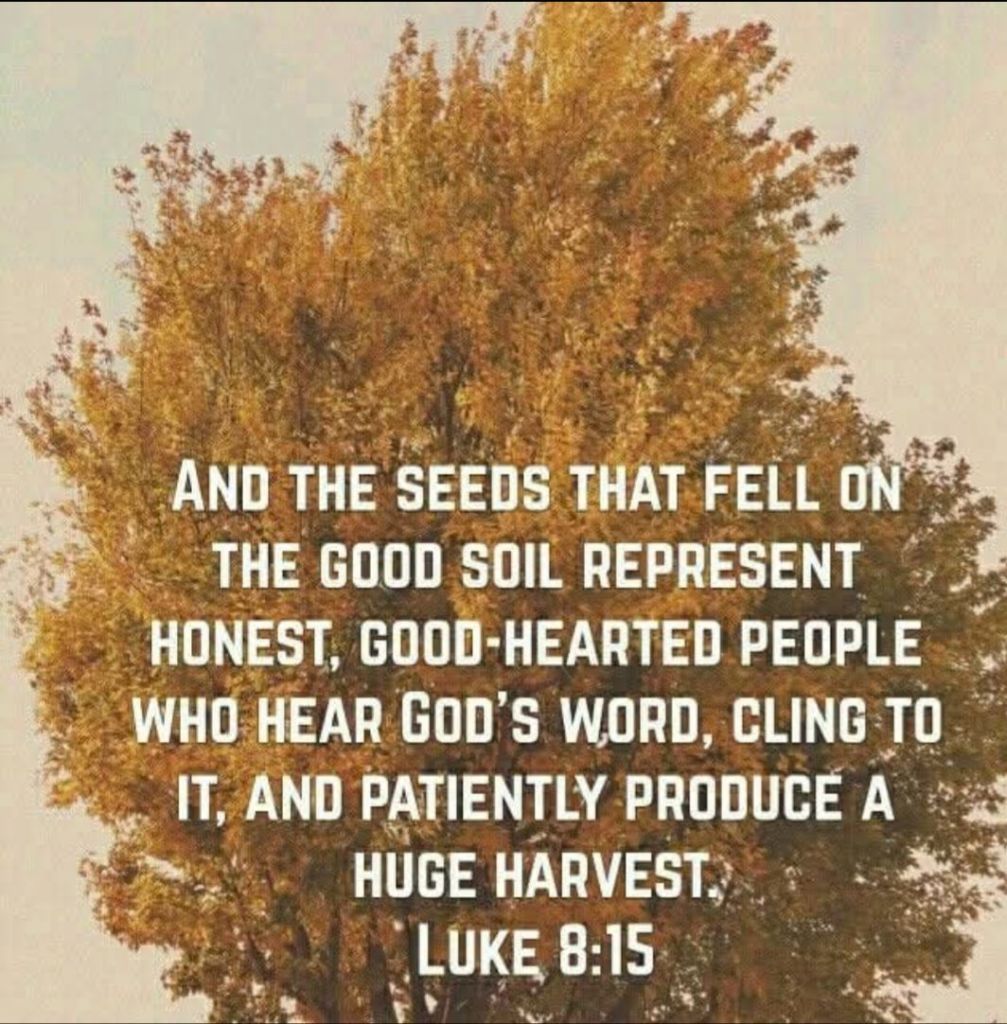
In the parable of the sower in Luke 8:1-15, the focus isn’t on the sower who scatters the seed but on the soil where the seed is sown. The life-bearing seed is “the word of God” (v. 11), and the soil represents the heart condition of the one who receives it. Jesus highlights different outcomes depending on where the seed falls. The seed that falls on “good soil” (v. 8) represents receptive hearts “who hear God’s word, cling to it, and patiently produce a huge harvest” (v. 15 nlt). We are “God’s field” (1 Corinthians 3:9) where “the word of God” is planted. Even as we cultivate good soil, it’s God who makes “things grow” (v. 7) and makes us fruitful (vv. 6-9). (K.T Sim, Insight, Our Daily Bread 14th May 2026)

We should all have heard about the Parable of the Sower in Luke 8:1-15 preached at least once in our lifetime or read about it as any attempt to read the Bible by a new believer inevitably starts at the Gospels. In fact when I was first exposed to the Word during my pre-believer days, I had an English-Malay translation of the Gospels lying in my home book shelf. Thus, as a young boy, I had also read about the Parable of the Sower.

The Parable of the Sower is easily understood as explained by K.T Sim above. It is God or the Holy Spirit sowing the seed of faith in our hearts and whether we retain the seed and turn it into fruit in our lives depends really on the condition of our hearts. It can be looked at purely from the hearts of non-believers being ready to come to faith or extended to every time a believer hears or reads the Word whether we are ready to apply it as heard into our lives. The point is that it is the condition of our hearts that determines whether the Word takes root and transforms our lives.

The interesting point in today’s ODB is that Katara Patton highlights that we may ask the Lord to make our hearts as good soil, ready to let the Word take root and grow the Word that we read or listen to. If we pray for our hearts to be good soil, God will grant us our request although practically the cares of the world may choke away the Word or the trials of life may cause us to fall away.

That is why we pray that our hearts be good soil and not a rocky path or grow up with thorns that choke up the Word. Our prayer is that our hearts be good and fertile soil, strong to withstand trials and tribulations and firm so that we are not easily deceived or tempted by the bright lights or the riches and pleasures of the world. May our hearts always be ready to embrace and apply the Word, spoken or written, whole-heartedly that we will grow spiritually in the knowledge of our Lord Jesus Christ and experience His grace and mercy each day of our lives! May goodness and mercy indeed follow us the rest of our days and may we dwell in the house of the Lord forever (Psalm 23:8)!

We will reap what we sow

https://odb.org/2026/05/13/waiting-for-the-harvest-2

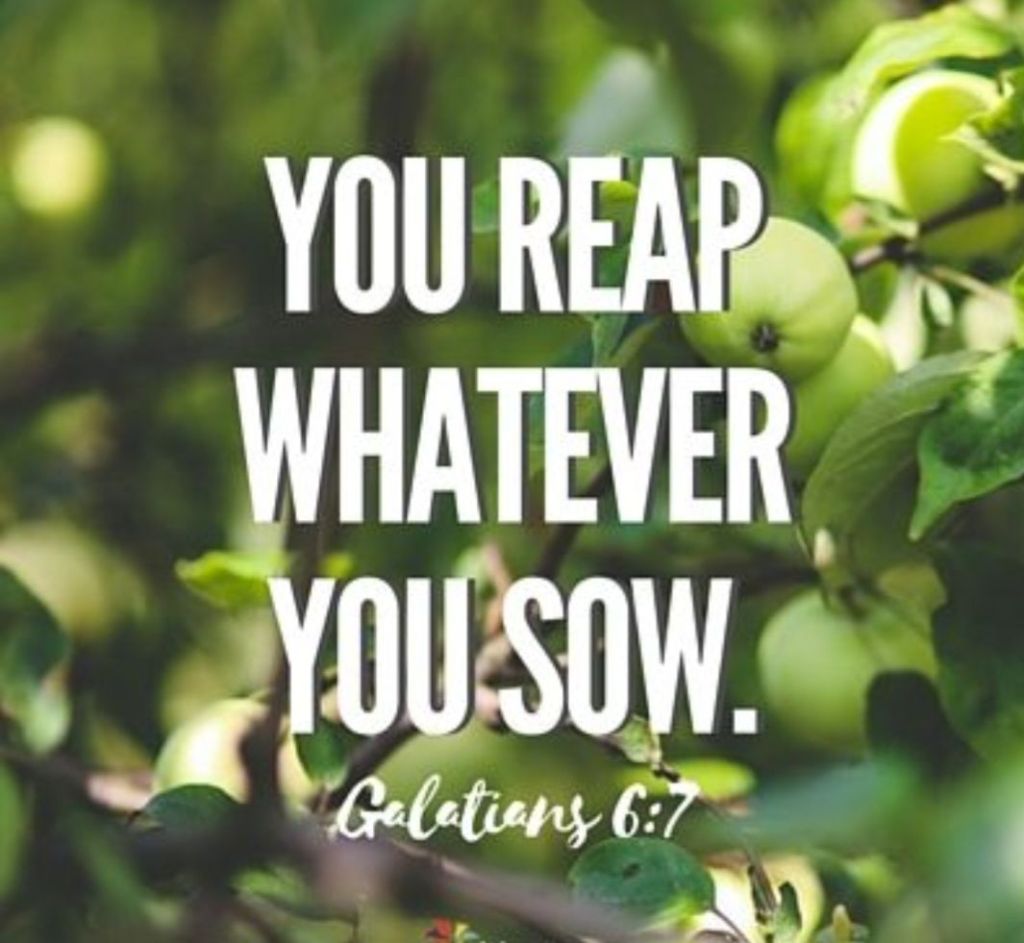
Galatians 6:7–10 (NIV): 7 Do not be deceived: God cannot be mocked. A man reaps what he sows. 8 Whoever sows to please their flesh, from the flesh will reap destruction; whoever sows to please the Spirit, from the Spirit will reap eternal life. 9 Let us not become weary in doing good, for at the proper time we will reap a harvest if we do not give up. 10 Therefore, as we have opportunity, let us do good to all people, especially to those who belong to the family of believers.

In 1962, Joanne Shetler and Anne Fetzer made an arduous trek by bus and foot into the rugged mountains of the Philippines to share the gospel with people who’d never heard of Jesus. For five years, they translated Scripture into the people’s language, but the Balangao villagers weren’t receptive. They did, however, help build a primitive landing strip so new supplies could be flown in. One day, a plane dubbed “magic from another world” by the people arrived. The pilot then flew a deathly ill, pregnant village woman to a faraway clinic. When the plane later returned with the recovered woman and her healthy newborn, the people began asking about “this God” they’d been told about. Soon the village had a church full of believers in Christ. (Dave Branon, Our Daily Bread 13th May 2026)

In Galatians 6:7-10, Paul emphasizes the theme of sowing and reaping—that is, that the choices we make come with real consequences. A life guided by “the flesh” (self-reliant human nature focused on self-gratification—5:16-21) inevitably leads to “destruction,” whereas a life guided by Christ’s Spirit leads to “eternal life” (6:8) and an abundant “harvest” (v. 9). Remembering this principle can strengthen the resilience and fortitude of believers in Jesus as they seek to “serve one another humbly in love” (5:13). (Monica La Rose, Insight, Our Daily Bread 13th May 2026)

One of the spiritual principles I believe most of us are well acquainted with is this principle of sowing and harvest although we are mostly taught sowing. In reaching out and preaching the Gospel, we are to just sow the seeds of faith and as we sow, we pray that one day, those seeds will take root and grow into big trees on fertile ground (representing the hearts of those we sowed). Ultimately, salvation is the work of the Holy Spirit and we need to always remember that humans are bestowed a will to make his or her decision. It’s a free will acceptance of Christ that is real and genuine.

But God also promises a harvest as a labourer is worthy of his wages (1 Timothy  5:18). Wages in the sense that we want to see the fruition of our efforts. If we work to set up an outreach, we want to see it thriving with the glory of God, if possible, in our lifetime. Some harvest can only be seen in generations to come where whole villages come to faith.

Taken at a wider context, sowing also speaks of what we invest in for our lives. In Galatians 6:7-9, Paul reminds us that a man reaps what he sows. Whoever sows to please their flesh, will reap destruction; whoever sows to please the Spirit, will reap eternal life. Therefore, let us not become weary in doing good, for at the proper time we will reap a harvest if we do not give up.

This is similar to the concept promulgated and articulated by our Lord Jesus Christ that we store up riches in heaven where moth and rust will not destroy. Everlasting treasures are in heaven written in our names, treasures we can enjoy at the time when we live for eternity. For we know that we come to this earth naked and we will leave naked; from dust to dust. Nothing from this world we can bring over when we pass on. We will reap what we sow. So will we reap eternal life or destruction and damnation? Are we on the narrow road that leads to eternal life?

Heed Paul’s advice – do not stop doing good, especially to those who belong to the family of believers (Galatians 6:10). Do good whenever we have the opportunity. Do not grow weary doing good. One day, we will reap the harvest. When we do good, we are also sowing towards our riches in heaven and we will reap what we sow!