A plumb line

https://odb.org/2026/07/21/doing-right
Amos 7:1–8 (NIV): 7 This is what the Sovereign LORD showed me: He was preparing swarms of locusts after the king’s share had been harvested and just as the late crops were coming up. 2 When they had stripped the land clean, I cried out, “Sovereign LORD, forgive! How can Jacob survive? He is so small!”
3 So the LORD relented. “This will not happen,” the LORD said.
4 This is what the Sovereign LORD showed me: The Sovereign LORD was calling for judgment by fire; it dried up the great deep and devoured the land. 5 Then I cried out, “Sovereign LORD, I beg you, stop! How can Jacob survive? He is so small!”
6 So the LORD relented. “This will not happen either,” the Sovereign LORD said. 7 This is what he showed me: The Lord was standing by a wall that had been built true to plumb, with a plumb line in his hand. 8 And the LORD asked me, “What do you see, Amos?” “A plumb line,” I replied.
Then the Lord said, “Look, I am setting a plumb line among my people Israel; I will spare them no longer.

Ben had bought pirated computer software for years, simply because it was cheaper. Even though it was illegal and broke copyright laws, he didn’t feel that it was morally wrong. After all, everyone did it, and why should he buy expensive original software? Who would check? After hearing a talk on daily examples of living by God’s standards, however, Ben, a new believer growing in the faith, began to wonder, What does it mean to do the right thing? Ben decided to replace all his software with original versions. It cost a lot more, but, as he explained to his friends, “God knows. And He calls us to do what’s right, right?”

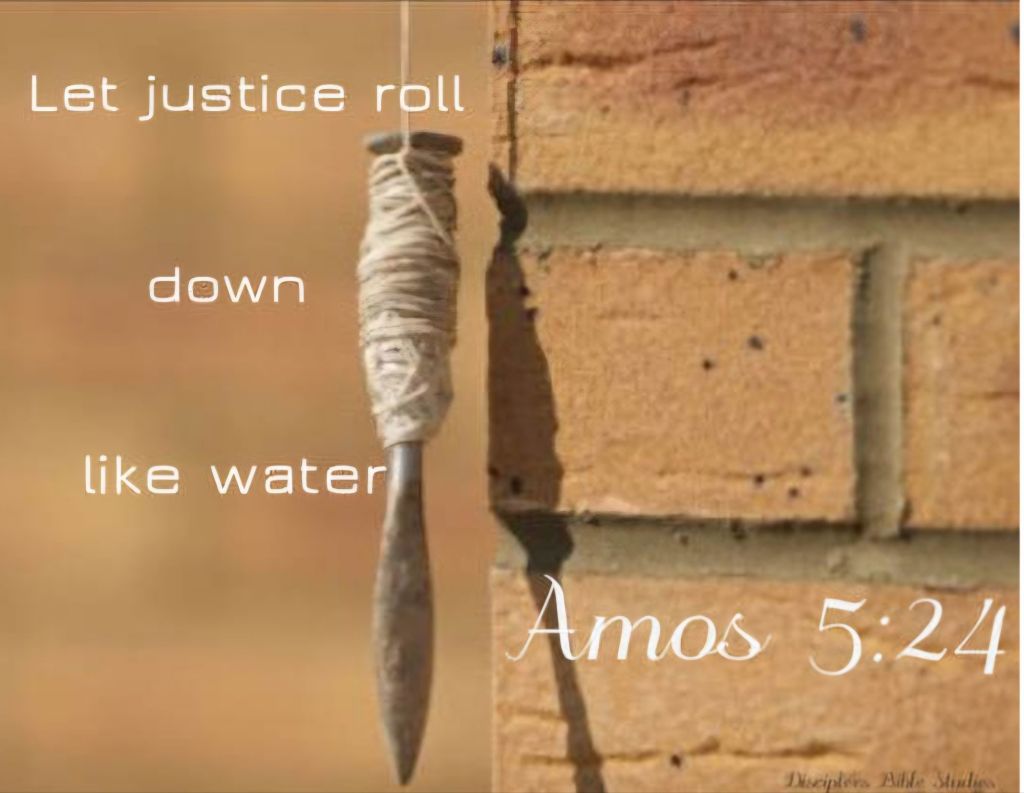
In Amos 7, God reminded the Israelites that His standards were impartial and absolute and applied to all, including His favored nation. His laws and moral standards were like “a plumb line” (v. 8)—a weighted line used by builders to ensure structural integrity by showing if a wall wasn’t being built perfectly vertical. (Leslie Koh, Our Daily Bread 21st July 2026)

A plumb line is a string with a heavy weight (called a plumb bob) attached to one end. When hung freely, gravity pulls it to find an exact vertical line, ensuring structures are straight and true. Metaphorically, because the plumb line is dictated by gravity, it represents an unchangeable standard of truth and righteousness. In the Bible, it is frequently used to symbolize God’s unchanging moral standards.

As Christians, I believe we will wrestle with this issue of following our flesh to chase after worldly wealth and success or follow God and His righteousness and trust that all these shall be added unto us ala Matthew 6:33. Some Christian circles preach that we may also achieve worldly success and gain wealth if we follow God and not the world because the LORD will bless His people, His children. Thus the plumb line will be the measure of whether we are adhering to His standards of righteousness or we follow the ways and standards of the world.

As we progress in our faith, however, as we do not conform to the ways (pattern) of this world, we are transformed by the renewing of our minds. In the process, we will test and approve His good, pleasing and perfect will. In discovering God’s will for our lives especially His plans and purposes, we will then realise that actually wordly success and wealth are not really what we want after all. We realise that we do not need to prove to our families and friends that following God has its share of blessings that are equivalent or will even surpass what we would have gained had we followed our flesh. In fact, the path that Jesus has now opened for us is a path that we want to follow. Spiritual enrichment and understanding are more useful compared to worldly wealth or success. The plumb line has now become our moral compass, to keep us on the narrow path that leads to righteousness.

Just that every now and then we may face situations where we may be tempted to deviate from the plumb line and snag a gold coin or two. This is what happened to Elisha’s servant Gehazi in 2 Kings 5. After Naaman was healed of his leprosy (a skin disease during biblical times, but not Hanson’s disease of modern times) and gave Elisha gifts worth millions in today’s money he brought all the way from Damascus to Samaria, Elisha refused – to illustrate the point that divine healing cannot be bought or measured in terms of the wealth of the world. However Gehazi later ran after Naaman and spinned a tall tale to elicit two talents of silver (worth 40 years of wages, not savings) and 2 sets of clothing. Gehazi gave in to his flesh (his greed) in a momentary lapse of judgment and suffered the consequences as Naaman’s leprosy then clung on to him and his descendants.

Make the plumb line our moral compass in all that we do. Always do the right thing. Live right-side up. Even if no one sees or bothers, God sees. Indeed, do not conform to the pattern of this world. It is deceitful and a snare to draw us away from God. Be transformed by the renewing of our minds that we may test and approve His good, pleasing and perfect will!

Pass it on

https://odb.org/2026/07/20/pass-it-on-5

2 Corinthians 1:1–7 (NIV): Paul, an apostle of Christ Jesus by the will of God, and Timothy our brother, To the church of God in Corinth, together with all his holy people throughout Achaia: 2 Grace and peace to you from God our Father and the Lord Jesus Christ. 3 Praise be to the God and Father of our Lord Jesus Christ, the Father of compassion and the God of all comfort, 4 who comforts us in all our troubles, so that we can comfort those in any trouble with the comfort we ourselves receive from God. 5 For just as we share abundantly in the sufferings of Christ, so also our comfort abounds through Christ. 6 If we are distressed, it is for your comfort and salvation; if we are comforted, it is for your comfort, which produces in you patient endurance of the same sufferings we suffer. 7 And our hope for you is firm, because we know that just as you share in our sufferings, so also you share in our comfort.

After a fifty-five year wait, England’s soccer team finally made it to the European Football Championship Cup finals. Locked in a tie with Italy, the game was decided by a penalty shootout. England’s last chance fell to a young player named Bukayo Saka. But as Saka kicked the penalty shot, Italy’s goalkeeper deflected it. England fans wept; the Cup was lost. Few will forget what happened next, though. England’s manager, Gareth Southgate, walked over to the devastated Saka and embraced him. Southgate knew how Saka felt. In 1996 it was he, as a young player, who had missed the penalty shot that cost England a place in the semifinals, and England’s then-manager Terry Venables had comforted him in the very same way. (Sheridan Voysey, Our Daily Bread 20th July 2026)

The spiritual principle shared in today’s ODB is that as God comforts us, we ought to comfort others. Paul encouraged in 2 Corinthians 1:4 – [God the Father] who comforts us in all our troubles, so that we can comfort those in any trouble with the comfort we ourselves receive from God. That is why we know that the things we go through in life is how God matures us but that is also how He teaches us so we may use our life experiences, especially our encounters with Him, to comfort others. Nothing in our past life is wasted even though we may have gone through “hell”. For instance, if we had gone hungry for 3 whole days surviving just on plain water when young because there was no money for food before salary day, we are able to appreciate those who go hungry and understand what they are going through.

This principle may be further extended beyond our past experiences to the wealth we have or our God-given talents and skills we honed at work. All we have may be used for the glory of God – as God blesses us, we bless others. One of the best ways to serve God is to use whatever we have first while we equip ourselves. Our management skills may be used to organise events for the church first while we spend more time deepening our bible knowledge. We serve with what we have rather than only serve when we are ready. We don’t know how long we will live. So don’t wait, just start somewhere from where we are with whatever we have.

The idea is to pass it on as God gives and blesses us, as Jesus moulds, shapes and matures us. Very little in the Kingdom of God is ours to hoard, most are to be shared to bless the larger community one way or another including our past experiences. The more we give and pass on, the more our Father will give us. That is why in the spiritual realm, it is better to give than to receive from others as the more we give, the more God will give us!

Have a good week, everyone! Be mindful to give more of ourselves to others as the LORD our God sees our heart and will make sure our hearts are overflowing with His grace and mercy!

Creator God

https://odb.org/2026/07/17/flight-school

Job 38:31–41 (NIV): 31 “Can you bind the chains of the Pleiades? Can you loosen Orion’s belt?
      32 Can you bring forth the constellations in their seasons or lead out the Bear with its cubs?
      33 Do you know the laws of the heavens? Can you set up God’s dominion over the earth?
      34 “Can you raise your voice to the clouds and cover yourself with a flood of water?
      35 Do you send the lightning bolts on their way? Do they report to you, ‘Here we are’?
      36 Who gives the ibis wisdom or gives the rooster understanding?
      37 Who has the wisdom to count the clouds? Who can tip over the water jars of the heavens
      38 when the dust becomes hard and the clods of earth stick together?
      39 “Do you hunt the prey for the lioness and satisfy the hunger of the lions
      40 when they crouch in their dens or lie in wait in a thicket?
      41 Who provides food for the raven when its young cry out to God and wander about for lack of food?

Dragonflies are dainty insects with some of the most amazing flight and endurance capabilities. Their aerial abilities have been studied to improve flight technology. Scientists recently found that with its wings beating thirty times a second, a dragonfly that has fallen upside-down can right itself in just 0.2 seconds. Its eyes process an incredible two hundred images per second to determine which way is up and make tiny adjustments.

God’s creativity and wisdom are on display all throughout our natural world. In the book of Job, the main character struggles to reconcile his suffering with God’s goodness and righteousness. God responds by asking Job, “Do you know the laws of the heavens? Can you set up God’s dominion over the earth?” (38:33). How exactly does a dragonfly maneuver so incredibly? We have a lot to learn. And yet we can trust that the all-knowing God who designed these creatures is the same one who knows how to bring us from the darkest night into the light and joy of His presence. (Karen Pimpo, Our Daily Bread  17th July 2026)

God’s majestic creation reveals many things about His nature. In creation, we see evidence of His power (Romans 1:20), for He spoke the universe into existence (Genesis 1:3; Hebrews 11:3). Creation reveals His sense of order (Psalm 139:13-14) and His brilliant design (v. 15). Perhaps above all else, however, it teaches us about His sovereignty (Colossians 1:15-18). Not only did He create the universe by the word of His power, but He’s even now maintaining that universe. He not only made everything, but He also rules over all that He’s made (v. 17). The challenge for believers in Jesus is to live in the conscious awareness of His power, His word, His order, and His design. We can trust the creator of the universe to help us in our trials and bring us into the joy of His presence. (Bill Crowder, Insight, Our Daily Bread 17th July 2026)

When I look at nature, I’m always fascinated by the complexity of God’s creation. Just today’s focus on the dainty dragonfly, you’ll be amazed at its ability to adjust itself when it falls upside down. Similar to how the domestic cat naturally adjusts its body to fall on its four legs from height.

I love documentaries and recently watched a clip on BBC using infrared light (night vision) on a drone tracking a male tiger moving towards a mother with her two juvenile cubs. The crew was so afraid that the male was looking to kill the cubs and might have ended up killing the mother as well. If you know general tiger behaviour, females raise their young on their own and are fiercely protective of their babies. In the end, it turned out that the male was part of the family, the patriarch, and this clip was the first if not the very few recorded evidence of a tiger family with both father and mother and their cubs! Nature has a way of even confounding our own comprehension of it! You may catch that clip here:

BBC One – Tiger Island, Series 1, Episode 2, A rare tiger family moment caught on camera https://share.google/LH4MJsvEQzkErV3Wc

Nature has its own way of amazing us and all this points to a creator. The intricate details of each species, whether animals or plants or even other organisms or how our internal organs work or how our bodies fight microorganisms that are invisible to the naked eye. As believers of Christ, we must always remember that Christ paved the way for us to reconnect with this all powerful and all knowing God, the God who created the universe and everything in it, by His spoken word. The same God of Abraham, Isaac and Jacob. In the words of Karen Pimpo in today’s ODB – “And yet we can trust that the all-knowing God who designed these creatures is the same one who knows how to bring us from the darkest night into the light and joy of His presence”.

The LORD God is our Heavenly Father and He loves and cares for us, our wellbeing, the state of our spiritual life, whether we are heading towards eternity with Him. Speak to Him, call out His name – He will guide us and bring us safely out of our deepest, darkest nights into His light and His presence! Amen!

Have a good weekend, everyone! May we all bask in the glory of His presence as we worship Him this Sunday!

Strength in numbers

https://odb.org/2026/07/16/who-do-you-need

1 Corinthians 12:12–14 (NIV): 12 Just as a body, though one, has many parts, but all its many parts form one body, so it is with Christ. 13 For we were all baptized by one Spirit so as to form one body—whether Jews or Gentiles, slave or free—and we were all given the one Spirit to drink. 14 Even so the body is not made up of one part but of many.

A famous athlete sat tall in his seat as he prepared to fly to the championship bout he knew he’d win. A flight attendant walked by and said, “Sir, please fasten your seat belt.” The man smiled. “Superman don’t need no seat belt.” She replied without missing a beat, “Superman don’t need no airplane. Buckle up.” And he did. Success can swell our heads. We don’t need a seatbelt or a flight attendant telling us what to do. We can take care of ourselves. If we bring this attitude to church, we’re like an eye that says to the hand, “I don’t need you!” or a head that says to the feet, “I don’t need you!” (1 Corinthians 12:21). The truth is, every part of the body is needed, and “those parts of the body that seem to be weaker are indispensable” (v.22) (Mike Wittmer, Our Daily Bread 16th July 2026)

In the Old Testament, the famous saying is “two are better than one” (Ecclesiastes 4:9-12) because if one falls down, the other can help him up. With two, they have a good return for their labour. In Ecclesiastes 4:12 (NIV), it is written, “Though one may be overpowered, two can defend themselves. A cord of three strands is not quickly broken“. It speaks of strength in numbers. One of the reasons why marriage succeed in elevating one’s economic status is the pooling of resources and talents. So modern-day unions are more partnerships, similar to business partnerships creating synergies to harness higher outputs or as Ecclesiastes 4:9-12 pointed out, they have a good return for their labour.

In the New Testament, Paul uses the imagery of the body to illustrate this point in the church. There are different parts in church and everyone needs each other as the hand cannot say to the eye that I don’t need you. We all know very well that if the little toe is hurt, the entire body will be affected. In fact even a small cut or abrasion in any part of our bodies will create such an irritation that our immune system and cells will work frantically to quickly repair the damage and repel any alien invaders. That is why self-healing and the immunity system are two very essential systems in the body.

When the healing system is compromised by illness (like diabetes causing nerve damage) or the immune system goes haywire (for example, auto immune diseases), the body will get into big trouble. While we are strong when united, we crumble if we fight amongst ourselves or betray one another or given a task, we shrink away or don’t do our part. Everyone is a brick on the wall, if a few bricks move away, the wall may just collapse.

The mesaage this morning is that we all have our roles to play as individuals in the body of Christ in the local and universal church. We all contribute our various talents into the pool and God mixes and blends us together to create a potent force to deal with the principalities of the air and the dark forces. There are various spiritual gifts scattered among us. We need to come together and be united, in spirit and in truth. That is the church, which is why congregational worship is essential to the life of the church! No single person is as strong as the whole body – we need to be humble to accept that we actually need one another!

Gratitude and thankfulness to God our Father

https://odb.org/2026/07/15/always-giving-thanks

Ephesians 5:15–20 (NIV): 15 Be very careful, then, how you live—not as unwise but as wise, 16 making the most of every opportunity, because the days are evil. 17 Therefore do not be foolish, but understand what the Lord’s will is. 18 Do not get drunk on wine, which leads to debauchery. Instead, be filled with the Spirit, 19 speaking to one another with psalms, hymns, and songs from the Spirit. Sing and make music from your heart to the Lord, 20 always giving thanks to God the Father for everything, in the name of our Lord Jesus Christ.

A fifty-ton, female humpback whale swam into a web of crab lines off the coast of California, trapping her in a tangled mess. Hundreds of feet of line and hundreds of pounds of traps wrapped around her body as she struggled to stay afloat. Four divers came to her rescue, swimming under her belly. For an hour, they cut rope—dangerous work since one flap of her tail could have killed them. After they freed her, rather than immediately escaping, she swam to and gently nudged each diver. “It felt to me like she was thanking us,” one rescuer said.

Whether or not whales are able to express gratitude, being thankful is truly an important part of being human. It’s vital for our life with God. Many of us thank Him for larger blessings (the birth of a child or healing from a disease). However, Paul tells us to offer gratitude for every gift we receive, for every bit of goodness we encounter. We’re to be “always giving thanks to God,” the apostle writes (Ephesians 5:20). Not sometimes. Not only for exceptional moments. Always. (Winn Collier, Our Daily Bread 15th July 2026)

Ephesians 5 invites us to walk in Christ’s light rather than stumble through the darkness of the world (v. 8). In verses 15-20, we encounter a surprising source of spiritual strength: gratitude. Paul urges us to “be filled with the Spirit” (v. 18) and to “[give] thanks to God the Father for everything in the name of our Lord Jesus Christ” (v. 20). Gratitude is a posture and attitude that returns our focus to the source of all good things (see James 1:16-18). When we express our thankfulness—even in ordinary or difficult moments—we acknowledge God’s presence and goodness. This reorientation helps us to live intentionally, reflecting Christ’s love. (J.R. Hudberg, Insight, Our Daily Bread 15th July 2026)

Even in the world, gratitude towards God or the creator is accepted as one of the best boosters for good mental health and happiness. A quote from Google – “Practicing gratitude increases happiness by shifting your focus from what is missing to what you already have. Science shows this habit literally rewires your brain, lowering stress hormones like cortisol while releasing mood-boosting neurotransmitters like dopamine and serotonin.” In other words, gratitude reduces stress and chemically increases our “feel good” mood.

Likewise in the spiritual world, Paul advocates the same principle of gratitude in general but specifically towards God. In everything, not for some major things, give thanks to God the Father in the name of our Lord Jesus Christ. Not for significant things only but in everything, always. As J.R. Hudberg wrote – “Gratitude is a posture and attitude that returns our focus to the source of all good things. When we express our thankfulness—even in ordinary or difficult moments—we acknowledge God’s presence and goodness.” It brings us back to God and that’s the key.

As we focus on the things we have, we forget those we don’t. To me, gratitude is like contentment. We are grateful and thankful for what we have and have already achieved, rather than lament on missed opportunities for greatness. If we are honest, we will see God has been good to us. Others may have done better, but there are also others who fared worse. Remember, in Christian life, we are running in our own lane. We have God’s will for us specifically. His tailored and bespoke customised plans and purposes for our life. Gratitude helps us to forget what’s behind, the past failures and disappointments, and focus on what lies ahead. As they say, leave the past behind and move on.

My prayer for all of us is that we look at the bright day ahead with gratitude and thankfulness towards God and our Lord Jesus Christ and the Holy Spirit! We are still breathing, still alive and kicking! Indeed sad birds still fly, but grateful birds soar high under the shadow of His wings! Amen!

A sign from God

https://odb.org/2026/07/14/cant-explain

Judges 6:36–40 (NIV): 36 Gideon said to God, “If you will save Israel by my hand as you have promised—37 look, I will place a wool fleece on the threshing floor. If there is dew only on the fleece and all the ground is dry, then I will know that you will save Israel by my hand, as you said.” 38 And that is what happened. Gideon rose early the next day; he squeezed the fleece and wrung out the dew—a bowlful of water.
39 Then Gideon said to God, “Do not be angry with me. Let me make just one more request. Allow me one more test with the fleece, but this time make the fleece dry and let the ground be covered with dew.” 40 That night God did so. Only the fleece was dry; all the ground was covered with dew.

Jay owned a Gideon Bible, yet his analytical mind didn’t permit him to accept its miracles. One thing haunted him, though: the genuine faith of his friend. So Jay offered a strange prayer. He told God, “If you want me to believe in You, then do something I can’t explain.” One day, something drew Jay to look for his Bible. It was gone. How could that be? He never lost track of things.

He drove in the rain to his teaching job at the University of Zurich. Stepping out of his car, he spotted a Gideon Bible on the wet pavement. That’s strange, he thought. Picking it up, he noticed the Bible was totally dry despite the rain. Something he couldn’t explain!

Gideon Bibles are named for an Old Testament hero of Israel. When God chose Gideon to lead Israel into battle against a vast army, Gideon had huge doubts. He told God, “I will place a wool fleece on the threshing floor. If there is dew only on the fleece . . . , then I will know that you will save Israel by my hand” (Judges 6:37). God answered Gideon’s challenge not once but twice (vv. 39-40). (Tim Gustafson, Our Daily Bread 14th July 2026)

Gideon asking for a sign is perhaps the most famous account of a mighty man of God seeking something supernatural from the LORD to confirm his calling. Our human nature tends to make us doubt, rather than believe and trust blindly, especially when it comes to life-changing decisions. Gideon of course asked for more than just a confirmation of his calling but also the success of God’s calling that he will indeed lead Israel to victory.

In the case of Moses, he saw a burning bush with fire but the fire did not consume the bush. That’s the supernatural reality of the God of Abraham, Isaac and Jacob. YHWH will go to great lengths to prove that He is God. Even in the case of Paul, Jesus appeared to him in a vision on his way to Damascus and later brought him up to the third heaven and Paul heard inexpressible things. Jesus also to teach him the mysteries of the Kingdom of God.

2 Corinthians 12:2-4 NIV I know a man in Christ who fourteen years ago was caught up to the third heaven. Whether it was in the body or out of the body I do not know—God knows. 3 And I know that this man—whether in the body or apart from the body I do not know, but God knows— 4 was caught up to paradise and heard inexpressible things, things that no one is permitted to tell.

If we have been in Christ for some time, we will know that the supernatural is never an impossibility in the faith. It is one of the ways God reaches out to man to do His will and to fulfil His plans and purposes for man. But what I like to highlight here this morning is that the LORD will go to great lengths to convince us His calling for our lives. If we were to ask for a sign, chances are He will oblige. I recall more than 40 years back a young pastor fresh out of seminary was sent by the Methodist church to pioner an outreach in my small town in Pasir Puteh, Kelantan. I asked Pastor Chiam how he confirmed his calling to go full-time for God. He told me before going to seminary he asked the Lord to show him 3 signs. I forgot what those signs were but he saw all three! It proved that His calling was divine and Pastor Chiam later returned to continue his service in Penang and I heard that he only retired a few years back, after many years of full-time service in His church.

If God has placed in us a burden to do something for Him or to go into full-time ministry or to be a missionary in a far land or just a calling to serve Him in some way, you may ask for a sign to confirm and afford your calling. With the supernatural confirmation, we will have the courage and boldness to step out in faith into an unknown future safely in the shadow of His migthy wings!

God’s unconditional love

https://odb.org/2026/07/13/drastic-measures-2

John 3:16–21 (NIV): 16 For God so loved the world that he gave his one and only Son, that whoever believes in him shall not perish but have eternal life. 17 For God did not send his Son into the world to condemn the world, but to save the world through him. 18 Whoever believes in him is not condemned, but whoever does not believe stands condemned already because they have not believed in the name of God’s one and only Son. 19 This is the verdict: Light has come into the world, but people loved darkness instead of light because their deeds were evil. 20 Everyone who does evil hates the light, and will not come into the light for fear that their deeds will be exposed. 21 But whoever lives by the truth comes into the light, so that it may be seen plainly that what they have done has been done in the sight of God.

Daniel was born into a Romanian orphanage. For seven years, he only left his crib to go to the bathroom. When he turned eight, a family from another country adopted him. They knew about attachment disorders—that Daniel could have difficulty attaching to them as his parents. Slowly, Daniel started to trust them. Over time, though, he began to rage to the point his parents hired a bodyguard to protect them from Daniel’s outbursts. They decided on a controversial therapy: For the next five years they were never away from Daniel even if he had a meltdown. On his thirteenth birthday Daniel broke down and, for the first time, told his parents he loved them very much. His mother summarized the experience: “Creating love is not for the soft and sentimental. Love is a battlefield.” (John Blase, Our Daily Bread 13th July 2026)

Many people are familiar with John 3:16, which describes the scope of God’s love for the world: “God so loved the world that he gave his one and only Son, that whoever believes in him shall not perish but have eternal life.” Many, however, misinterpret this verse. They think that if God’s love is so great, no one will “perish.” The critical phrase is “whoever believes in [Jesus].” John also writes, “Whoever does not believe [in Jesus] stands condemned already because they have not believed in the name of God’s one and only Son” (v. 18). (Tim Gustafson, Insight, Our Daily Bread 13th July 2026)

A difficult child is something every family dread but some cannot avoid. Some families have a child with disability or a debilitating neurological illness. Or there are families with physically normal children but anti social behaviour like youths who withdraw from society and can’t function in the community or those who mix with the wrong company and ended up on the streets in crime and drugs. I know of someone with a child who is destructive, abusive and out of control against her parents but behaves normally in a psychiatric ward.

The thing is all these families with less than ideal children will not abandon their child. They will love their child come what may and sacrifice their time, money and even vacations for their special needs child. I have a friend who is a business owner but has never been abroad for a holiday as a family because their second child has a neurological disease that needs constant care. They want to be constantly at his side to feed him and attend to his needs.

Thus, John 3:16 demonstrates God’s love in the sense that no matter how horrible we may be as human beings created by Him in His image (like we may totally ignore Him in our haughtiness), He still loved us by sending His one and only Son, Jesus Christ our Lord and Saviour, to die for our sins that whosoever believes in Jesus shall not perish but have life everlasting. God’s love is akin (but much more) to those families and parents who loved their child and sibling regardless of his or her special needs. As difficult as they may be to love like those who are abusive and violent, they are still loved. We may be an atheist and do not believe in the existence of God, yet God still loves us. You may believe in other gods and not the God of Abraham, Isaac and Jacob but God nevertheless loves you. Salvation however is only through belief in Jesus Christ, His one and only Son.

Have a good week, everyone! Every day brings its own set of challenges and struggles. Seek Him and pray that His grace and mercy be upon us that He will grant us wisdom and discernment to deal with issues at work and in our family! Amen!

Spiritual gifts

https://odb.org/2026/07/09/sharing-our-spiritual-gifts

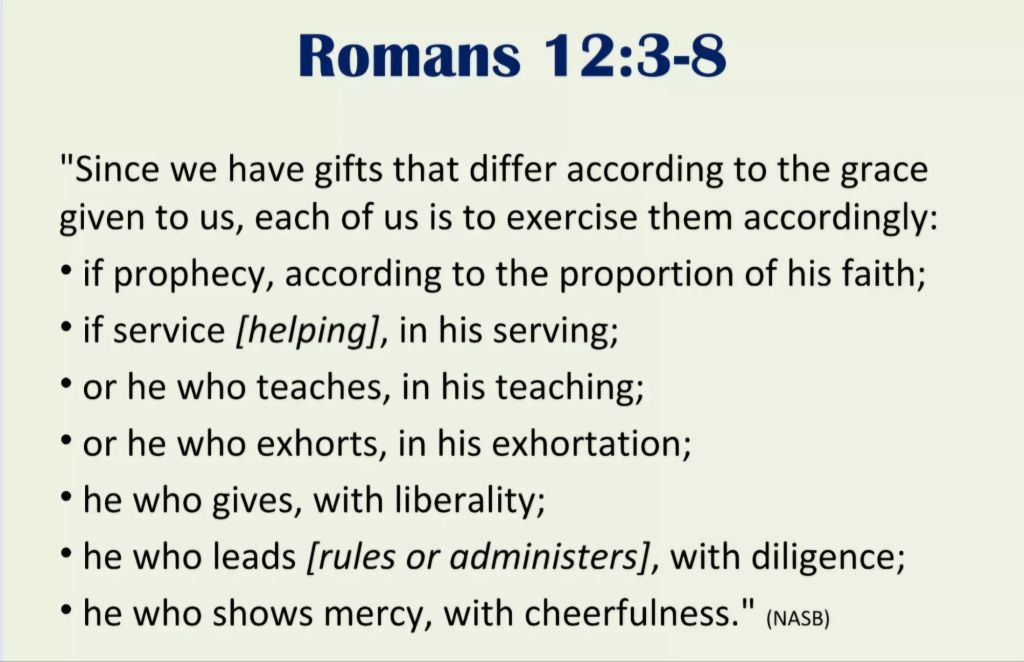
Romans 12:3–8 (NIV): 3 For by the grace given me I say to every one of you: Do not think of yourself more highly than you ought, but rather think of yourself with sober judgment, in accordance with the faith God has distributed to each of you. 4 For just as each of us has one body with many members, and these members do not all have the same function, 5 so in Christ we, though many, form one body, and each member belongs to all the others. 6 We have different gifts, according to the grace given to each of us. If your gift is prophesying, then prophesy in accordance with your faith; 7 if it is serving, then serve; if it is teaching, then teach; 8 if it is to encourage, then give encouragement; if it is giving, then give generously; if it is to lead, do it diligently; if it is to show mercy, do it cheerfully.

“You’re good at playing the guitar,” I said to a new friend at church. “Thanks,” he said. “That’s my ministry.” There was that word again. Ministry. I didn’t know what that was or how someone “got” a ministry. But my friend was simply using the musical ability he’d been given to serve others. When I later discovered that one of my gifts was exhortation, or encouragement, I was a bit disappointed. It felt too plain. But soon I realized that as the care leader of our small group, I delighted in writing encouraging notes or calling our members. I’d been using one of my spiritual gifts without even knowing it. As believers in Jesus, we’re each given spiritual gifts to serve in the church (1 Corinthians 12:6). Sometimes we don’t know what they are, so we simply serve where there’s need. The Holy Spirit will do the rest (vv. 4-6, 8-11). (Nancy Gavilanes, Our Daily Bread 9th July 2026)

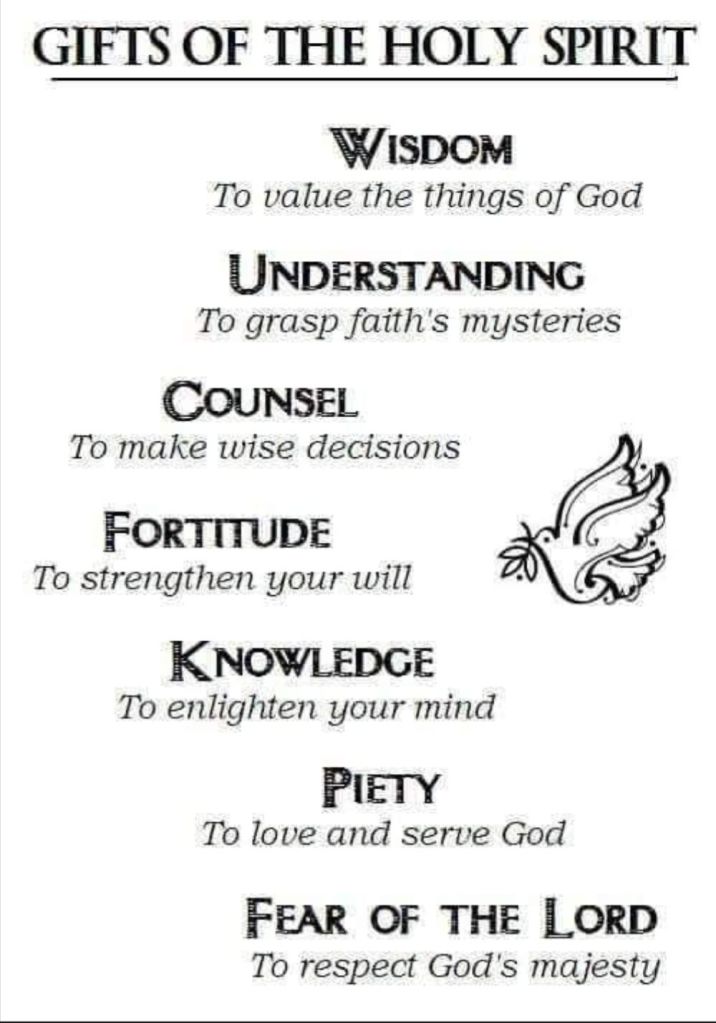
Spiritual (grace) gifts are listed in Romans 12:6-8; 1 Corinthians 12:4-11; and 1 Corinthians 12:28. No two lists are identical, which indicates they aren’t exhaustive. The purpose of listing the gifts isn’t to enumerate how many types of gifts there are but rather to teach us to use them in a loving way that promotes growth and unity in the church (1 Corinthians 12:12-27; 13:1-13; 1 Peter 4:10). Spiritual gifts equip God’s people to do His work, to edify and build up the church (Ephesians 4:11-16), and to serve others and bring glory to God (1 Peter 4:10-11). To achieve this, Paul tells us not to think too highly or too lowly of ourselves but to use our spiritual giftedness in humility (Romans 12:3). (K.T. Sim, Insight, Our Daily Bread 9th July 2026)

Personally, I got to know Christ through learning how to play the guitar. A group of outstation (an expression common in Malaya since the British days to denote people who are from elsewhere but stationed in a particular place, usually used for government servants) teachers opened their home in Pasir Puteh to us local students and introduced us to musical instruments. 3 of us went there to fellowship and learn to play the guitar and in the process, we eventually accepted Christ. A few years later, I joined a church in Kota Bharu and started playing the guitar for their worship services and that’s how I started my “ministry” or one could say, my involvement in church ministry. I still lead in worship and play the guitar but that’s no longer my main ministry.

We could stumble upon a ministry based on our God-given talents like some of us are more encouraging in words and demeanour. Like K.T. Sim said, the lists of spiritual gifts are not meant to be exhaustive and thus it could be our own God-given talents. Or we could also work towards them like teaching or discipleship where training or knowledge may be acquired informally or even formally by enrolling in a seminary. Recently, a leader in my local church started a Greek class, no doubt leveraging on his theological studies in a bible college.

I have been in the music ministry for more than 40 years now. Most ministries are a life long thing. We serve using our talents and spiritual gifts until our last breath. Start somewhere and over time we will discover our spiritual gifts. For example, as we get involved more in ministering, we  may gain the gift of discernment and word of knowledge. Some in the process learned they have the gift of healing, meaning when they pray, they have a higher chance of invoking God’s healing power. We will only know what are our spiritual gifts when we step out in faith. When we trust the prompting of the Spirit and trust perhaps in a picture we see as we pray. The more we operate in the spiritual realm, the better we will get. Don’t be afraid but step up in faith!

The Holy Grail

https://odb.org/2026/07/08/the-holy-grail

The Holy Grail prop from the movie Indiana Jones

Matthew 26:26–30 (NIV): 26 While they were eating, Jesus took bread, and when he had given thanks, he broke it and gave it to his disciples, saying, “Take and eat; this is my body.” 27 Then he took a cup, and when he had given thanks, he gave it to them, saying, “Drink from it, all of you. 28 This is my blood of the covenant, which is poured out for many for the forgiveness of sins. 29 I tell you, I will not drink from this fruit of the vine from now on until that day when I drink it new with you in my Father’s kingdom.” 30 When they had sung a hymn, they went out to the Mount of Olives.

For centuries, people have been fascinated by the Holy Grail—the cup Jesus drank from at the Last Supper. The legends surrounding King Arthur and the knights of the Round Table detail their obsession over the search for the cup. They believed it had magical powers. In film, Indiana Jones and his father, Henry, fulfilled Henry’s lifelong pursuit of the Grail.

While this makes for fascinating storytelling, the truth is much more straightforward. The cup itself has no special powers. The real power is found in what it represents. Matthew describes the scene in the upper room the night before Jesus went to the cross: “Then [Jesus] took a cup, and when he had given thanks, he gave it to them, saying, ‘Drink from it, all of you. This is my blood of the covenant, which is poured out for many for the forgiveness of sins’ ” (26:27-28). The cup is a picture of the blood that Jesus would shed on our behalf. (Bill Crowder, Our Daily Bread, 8th July 2026)

One of the most fascinating aspects of Christian life that was a sharp departure from my life as a non-believer is the practical absence of physical objects of power. Thus even as movies portray vampires being afraid of crosses and holy water (and garlic!), the Christian faith itself does not believe in its own objects having any sort of special powers. The same way that the cup that Christ drank from during His last Passover meal had no supernatural powers (contrary to popular culture on the Holy Grail). Even the Holy Bible as a book in itself is not an object of special powers.

However, the words from the written Word spoken out aloud by a born-again believer is powerful as the spoken Word of God is able to drive out demons and release the power of healing. Remember that the LORD God created the world and everything in it from His spoken word. It could change the spiritual atmosphere of a place. Ultimately the spiritual power of a believer lies within the believer’s life – redeemed, sanctified and lived for the glory of God. Objects in the Christian world is not the source of power, it is the Holy Spirit living within a transformed and sanctified believer’s life who has.

There is one exception despite this overall generalisation and that is the sacraments of the Holy Communion. In this respect, notwithstanding that the elements are just ordinary food items like a piece of bread (or nowadays it’s more common to use cornflakes) and the drink is just ordinary grape juice and not some drink flown in from Jerusalem (although some churches serve real wine), there is belief that the sacraments have power to heal when taken as part of the Lord’s Supper. Not in the items themselves but in the body and blood of Christ they represent and in the context of the ceremony itself. Ultimately, it is God who heals as we partake Holy Communion or the Eucharist.

Having said that, it is important to note that objects outside the faith and relics used by others to pray and worship other gods especially those involved in the dark arts have spiritual powers. That is why believers are discouraged from bringing such items into their homes as these items could lead to the proliferation of demonic and other spirits into the home.

What’s our application for this morning’s message? Rather than inanimate objects, we ourselves are the actual and real source of supernatural powers as Christ and the Holy Spirit live within us and our hearts animate the glory of God. We have the power of prayer from the words we utter to bring down supernatural powers from the heavenly realm into the natural to break demonic bondages for our fight is not against flesh and blood but against principalities of the air as per Ephesians 6:12. Our power as sanctified and redeemed believers lies in our prayers – we are just a prayer away from the supernatural realm in the heavenlies. When confronted face to face by demonic forces or evil spirits, pray against them in the name of Jesus and by the power of His blood, James 4:7 – “Submit yourselves, then, to God. Resist the devil, and he will flee from you.”

The Godly wisdom of King Solomon

https://odb.org/2026/07/07/the-way-wisdom-works

1 Kings 3:24–28 (NIV): 24 Then the king said, “Bring me a sword.” So they brought a sword for the king. 25 He then gave an order: “Cut the living child in two and give half to one and half to the other.”
26 The woman whose son was alive was deeply moved out of love for her son and said to the king, “Please, my lord, give her the living baby! Don’t kill him!”
But the other said, “Neither I nor you shall have him. Cut him in two!”
27 Then the king gave his ruling: “Give the living baby to the first woman. Do not kill him; she is his mother.”
28 When all Israel heard the verdict the king had given, they held the king in awe, because they saw that he had wisdom from God to administer justice.

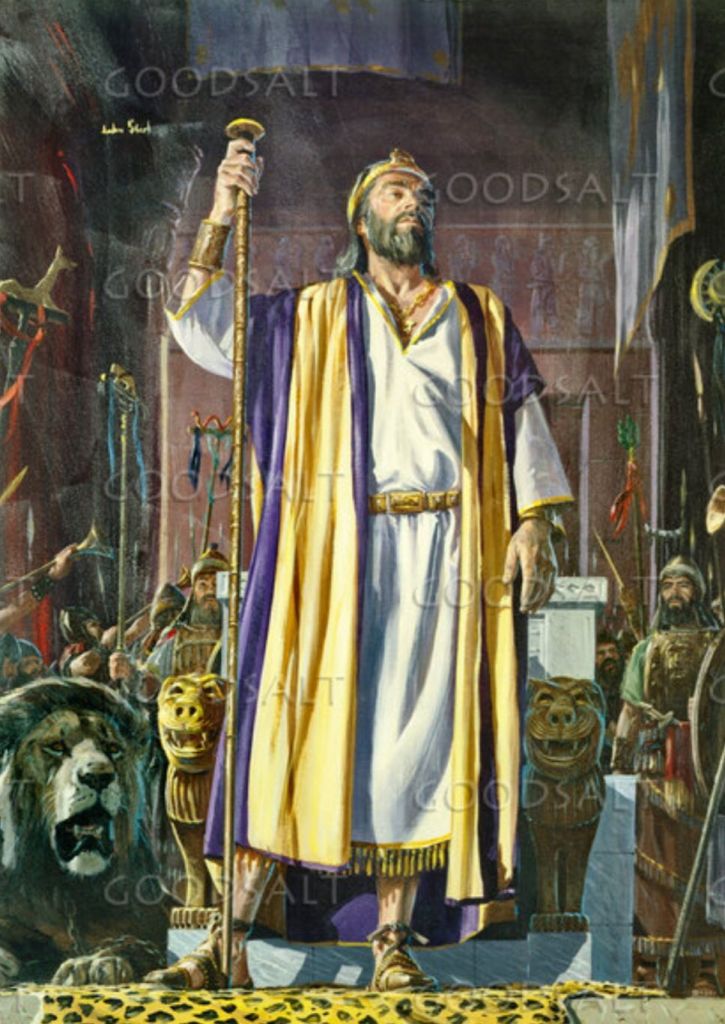
The people in Israel learned a lesson on wisdom from King Solomon. Two women had delivered babies. One baby died when his mother accidentally “lay on him” (1 Kings 3:19). This mother then tried to claim the living baby as her own. The women went to Solomon to ask who should keep the baby. When he heard the complaint, he ordered that the living baby be cut in two so both women could have a half of the child (v. 25). The woman who was not the mother agreed to this order, but the true mother said, “Give her the living baby! Don’t kill him!” (v. 26). When she spoke up to save the child, Solomon ruled that she was the mother and said to give her the baby (v. 27). Solomon’s God-given wisdom was on full display. (Katara Patton, Our Daily Bread 7th July 2026)

As King Solomon began his reign, “The Lord appeared to [him] during the night in a dream” and told him, “Ask for whatever you want” (1 Kings 3:5). He asked for “a discerning heart to govern [God’s] people” (v. 9). God granted his request (3:10-14; 4:29-34), and he began well (3:28). Yet his personal life became a shambles due to his habit of marrying women who practiced other religions (11:2). He “loved many foreign women” (v. 1) and “as [he] grew old, his wives turned his heart after other gods” (v. 4). Despite what God had given him, he disregarded his own wisdom. Today, we can ask God to direct our paths and help us walk in the way of wisdom. (Tim Gustafson, Insight, Our Daily Bread 7th July 2026)

One of the most famous story about King Solomon was the choice given to him by God to choose either wealth or wisdom and he chose wisdom. I learned this when young, years before I knew Jesus. Actually the true account was that God asked him to ask for anything and he chose a discerning heart to tell right and wrong. God commended him for choosing a discerning heart to administer justice, and not for wealth or long life or the destruction of his enemies. But because he chose wisdom and not wealth or long life, God granted him all three!

In the history of the kings in Israel (including the divided kingdom of Northern Israel and Judah), many kings were considered as bad. Solomon was however regarded as good although his passion for marrying foreign women brought foreign gods into Israel and caused Israel to drift away from God. Nevertheless in his book Ecclesiastes, as much as he dismissed much of life as meaningless (vanity), he concluded that life is meaningful only when we have God in our lives. That’s the true wisdom in life! If not, we would have lived and faded away like flowers across the meadow. After Jesus came into the world, we now are made more aware that there is life after death, and following and accepting Christ as our personal Lord and Saviour leads us to eternal life. A life after death with a resurrection one day that will usher us into the new heaven and new earth of Eden recreated, to be lived with God in all His glory. That is why we don’t just exist for a fleeting moment to fade away into nothingness.

If we trace the lineage of Solomon, we will discover that he is the second son of the adulterous relationship between David and Bathsheba (as mentioned in my yesterday’s post – King David’s sin and repentance – Ronnie’s Thoughts https://share.google/EhvlhMaU5Ca1ztkCU). It is tangible evidence of the forgiveness of God following David’s repentance of his sin.

Nowadays I always pray for wisdom and discernment for my wife and I and our children as we go to work each day. Not to administer justice like Solomon (haha) but to handle our work and interact with the people at work so that we are effective and successful in achieving our KPIs and goals. Wisdom is still the most valuable compared to wealth or long life because in the end, true wisdom is actually being able to choose God over all other things and that’s the right choice that will lead us to eternal life!