
https://odb.org/2025/05/07/a-new-game
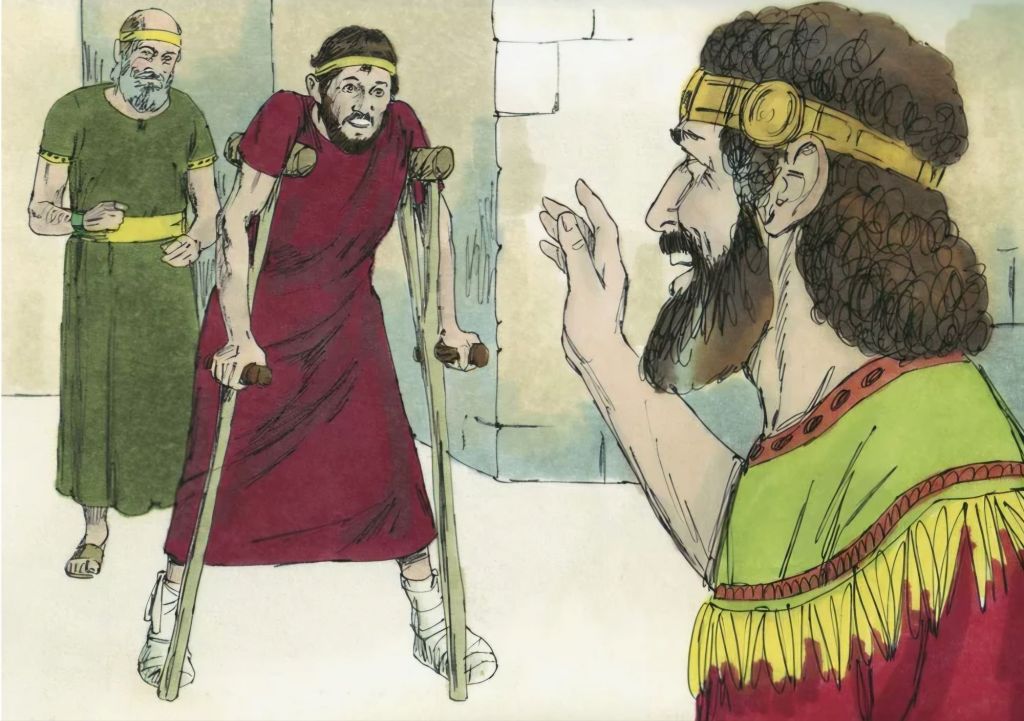
2 Samuel 9 (NIV): 3 The king asked, “Is there no one still alive from the house of Saul to whom I can show God’s kindness?” Ziba answered the king, “There is still a son of Jonathan; he is lame in both feet.” 6 When Mephibosheth son of Jonathan, the son of Saul, came to David, he bowed down to pay him honour.
David said, “Mephibosheth!”
“At your service,” he replied. 7 “Don’t be afraid,” David said to him, “for I will surely show you kindness for the sake of your father Jonathan. I will restore to you all the land that belonged to your grandfather Saul, and you will always eat at my table.”
9 Then the king summoned Ziba, Saul’s steward, and said to him, “I have given your master’s grandson everything that belonged to Saul and his family. 10 You and your sons and your servants are to farm the land for him and bring in the crops so that your master’s grandson may be provided for. And Mephibosheth, grandson of your master, will always eat at my table.” (Now Ziba had fifteen sons and twenty servants.)
I have written a few times on Mephibosheth in these pages, and until today, David’s love and compassion for Mephibosheth still fascinates me. It is a love borne out of a pact made with Jonathan while he was young and was in hiding from King Saul, who was bent on killing him on the mistaken notion that by eliminating David, he will preserve his throne. It was mistaken because God preserved David’s life and, in fact, gave David two opportunities to kill Saul, which the former declined because he believed that the throne should come to him by God’s will and not through his hands. Saul, on the other hand, had become known as the man who took things into his hands and suffered the devastating divine consequences. Saul eventually died in battle, and unfortunately, his son and David’s best friend, Jonathan, also died in the same battle. See 1 Samuel 31 – the battle at Mount Gilboa.
In 2 Samuel 9:3, David asked whether there was anyone left in Saul’s household to whom he could “show God’s kindness” for the sake of his friend Jonathan. The word translated “kindness” is the Hebrew word hesed, which is often used to describe God’s steadfast love and faithfulness to fulfil covenant promises to His people. In this context, David shows hesed, or covenant faithfulness, by keeping the covenant promises he had previously made with Jonathan when he was young by restoring the lands and servants Saul used to have to Mephibosheth, Jonathan’s son, and promising the latter a permanent place at his table.
There are times when we ourselves as the redeemed of the Lord should show the hesed kindness that David had for Mephibosheth. It speaks of the covenant love and faithfulness of God. A love and compassion and kindness that is steadfast and unfailing. A love and kindness God has for us as His children translated into our love and kindness for others. A love that is steadfast and unwavering for our spouse, our children, and our brothers and sisters in Christ.


Well said! We are studying this too at our church and what insight of the covenant David had to honor this family line with joy!
LikeLike