Lost sheep

https://odb.org/2025/10/16/feeling-lost

Psalm 119:169–176 (NIV): 169 May my cry come before you, LORD;
give me understanding according to your word.
170 May my supplication come before you;
deliver me according to your promise.
171 May my lips overflow with praise,
for you teach me your decrees.
172 May my tongue sing of your word,
for all your commands are righteous.
173 May your hand be ready to help me,
for I have chosen your precepts.
174 I long for your salvation, LORD,
and your law gives me delight.
175 Let me live that I may praise you,
and may your laws sustain me.
176 I have strayed like a lost sheep.
Seek your servant,
for I have not forgotten your commands.

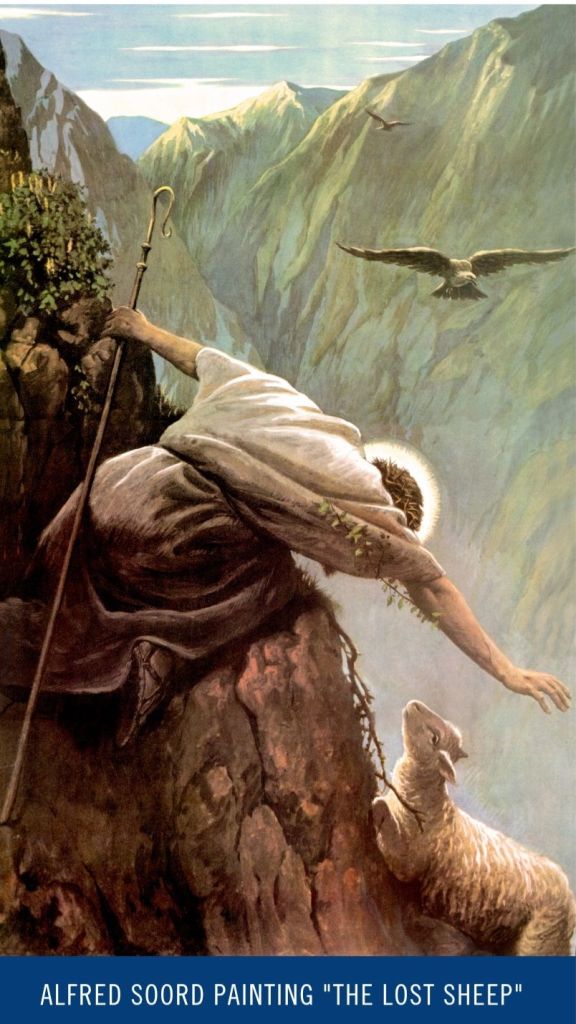
In the parable of the lost sheep (Luke 15:1-7), Jesus painted a picture that a shepherd would leave behind his 99 sheep to look for the one that got lost. It reflects God’s heart as a loving shepherd where every single one of us is valuable to and treasured by Him. Not only in terms of sheep who strayed away but to those who have yet to become sheep and are lost in darkness. That’s the truth and hope that we hold on to in case one day we were to stray away and become lost in the world or amidst our pursuit of our own fleshy desires or for wealth, fame or pleasures of life.

Except that, in my view, we shouldn’t stray if we could help it. Don’t get distracted from our faith by the bright city lights. In fact, nowadays, with the proliferation of social media and user content, especially by the new profession called influencer, our minds could easily be discreetly persuaded or influenced not only by the influencers themselves but also spiritual forces behind not so much those persons, but those content. It’s the same danger posed by television or computer games if we over indulge, just that nowadays fewer people watch television.

It’s very dangerous for our faith if we think that it’s OK to stray because God will find a way to reach out to save us. Did Jesus jump when tempted by the devil to do so from the top of the Temple? There is an implied rule in our faith not to test God as chances are nature will run its course. The LORD allowed the Israelites to be exiled first by the Assyrians and then the Babylonians due to their insolence and unfaithfulness. He eventually delivered them as a nation, but not as individuals. Many did not make it home, and some died in captivity, while there were those who chose to stay behind in the prosperity of Babylon (which biblically represents the world).

See extract below from an AI overview:

AI Overview
No, not all exiled Israelites returned to Israel; most of the northern ten tribes taken by Assyria never returned. While many from the southern kingdom of Judah returned from Babylonian exile, a significant portion of the population chose to remain in Babylon, and the returnees only represented a remnant of the former kingdom. The tribes of Benjamin, Judah, and Levi were the main groups to return.

Straying is inherently dangerous for our faith. For sheep, the danger is being eaten by wolves. For us, we may enjoy the world so much that we end up preferring and choosing the world over God. What a tragedy that would be! Worst, we may already be lost without even realising it!

God is light

https://odb.org/2025/10/15/walking-in-the-dark

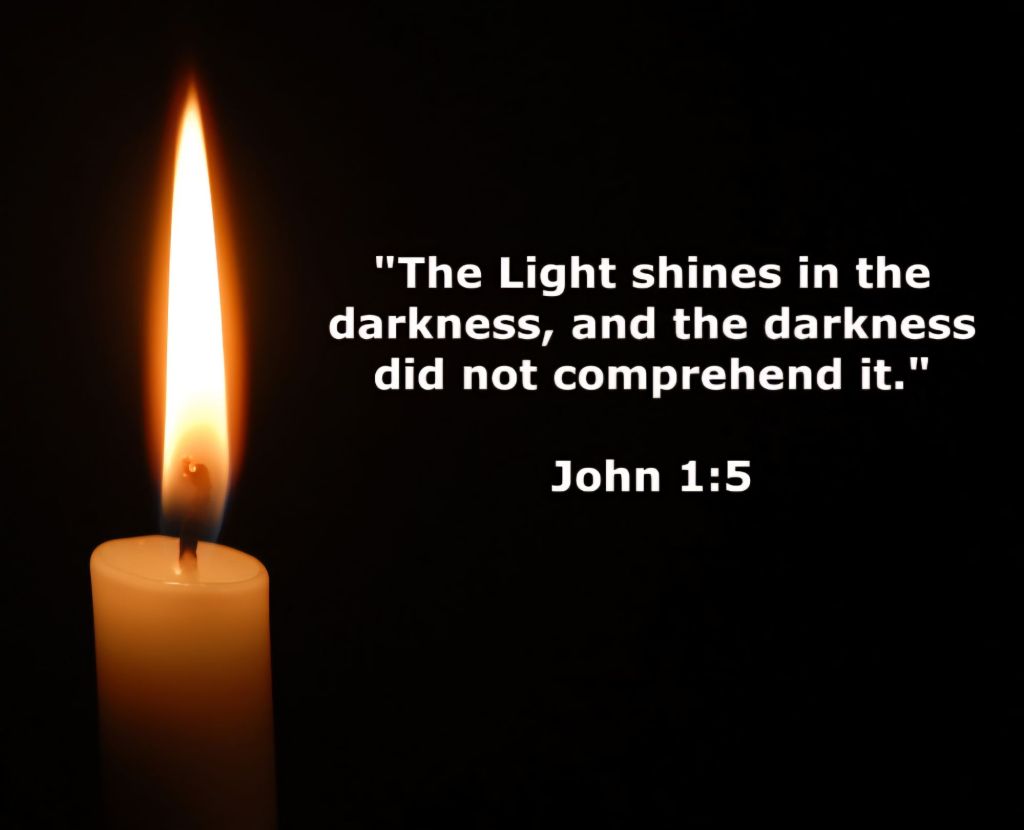
1 John 1:5–10 (NIV): 5 This is the message we have heard from him and declare to you: God is light; in him, there is no darkness at all. 6 If we claim to have fellowship with him and yet walk in the darkness, we lie and do not live out the truth. 7 But if we walk in the light, as he is in the light, we have fellowship with one another, and the blood of Jesus, his Son, purifies us from all sin. 8 If we claim to be without sin, we deceive ourselves, and the truth is not in us. 9 If we confess our sins, he is faithful and just and will forgive us our sins and purify us from all unrighteousness. 10 If we claim we have not sinned, we make him out to be a liar, and his word is not in us.

In his letter to the early believers in Jesus, the apostle John talked about choosing to walk in a different kind of darkness. First John 1:6 refers to sin as “darkness.” Walking in darkness isn’t a momentary lapse but a choice to keep engaging in wrongdoing. John reminds us that our holy God “is light” and “in him there is no darkness” (v. 5). So when we claim a relationship with Him yet willfully continue sinning, “we lie and do not live out the truth” (v. 6). Jesus, the light of the world, came so that “whoever follows [Him] will never walk in darkness, but will have the light of life” (John 8:12). (Karen Huang, ODB 15 October 2025)

The point this morning is that since God is light, we can not remain in darkness after we have been in the light. We are part of the light already, and the light is in us. Darkness here is taken to mean continuing in intentional sin, which is incompatible with our nature and character of a bible believing Christian who has been redeemed by the blood of the Lamb.

Yet this is an issue we still struggle with as believers in Christ. We still sin due to the fallen nature of our body. Sometimes, we can not control ourselves. We fight the tendency, but we don’t always succeed.

1 John 1 has the solution. John advises that if we claim we have no sin, we deceive ourselves. But if we confess our sins, He is faithful and just and forgive us our sins and purify us from all unrighteousness. The blood of Jesus, his Son, purifies us from all sin. If we claim we have not sinned, we make Him out to be a liar, and His word is not in us.

We will not be able to overcome our sinful and carnal nature overnight. It will take a long time, probably a lifetime. In the meantime, be consistent is seeking out the LORD, confessing our sins before Him. Plead for the blood of Jesus to cover us and rest in the assurance that He is just and faithful. He will forgive us our sins. The point is if we fall, we confess our sins and rise again. God is light. We are light. Don’t continue to walk in darkness.

Two are better than one

https://odb.org/2025/10/14/it-takes-two-2

Ecclesiastes 4:8–10 (NIV): 8 There was a man all alone; he had neither son nor brother. There was no end to his toil,
yet his eyes were not content with his wealth. “For whom am I toiling,” he asked,
“and why am I depriving myself of enjoyment?” This too is meaningless—
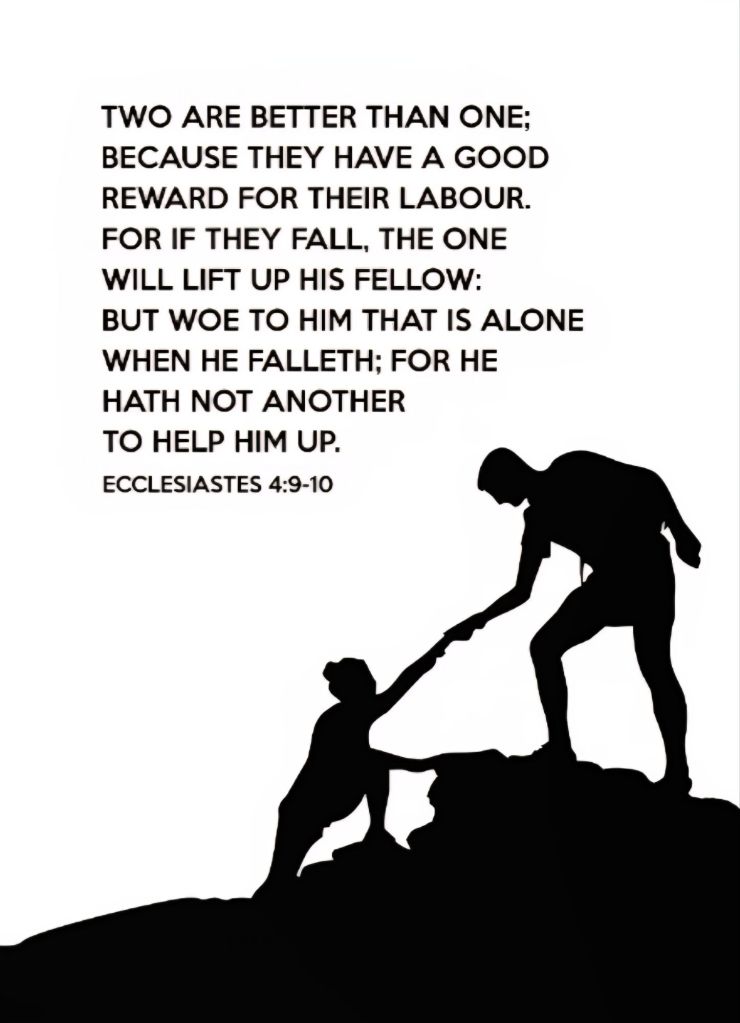
a miserable business! 9 Two are better than one because they have a good return for their labour: 10 If either of them falls down, one can help the other up. But pity anyone who falls and has no one to help them up

The book of Ecclesiastes—written from the perspective of “under the sun” (1:14) or the human experience on earth—seems to be one long lament. What’s it all about? Does anything ultimately matter? Why even try? That forlorn theme continues here, as the writer (called “the Teacher” in 1:1) observes “a man all alone” (4:8). Eventually, this solitary figure asks himself, “For whom am I toiling?” The Teacher observes, “This too is meaningless—a miserable business!” (v. 8). Yet Ecclesiastes also recognizes that there is a life worth living. The wise man declares, “Two are better than one” (v. 9) and points to a specific reason why doing life together is preferred: “If either of them falls down, one can help the other up” (v. 10). God lovingly equips us to help each other and, in turn, to accept help. Our necessary interdependence reminds us of our complete reliance on God and His goodness. (Tim Gustafson, ODB 14 Oct 2025)

Some of us are used to being solitary in the pursuit of our dreams, ambitions or even ministry goals. In a way, it is easier to go at it alone. You can do whatever you want without needing to think of the other’s life goals or dreams. For example, when travelling, you may want to see something, but your other may want to see something else. Or you may want to rough it out, and the other wants to sleep in comfort. You may want to splurge on business class while the more prudent and frugal other may just want to spend more on food or attractions than the flight. No matter how wealthy one may be, there are always limits.

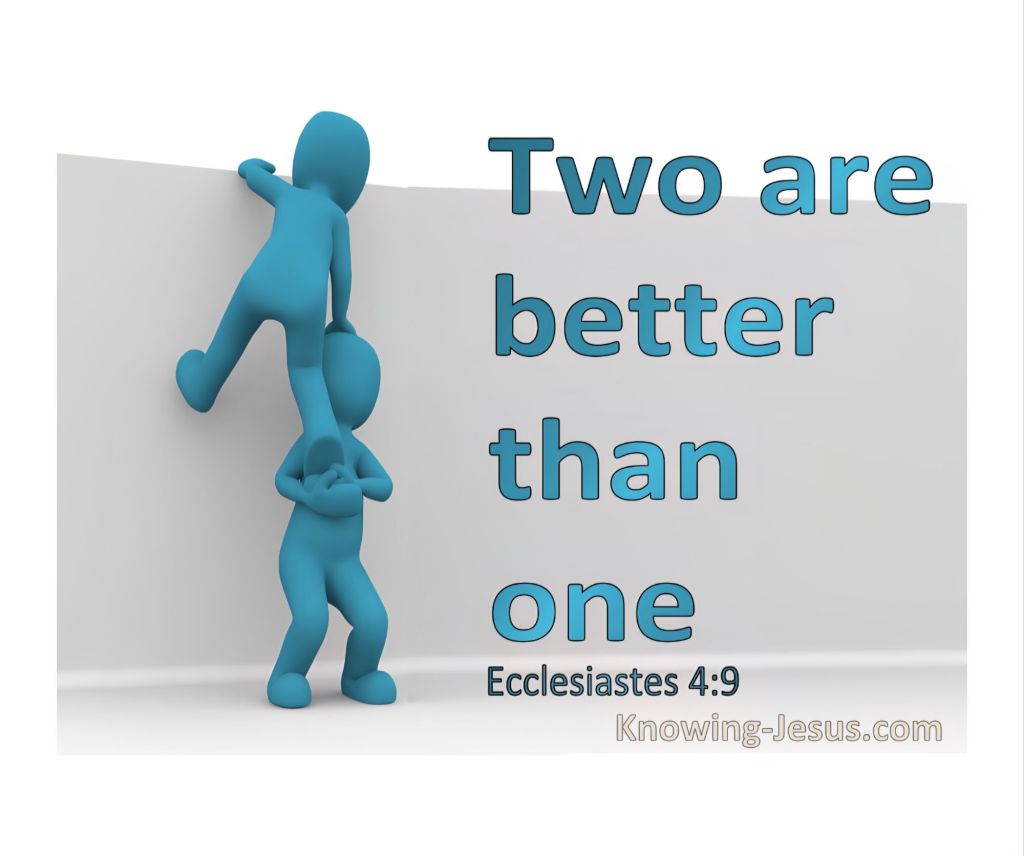
But an interesting question Ecclesiastes asks is for whom am I toiling? Is it only for ourselves? Is our toil meaningful if such? Even if our goals are aligned with God’s plans and purposes for our lives and we have Jesus as our friend and Lord? If we are called to be single, like in the case of Paul, we’ll need to walk this journey alone and adapt accordingly. But given a choice, I’ll rather have someone by my side and the fruits of our union to share my joys and sadness with. To enjoy together as a family the fruits of our toil. That is why Ecclesiastes teaches two is better than one. If God allows, we should journey this life with someone to build a family. If one falls down, the other can help him or her up.

Two is surely better than one, but the greatest sacrifice one needs to make, in my view, is to learn to adapt and accept that in whatever we do, we must take into consideration the other’s needs, preferences and dreams. Thus, if our goal is to respond to God’s calling, then we should have someone who is aligned or agrees with our goal, or else we would need to forgo our calling in God. That is the drawback of two, although two is better than one. The challenge is to find that someone who will complement us as much as we need to accommodate him or her into our lives. If not, it might well be better to go at it alone, although two is better than one.

In short, there are no quick answers when it comes to issues of life and faith. The Word teaches two is better than one. That is the unwavering truth. Yet Paul never married and achieved so much for God. That’s the irony of our faith, and can I say life!

Thanksgiving

https://odb.org/2025/10/13/gratitude-gathering

1 Chronicles 16:8–14 (NIV): 8 Give praise to the LORD, proclaim his name;
make known among the nations what he has done. 9 Sing to him, sing praise to him;
tell of all his wonderful acts. 10 Glory in his holy name; let the hearts of those who seek the LORD rejoice. 11 Look to the LORD and his strength; seek his face always. 12 Remember the wonders he has done, his miracles, and the judgments he pronounced, 13 you his servants, the descendants of Israel, his chosen ones, the children of Jacob. 14 He is the Lord our God; his judgments are in all the earth.

We don’t have a national tradition of thanksgiving in our nation like a festival or holiday, but as believers, thanksgiving is usually present in our lives. For example, one of the things we learned in leading worship over the years is the element of thanksgiving. So, we are taught to follow a certain sequence for our selection of worship songs, and broadly, it is as follows:

  • Intro song
  • Praise
  • Thanksgiving
  • Corporate worship/adoration
  • Personal worship/self reflection
  • Closing song/benediction

In terms of keys, for guys, we usually prefer F, G, or A, but it is better to interpose another set of keys like C, D or E or even Bb or Eb in between our favourite song key so that there is a variety of tones for the 5 to 6 worship songs (number of songs depends on time allocated). Timing wise, it is usually faster at the start and moderate or slower throughout. The personal worship element is crucial to allow the congregation some personal “facetime” with the Lord as we worship in the spirit. But the part on thanksgiving is equally necessary, so we always remember and proclaim His goodness in our lives. Some worship leaders structure their songs thematically, but I usually don’t. For me, what’s more important is that the songs touch me or else I’ll have difficulty leading with them. Thus, my underlying theme is usually glorifying God or Christ.

Besides worship, whether corporately or in our own quiet time, we can have an attitude of thanksgiving such that whenever we receive something like a blessing or an answered prayer or we get to show grace or bless someone, we thank the Lord. Make thanking God and having a genuine gratefulness second nature. It keeps us humble and grounded as even our very existence is God-given. For instance, to live optimally, our body needs to beat at a certain heart rate, and our oxygen intake and blood pressure levels must be just right. Any one of our bodily systems goes out of whack, and we may potentially have a serious medical situation.

Have a good week ahead – be thankful as God preserves, protects and blesses us, and it is my prayer for everyone (myself included) that we will live in the centre of His will, in our spiritual life and at work! Amen!

Depression

https://odb.org/2025/10/10/prayer-of-the-desperate

Psalm 88:6–9 (NIV): 6 You have put me in the lowest pit, in the darkest depths. 7 Your wrath lies heavily on me; you have overwhelmed me with all your waves. 8 You have taken from me my closest friends and have made me repulsive to them. I am confined and cannot escape; 9 my eyes are dim with grief. I call to you, LORD, every day, I spread out my hands to you?

Charles had sunk into depression. Despite having a loving family, he felt all alone. “The overwhelming pressure of supporting them was continuing to build,” he said, “and I felt like taking my own life.” Surprisingly—or perhaps not—Charles Morris also led a Christian ministry. A wise friend told him that when faced with depression, “We should soak in the Psalms.” Charles got through his deep despondency by reading relatable Bible passages, accepting prudent medical care, and pouring his heart out to God. (Tim Gustafon, ODB 7th Oct 2025)

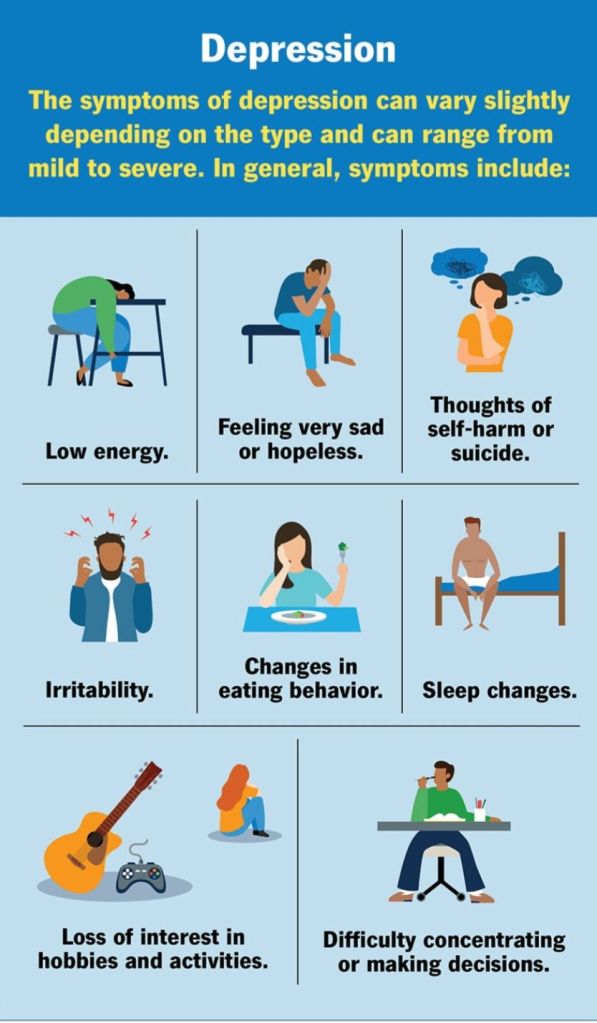
When used correctly in its proper context, the word “depression” is not just feeling depressed or beaten down or moody. It’s an illness and is medically accepted as such. It is persistent or chronic in medical speak. But it is treatable. If left untreated and allowed to deteoriate, it may lead to death by suicide.

Depression is a mood disorder that causes a persistent feeling of sadness and loss of interest. Also called major depressive disorder or clinical depression, it affects how you feel, think, and behave and can lead to a variety of emotional and physical problems. You may have trouble doing normal day-to-day activities, and sometimes, you may feel as if life isn’t worth living. (Mayo Clinic)

I just heard two days ago in the office of someone who just went missing from work for 3 whole months (but remain fully paid) due to depression. My company finally issued him a show cause letter but did not summarily dismiss him as permitted under labour laws. So he has the opportunity to explain himself, but he will need strong medical evidence (like a psychiatrist’s report) to continue working. I have to admit that it is rare for employers to be so compassionate.

As believers, we are not immune from depression. While our spirit may be born again, our mind is still going through transformation. In the process, we may slip into depression due to events or circumstances in our lives. It could be something as basic as losing a pet that we are very attached to or a more complex situation of losing our job that we have been doing for a long time. The latter is more complex because our self-worth and confidence may have been affected, and coupled with no income and depleting savings (if any), we may even lose the will to live. In such situations, we may not be able to even pay rent. Some may have the option of returning to our hometowns to stay with our parents, but even with that, it is still bad. We will be cut off from our existing social circle and support system, and it reduces our chances of getting another job. In other words, one thing leads to another, and our world goes spiralling down, affecting our state of mind.

One of the ways to get out of depression (but if you are already in it, you may not listen) is to bury ourselves in His Word, particularly the Psalms. Some Psalms are raw and honest about what the Psalmists are going through, and we may relate to them. Most importantly, we have the opportunity to pour our grievances and grieve to God. Sometimes speaking to someone is necessary. So speaking to God, praying and immersing ourselves in His Word will surely help.

No one is immune. Something could just trigger a negative response. We must always be on guard. Keep our emotions in check. Keep active. Serve God. Immerse ourselves in the Word and pray.

Have a good weekend ahead, everyone!

God or wealth

https://odb.org/2025/10/09/cautionary-tale

Ecclesiastes 5:13, 14, 18–20 (NIV): 13 I have seen a grievous evil under the sun: wealth hoarded to the harm of its owners, 14 or wealth lost through some misfortune, so that when they have children there is nothing left for them to inherit. 18 This is what I have observed to be good: that it is appropriate for a person to eat, to drink and to find satisfaction in their toilsome labor under the sun during the few days of life God has given them—for this is their lot. 19 Moreover, when God gives someone wealth and possessions, and the ability to enjoy them, to accept their lot and be happy in their toil—this is a gift of God. 20 They seldom reflect on the days of their life because God keeps them occupied with gladness of heart.

In the classic film Citizen Kane, Charles Foster Kane amasses wealth and power by building a newspaper empire. In a story reminiscent of Ecclesiastes 2:4-11, Kane spares himself no pleasure, building a castle with grand gardens full of artistic treasures. Citizen Kane ends with the revelation that Charlie’s pursuits have been driven to fill a void in his heart—the parental love he lost as a child. I can imagine the author of Ecclesiastes agreeing. Our Father God has “set eternity in the human heart” (3:11), and life can only be enjoyed with Him (2:25). Charlie Kane’s cautionary tale speaks to us all: Don’t seek spiritual fulfilment through wealth and power, but through the one who pours His love into our hearts (Romans 5:5) (Sheridan Voysey, ODB 9 October 2025)

The issue of pursuing wealth and spirituality had always been on my mind since I first accepted Christ in my teens. When I was younger, I used to think that they were mutually exclusive in the sense they were not compatible with one another. You either choose wealth (which then represents the world) or choose God. Solomon in Ecclesiastes teaches that the accumulation of wealth (wealth hoarded) is destructive and that is true to the extent that when we have a lot, we tend to worry more about how to grow it or how to avoid losing it and as a result may end up having sleepless nights. Solomon ends Ecclesiastes 5 beautifully by declaring first that man is entitled to enjoy the fruits of his labour. But most importantly, it is better if God gives us our wealth as He will give us the ability to enjoy it, to accept our lot, and be happy in our toil. We won’t think too much of our wealth because God distracts us by keeping us occupied with gladness of heart. In other words, we are so grateful and happy that we have no time to worry about our wealth.

For us who are more mature Christians, we know that the love of money is the root of all evil (1 Timothy 6:10). We know that money or wealth itself is neutral. The love of money breeds covetousness and causes us to compromise our faith. We may end up doing unethical things to gain money and wealth. When we have wealth, we become worried that we may not grow it fast enough, thereby slowly losing its value with inflation and reducing purchasing power creeping in.

The lesson this morning is to always pursue God first (which Solomon always advocates), and then as we work hard in our secular jobs, God will bless us with wealth eventually. Since we put God first, He will bless us with the ability to enjoy our wealth, to be contented and grateful for His blessings. One of the things I learned in my early career days is to live below our means and have delayed gratification so that we always have more instead of not enough. Stretch the dollar, and you might not need many dollars!

Live a life worthy of your calling

https://odb.org/2025/10/08/jacks-story

Ephesians 4:1–6 (NIV): 4 As a prisoner for the Lord, then I urge you to live a life worthy of the calling you have received. 2 Be completely humble and gentle; be patient, bearing with one another in love. 3 Make every effort to keep the unity of the Spirit through the bond of peace. 4 There is one body and one Spirit, just as you were called to one hope when you were called; 5 one Lord, one faith, one baptism; 6 one God and Father of all, who is over all and through all and in all.

God’s love poured out through the creation of a new community made up of believing Jews and gentiles—something Paul calls “the mystery of Christ” (Ephesians 3:4)—is the foundation for the apostle’s encouragement to “live a life worthy of the calling you have received” (4:1). Jews and gentiles—two groups long estranged from each other—were called to devote themselves to cultivating the unity created through Christ’s Spirit (v. 3). They needed to serve one another “with all humility and gentleness, with patience, bearing with one another in love” (v. 2 esv). Today, we’re also called to love and serve others with the gifts we’ve been given. (Monica La Rose, ODB 7 October 2025)

Christianity is not just about professing our faith but living out our lives that glorify Christ. In the early days when the early adopters were Jews, they accepted and worked together with the gentiles (non-Jews) and were united in love for Christ. The Jews have customarily excluded non-Jews in certain matters, in particular, their religious obligations. For example, gentiles were only permitted at the fringes of the Temple, the outer courts. With the veil broken by the victory of Jesus on the cross, believers in Christ have direct communion with God, and in the process, the distinction between Jews and gentiles was also broken. We are now all equal in Christ and are rightful beneficiaries of the Abrahamic Covenant and its blessings.

In parallel, we are to live lives that are worthy of our calling in Christ being co-heirs and sons and daughters of God. Always remember who we are whenever we do anything lest the name of our Saviour is put to shame. We may easily behave like others of the world, but we won’t because we have Christ in us. We are different. We have Christ in us. Because of the Holy Spirit in us, we are able to act differently. There is a saying, as Christians, we live right side up in an upside down world! Paul puts it another way in Romans 12:1 – we are to present our bodies as a living sacrifice, holy and pleasing to God, as our spiritual act of worship in view of God’s mercy (in saving us).

As I have always said in these pages, we all know where we are with God in our relationship with Him, in our faith, and the extent of our spiritual formation and character building in Christ. We still have personality flaws. We still sin. Sometimes, we still act or speak, in a manner unworthy of our calling. As long as we are aware and seek to change; do better next time, we will eventually think, speak, and act as if we were Christ! We can only get better if we work with the Holy Spirit and allow Him to transform us from within. I’m therefore confident that we will all be able to live a life worthy of our calling! If not right now, one day soon! Amen

All up in smoke

https://odb.org/2025/10/07/up-in-smoke

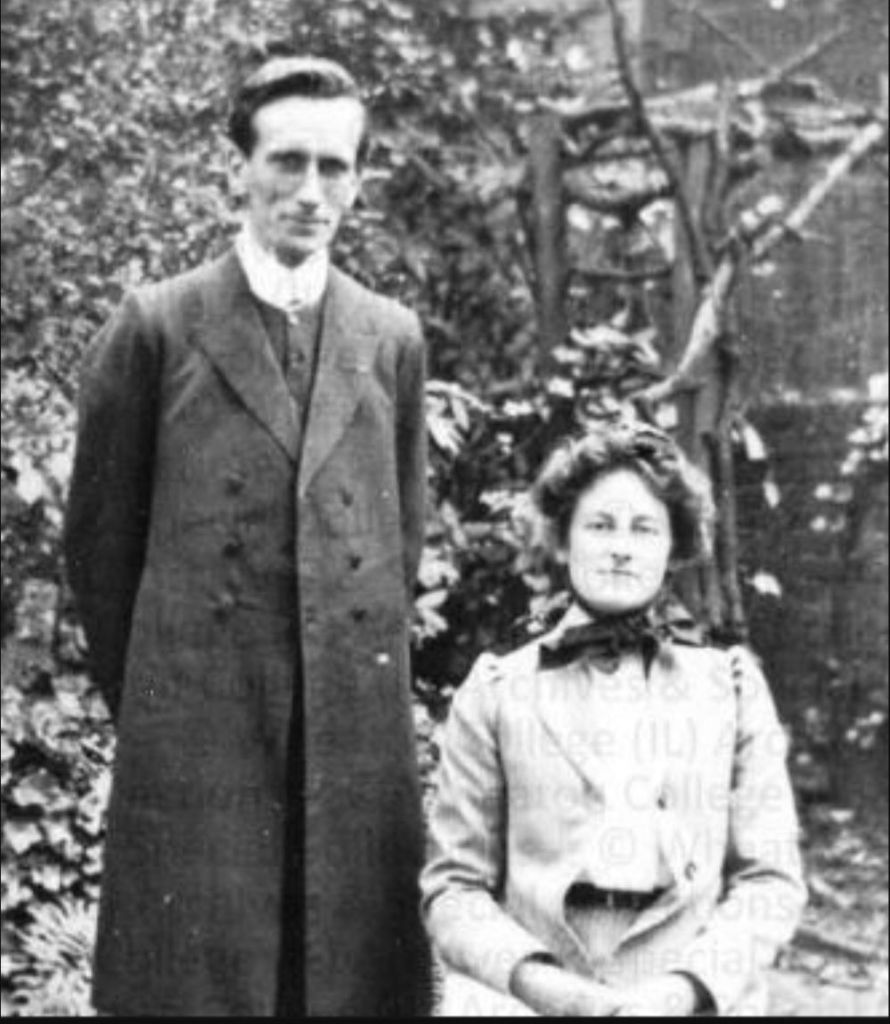
Mr and Mrs Oswald Chambers
Gertrude Annie “Biddy” Hobbs Chambers

John 16:31–33 (NIV): 31 “Do you now believe?” Jesus replied. 32 “A time is coming and, in fact, has come when you will be scattered, each to your own home. You will leave me all alone. Yet I am not alone, for my Father is with me. 33 “I have told you these things, so that in me you may have peace. In this world you will have trouble. But take heart! I have overcome the world.”

During the Blitz on London on December 29, 1940, a bomb destroyed a warehouse near St. Paul’s Cathedral. When Biddy Chambers received the news that all 40,000 copies of Oswald Chambers’ books stored there were lost—which she had compiled and edited but not insured—she set down her teacup and remarked to her daughter, “Well, God has used the books for His glory, but now that is over. We’ll wait and see what God will do now.” (Amy Boucher Pye, ODB 7th Oct 2025)

The calmness of Biddy Chambers in dealing with the destruction of 40,000 copies of her husband’s books is an example of how we should react when certain mishaps or misfortunes occur in our lives. Even if those were events or things meant to glorify God. God may protect certain things like the Cathedral in Cologne, Germany, that was untouched by the bombs dropped by Allied forces. But in most cases, He allows nature to take its course. Even a minister of God is susceptible to a heart attack or stroke if he doesn’t take his medication as much as God has a specific calling and purpose for His life.

Biddy Chambers’ 40,000 books were a great loss as so much could be done, and so many reached through those books. Notwithstanding that great loss, she picked up the pieces and started again. Eventually, the books were reprinted, and many lives were blessed by Oswald Chambers’ books and writings.

The lesson this morning is that sometimes we may not fully understand God’s work and how He works. But trust that He will eventually achieve His plans and purposes. We are just vessels for His glory. Just keep on going and don’t give up doing what God has placed in our hearts to do. We may not or can not see the fruits of our labour but persevere on nevertheless. Trust that God will use our labour for His glory. It will not be in vain. If nothing comes out in this present generation, perhaps something will be in the next! Don’t give up even if something unexpected has occurred. Push on for Christ!

Selfishness versus selflessness

https://odb.org/2025/10/06/making-room-for-others

Philippians 2:1–11 (NIV): 1 Therefore if you have any encouragement from being united with Christ, if any comfort from his love, if any common sharing in the Spirit, if any tenderness and compassion, 2 then make my joy complete by being like-minded, having the same love, being one in spirit and of one mind. 3 Do nothing out of selfish ambition or vain conceit. Rather, in humility, value others above yourselves, 4 not looking to your own interests but each of you to the interests of the others. 5 In your relationships with one another, have the same mindset as Christ Jesus.

At electric vehicle charging stations across the United States, some drivers overstay their time at “fast-chargers,” which are designed to help drivers quickly charge their cars and get back on the road. To resolve this unkind behaviour, one of the largest charging networks has implemented strict time limits at some of its busiest stations. When a vehicle’s battery charge reaches eighty-five per cent, the driver must make room for the next car in need of a charge. (Marvin Williams, ODB 6 Oct 25)

I’m not sure whether we have the same system in Malaysia as fast DC chargers become more common, and more and more electric cars now have higher charging capacity. For example, the just launched Xpeng G6 facelift can reach a state of charge of 80% from 20% in just 12 minutes as its 80.8 kW/h LFP battery architecture supports 5C charging with a charging capacity of 451 kW! But what I have seen in Malaysia are ICE cars parking at EV charging bays! Of course, the solution to this issue is not just education and civic-mindedness but also laws and enforcement. Humans, by nature, are a selfish bunch!

But as Christians, it’s a totally different kettle of fish. We, on the other hand, are moulded by the Holy Spirit to be selfless. As we move away from our old self and embrace our born-again spiritual nature, we will inevitably become less and less selfish. As we think and consider more of the needs of others, the world may laugh at us or call us stupid. But will that bother us? No, because we put Christ first in all that we do. We have an eternity mindset and people who are minded as such, always putting the interests and needs of others first. For example, in a buffet, when we see that there are only 10 large juicy and succulent prawns left at the tray, a believer will just take two so that others will have their fair share but a selfish individual may just take all 10! As for me, I will probably take 3 – I’m not that selfless!

Selfishness and selflessness are virtues we need to deal with as part of our spiritual formation and character building. There is no need to maximise our gain. Always leave a fair share for others. In the end, if we had taken the 10 prawns, it may look like a win, but in economic theory, we know that too much of a good thing is never a good thing! Not only two will taste better than 10, but it will leave us more room to savour other delicacies! Put others first, and not only that it pleases God and confounds the world, it may well be good for us, actually!

Have a good week ahead, everyone, and start putting others first!

Eternal perspective

https://odb.org/2025/10/03/representing-jesus

2 Corinthians 5:9–10 (NIV): 9 So we make it our goal to please him, whether we are at home in the body or away from it. 10 For we must all appear before the judgment seat of Christ, so that each of us may receive what is due us for the things done while in the body, whether good or bad.

Saying we’re Christian and wearing clothes with Christian messages are good things. However, the Bible teaches that the way we live and love as we share the gospel is the true identifier of those who follow Jesus. The apostle Paul and the other believers in Corinth were compelled, or driven, to please God by living with an eternal perspective while sharing Him with others (2 Corinthians 5:9-14). (Xochitl Dixon, ODB 3 Oct 25).

I think one of the best ways to reflect Christ in our actions and spoken words, besides developing our character in Christ, is to always have an eternal perspective when living out life. If we think eternal, we will be less likely to indulge in temporal pleasures or intentionally commit sin or ruin our testimony before others. It is also much easier to go through difficult and hard times as what awaits us in eternity will be so glorious that the little sufferings we go through for Christ in the present pales in comparison. In other words, I should be able to endure tough times while on earth as I wait for my reward in eternity. While the former is temporal, the latter is for all eternity. As Paul puts it in 2 Corinthians 5:9-10, we make it our goal to please Him, for we will appear before the judgment seat of Christ to receive what is due to us for the things done while in the body, whether good or bad.

Have an eternal perspective! Open ourselves up to the spiritual realm. Be sensitive to what’s happening there and how it impacts the world today. The master of deception is at work. There are dark forces at work in the entertainment world, in media, or even in AI (artificial intelligence). Not that we can’t use these present-day contemporary tools. We just need to be careful and mindful that the devil’s objective in these end days is to distract and draw us away from our eternal purpose and destiny. Think eternal always! Have an eternal perspective in all that we think and do! Amen!