
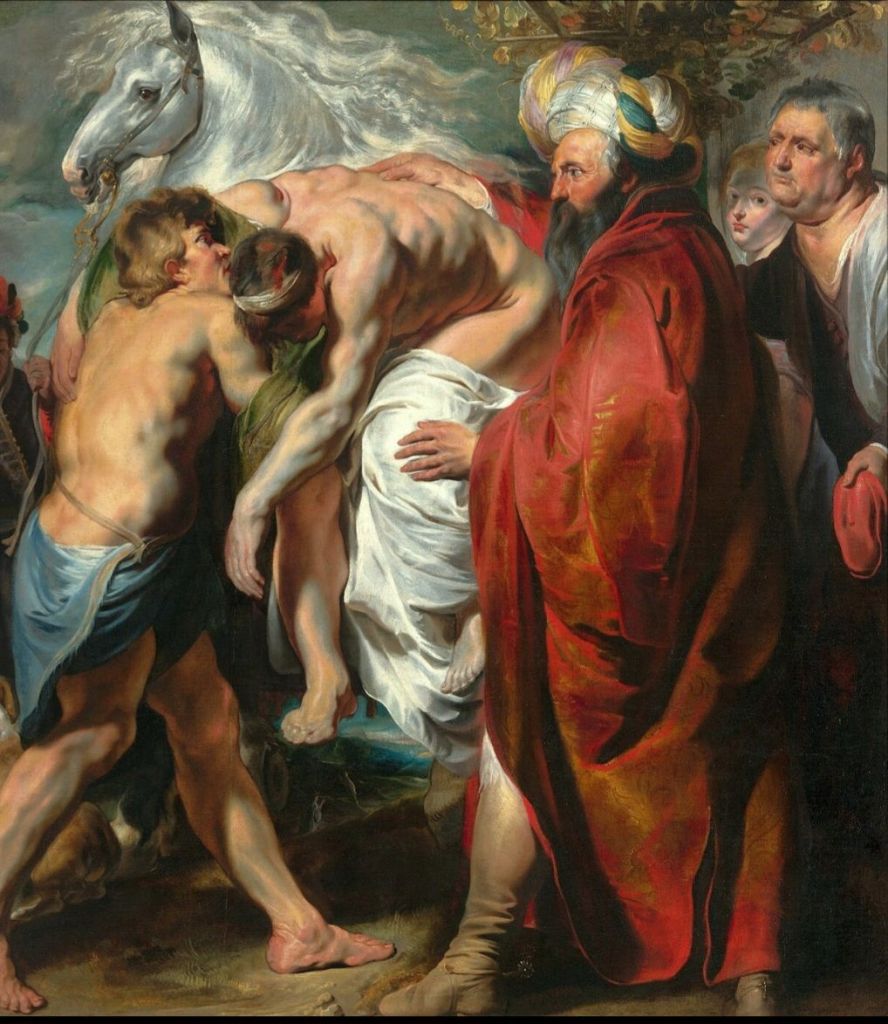
Luke 10:25–34 (NIV): 25 On one occasion an expert in the law stood up to test Jesus. “Teacher,” he asked, “what must I do to inherit eternal life?”
26 “What is written in the Law?” he replied. “How do you read it?”
27 He answered, “ ‘Love the Lord your God with all your heart and with all your soul and with all your strength and with all your mind’; and, ‘Love your neighbor as yourself.’”
28 “You have answered correctly,” Jesus replied. “Do this and you will live.”
29 But he wanted to justify himself, so he asked Jesus, “And who is my neighbor?”
30 In reply Jesus said: “A man was going down from Jerusalem to Jericho, when he was attacked by robbers. They stripped him of his clothes, beat him and went away, leaving him half dead. 31 A priest happened to be going down the same road, and when he saw the man, he passed by on the other side. 32 So too, a Levite, when he came to the place and saw him, passed by on the other side. 33 But a Samaritan, as he traveled, came where the man was; and when he saw him, he took pity on him. 34 He went to him and bandaged his wounds, pouring on oil and wine. Then he put the man on his own donkey, brought him to an inn and took care of him.
The key to understanding the parable of the good Samaritan (Luke 10:25-37) lies in knowing how first-century Israel answered the question, “Who is my neighbor?” (v. 29). They’d distorted the command “love your neighbor as yourself” (Leviticus 19:18) into “love your neighbor and hate your enemy” (Matthew 5:43). The Jews defined a neighbor as a fellow Israelite, for gentiles were accursed. For the Pharisees (experts in the law), it referred to a fellow Pharisee, for those who knew nothing of the law were accursed (John 7:49). Jesus turned this thinking upside down by making a hated Samaritan (people of mixed race whom the Jews viewed as heretics) the hero of the story. The Spirit can help us today to show compassion to others instead of simply passing by. (Bill Crowder, Insights Our Daily Bread 16 December 2025)
Unfortunately, the world, likely influenced by Satan’s indirect propaganda over the ages capitalising on human nature, had accepted the axiom that one should love one’s own but hate others. Most take the latter slightly or even moderately but some to extremes. But this ingrained thinking likely led to prejudice, racism, bigotry fueling hatred among races over centuries, for instance, between Arabs and Jews.
There are examples everywhere, between whites and coloured people, the British and the French and at home, between the 3 main races in Malaysia – the Malays versus the Chinese and Indians. Amongst the Malays, there is this preconceived idea that the non-Malays, whose ancestors were brought into Malaya to work at the tin mines and rubber estates, are out to take their inherent right to the riches of Malaya. Unfortunately, it was the British who exploited the situation as part of their global colonialism and present-day non-Malay Malaysians are just descendants of their ancestors. They are not migrants but descendants of migrants. Of course, this is not unique to Malaysia. Prejudice, racism and hatred exist everywhere in the world, even in homogeneous societies.
The issue is how can we as believers not only take a different view (which I believe most of us already have) but also make a difference? Can we be the Good Samaritan in situations we encounter in life? Can we put aside our ingrained prejudices, shaped by years of social conditioning, and love our “neighbour” as Jesus intended – everyone else, not just our kind or fellow believers? We probably can’t change others or society at large, but we can be the Good Samaritan!
 Ronnie's Thoughts