
https://odb.org/2025/10/14/it-takes-two-2

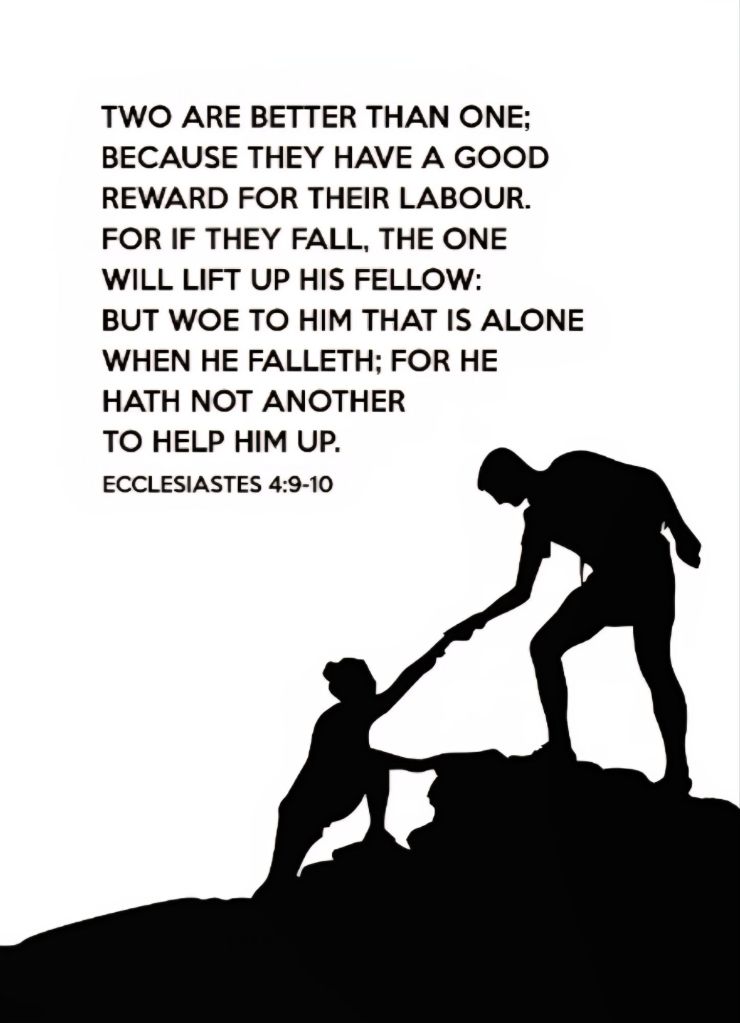
Ecclesiastes 4:8–10 (NIV): 8 There was a man all alone; he had neither son nor brother. There was no end to his toil,
yet his eyes were not content with his wealth. “For whom am I toiling,” he asked,
“and why am I depriving myself of enjoyment?” This too is meaningless—
a miserable business! 9 Two are better than one because they have a good return for their labour: 10 If either of them falls down, one can help the other up. But pity anyone who falls and has no one to help them up
The book of Ecclesiastes—written from the perspective of “under the sun” (1:14) or the human experience on earth—seems to be one long lament. What’s it all about? Does anything ultimately matter? Why even try? That forlorn theme continues here, as the writer (called “the Teacher” in 1:1) observes “a man all alone” (4:8). Eventually, this solitary figure asks himself, “For whom am I toiling?” The Teacher observes, “This too is meaningless—a miserable business!” (v. 8). Yet Ecclesiastes also recognizes that there is a life worth living. The wise man declares, “Two are better than one” (v. 9) and points to a specific reason why doing life together is preferred: “If either of them falls down, one can help the other up” (v. 10). God lovingly equips us to help each other and, in turn, to accept help. Our necessary interdependence reminds us of our complete reliance on God and His goodness. (Tim Gustafson, ODB 14 Oct 2025)
Some of us are used to being solitary in the pursuit of our dreams, ambitions or even ministry goals. In a way, it is easier to go at it alone. You can do whatever you want without needing to think of the other’s life goals or dreams. For example, when travelling, you may want to see something, but your other may want to see something else. Or you may want to rough it out, and the other wants to sleep in comfort. You may want to splurge on business class while the more prudent and frugal other may just want to spend more on food or attractions than the flight. No matter how wealthy one may be, there are always limits.
But an interesting question Ecclesiastes asks is for whom am I toiling? Is it only for ourselves? Is our toil meaningful if such? Even if our goals are aligned with God’s plans and purposes for our lives and we have Jesus as our friend and Lord? If we are called to be single, like in the case of Paul, we’ll need to walk this journey alone and adapt accordingly. But given a choice, I’ll rather have someone by my side and the fruits of our union to share my joys and sadness with. To enjoy together as a family the fruits of our toil. That is why Ecclesiastes teaches two is better than one. If God allows, we should journey this life with someone to build a family. If one falls down, the other can help him or her up.
Two is surely better than one, but the greatest sacrifice one needs to make, in my view, is to learn to adapt and accept that in whatever we do, we must take into consideration the other’s needs, preferences and dreams. Thus, if our goal is to respond to God’s calling, then we should have someone who is aligned or agrees with our goal, or else we would need to forgo our calling in God. That is the drawback of two, although two is better than one. The challenge is to find that someone who will complement us as much as we need to accommodate him or her into our lives. If not, it might well be better to go at it alone, although two is better than one.
In short, there are no quick answers when it comes to issues of life and faith. The Word teaches two is better than one. That is the unwavering truth. Yet Paul never married and achieved so much for God. That’s the irony of our faith, and can I say life!
 Ronnie's Thoughts