https://odb.org/2025/05/21/loving-the-stranger-3
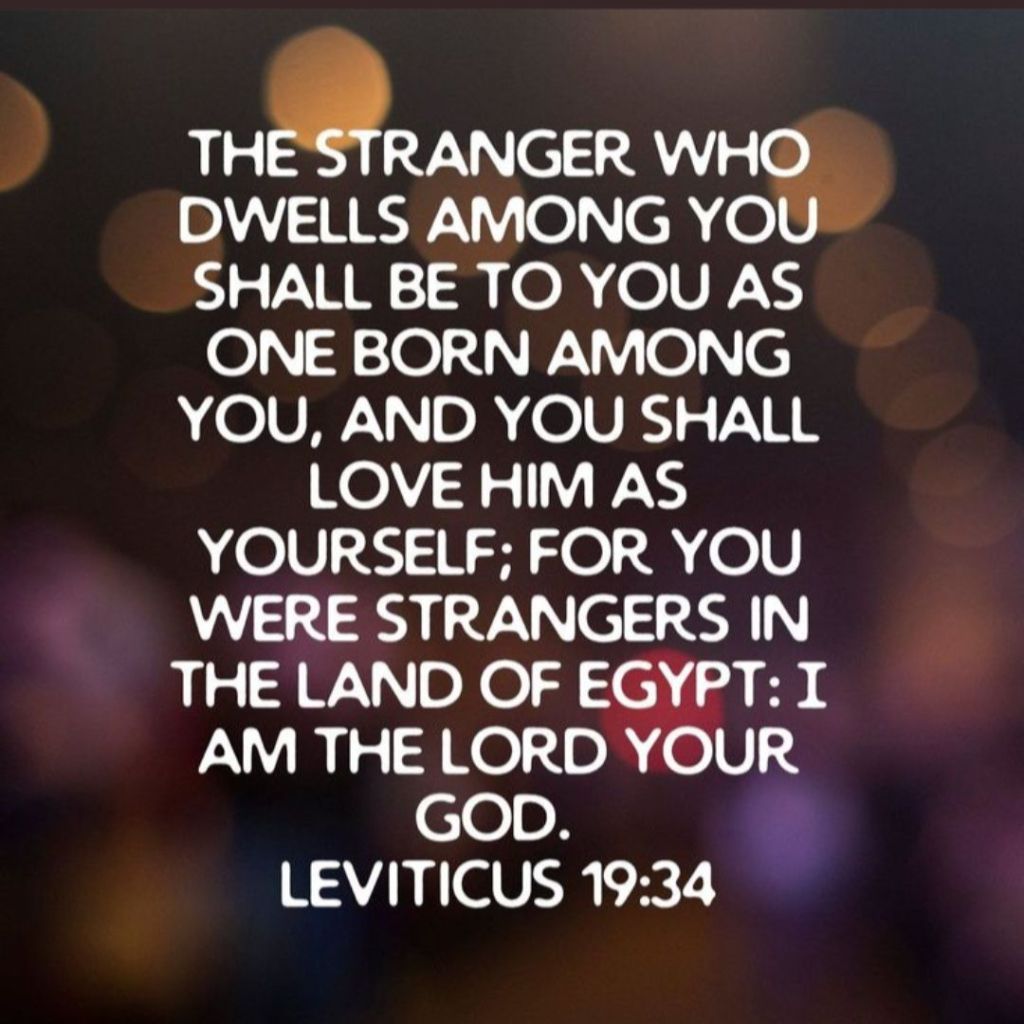
Leviticus 19:9–10, 33-34 (NIV): 9 “ ‘When you reap the harvest of your land, do not reap to the very edges of your field or gather the gleanings of your harvest. 10 Do not go over your vineyard a second time or pick up the grapes that have fallen. Leave them for the poor and the foreigner. I am the LORD your God.
33 “ ‘When a foreigner resides among you in your land, do not mistreat them. 34 The foreigner residing among you must be treated as your native-born. Love them as yourself, for you were foreigners in Egypt. I am the LORD your God.
God’s love for the underprivileged has often been cited in these pages. The Mosaic law, as enumerated in Leviticus 19 today, covers the foreigner and the poor, although its full breadth extends to the widows and orphans. Basically, the rule is not to be too exacting in collecting our harvest but to intentionally leave some behind for the underprivileged to collect so that no one goes hungry in ancient Israel.
But who is the foreigner or stranger during those times. People who were non-natives and as much as that definition cover the residents and the passersby, the law is more for the long term residents who are not Israelites or what the bible calls non-natives. One example will be Ruth, who was a Moabite but became the great grandmother of David through her marriage to Boaz. In fact, it was this same law that enabled Ruth to first meet Boaz, a wealthy landowner who fell in love with her. Of course, we know that it was Naomi, an Israelite returning home, who taught Ruth the local customs and encouraged her to meet Boaz.
While we may naturally think of the foreigner as the foreign workers we have in our midst, the Indonesias, Burmese, or Bangladeshis but a foreigner can well be anyone who is not yet in the kingdom of God, in the same way, the stranger is someone who is not a part of the Israeli nation. In our faith, we love our brethren like ourselves, but the actual teaching by Jesus is to love your neighbour as yourself. This means anyone else out there, including our brethren, as well as the non-believer. Will we, for example, give an RM5 note for an RM3 print broadsheet without insisting on the change? Or pay RM10 for an RM9 coffee? That, in my view, is what it means in the modern context of “not reaping the harvest to the very edges of the field.” It’s OK to leave some change behind for the street vendor or to buy a plate of hot meal for the homeless.
Have a good week ahead! Look for opportunities to be a blessing unto others, especially the underprivileged in society, the poor, the widows, and the orphans as well as the stranger! Our acts of small generosity will put a smile in the face of our Lord Jesus Christ!
 Ronnie's Thoughts